Planning for the future: St. Mike’s group explores what worked (and didn’t) during VT’s COVID-19 response
Vermont is considered to have had one of the most successful responses to the COVID-19 pandemic in the U.S. when the virus brought the world to a standstill in 2020. A research group at St. Mike’s is asking why.
Over the past four years, the multidisciplinary project has given students real-world research experience while allowing faculty to explore effective communication strategies in hopes of limiting the effects of future public health emergencies.
This past summer, a group of undergraduates worked on the project alongside Sociology Professor Candas Pinar, Computer Science Professor Bradford Demarest, and Political Science and Public Health Professor Patricia Siplon. They are particularly interested in Gov. Phil Scott’s press conferences from that time, beginning in March 2020. They are analyzing Scott’s speeches and answers to reporters’ questions through multiple lenses, including public health.

Vermont Gov. Phil Scott gives a press conference, which was streamed by ORCA Media, in March 2020 explaining the “Stay Home, Stay Safe” initiative to prevent the spread of COVID-19. Saint Michael’s College professors and students are currently several years into a five-year grant to study why Scott’s messaging was so effective in Vermont.
The research is part of the University of Vermont’s broader Science of Online Corpora, Knowledge, and Stories (SOCKS) project, which is federally funded through Vermont EPSCoR (The Vermont Established Program to Stimulate Competitive Research).
While the analysis methods vary among the members of the Saint Michael’s team, they’re all focused on the same question: whether Scott’s language called on social capital and how that affected Vermonters’ actions during the pandemic.
Social capital, at its core, is what holds communities together. Pinar explained that it is “the connections and bonds that exist between people.
“It’s also what we have access to as a result of those bonds,” Pinar added. “We might get access to new information, or if you live in a community where people look out for each other, you might enjoy a higher level of security.”
The team is looking through transcripts from videos of Phil Scott’s speeches to dial in on when and how he references this kind of ideology.
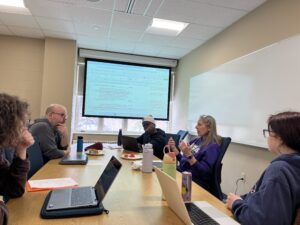
Saint Michael’s College faculty and students discuss progress they’ve made so far on research into Vermont Gov. Phil Scott’s COVID-19 messaging and why it was so effective in the state. (Courtesy of Candas Pinar)
Studying stories and social capital
The SOCKS project, in essence, aims to study words and stories, and their power.
These researchers are studying how Gov. Scott used stories and specific language during COVID-19 press conferences to bring communities together and encourage adherence to health guidelines.
The project began with Pinar and Siplon partnering with former Saint Michael’s Criminology Professor Krista Billingsley, who served as the project’s Primary Investigator (PI). Demarest later joined the group, and Pinar took over as the PI after Billingsley pursued new opportunities beyond the College.
“We were really interested in Vermont’s response to the COVID- 19 pandemic, because it was such a leader in this country,” Pinar said. “We knew that Vermont is known for being a state that has a very coherent sense of community, and very high levels of what we call social capital. So, we brought those two interests together into this project where we were wondering, to what extent did political leaders in Vermont during the pandemic really highlight those stories of community in their communications with the public?”
Social capital is a major topic in the social sciences, specifically sociology, but to others, it’s an elusive term. When she first joined the SOCKS team, Health Science major Clara Hershey ’28 was unfamiliar with the concept.
“I’ve never taken a sociology class,” Hershey said. Social capital, she added, was “the bulk of what our research team was focused on. I did a lot of reading the literature and trying to grasp what social capital was.”
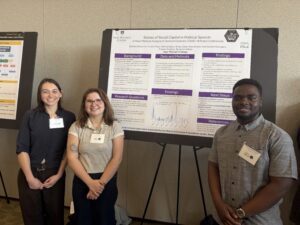
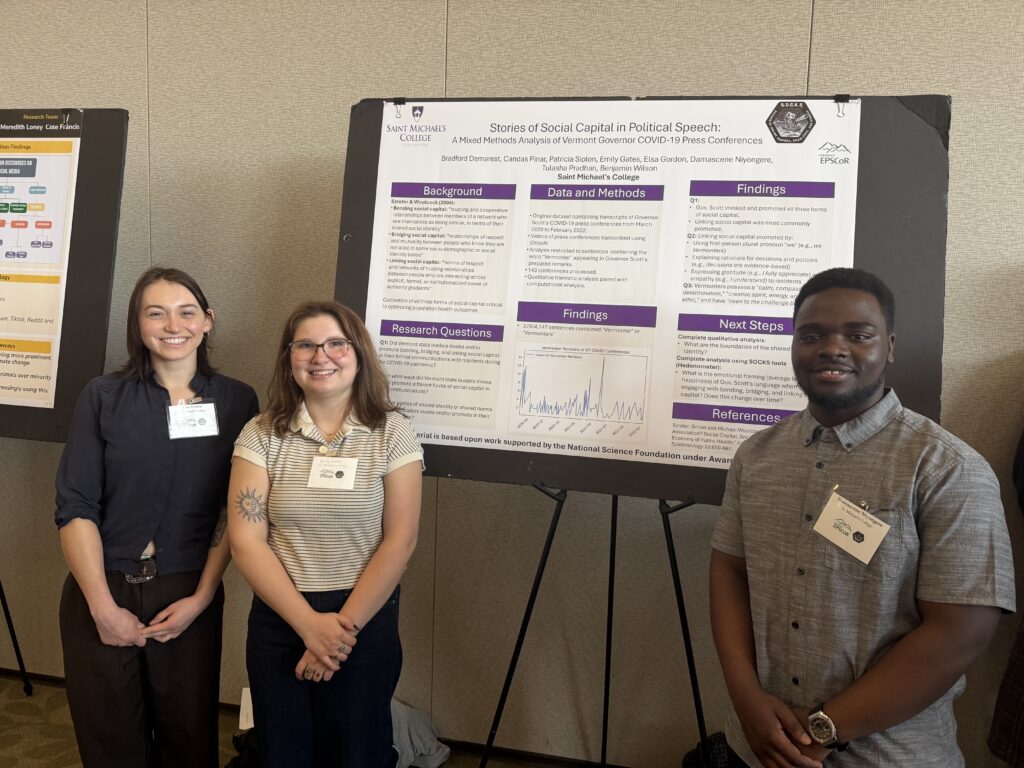
From left, past Saint Michael’s College research student Elsa Gordon poses with current researchers Emily Gates and Damascene Niyongere after presenting on their research through the SOCKS project. (Courtesy of Candas Pinar)
The grant began at the tail end of the pandemic, and Pinar said that “it was the forefront of a lot of what we were doing as public health professors.”
The research continued this summer, with six students involved. Emily Gates ’27 has been working with Pinar for the past two summers, while Lavender Gaudette ’27 and Hershey joined the team this year.
Maya Clough ’28, who is also working on research with Chemistry Professor Megan Browning, has helped collect data for the team by transcribing the press conference videos into text that they could analyze.
“All of the data that we’re working with has to be created,” Pinar said. “That requires a very elaborate and tedious process that Maya has spearheaded this summer. The original data set was created by another undergrad, but because of Maya’s contributions, we now have language from press conferences before the COVID-19 pandemic so that we can compare over time.”
Comparing press conference language before and during the pandemic is just one way the project is constantly growing and evolving. The team is also analyzing Scott’s speeches against those of Chris Sununu, New Hampshire’s governor during the pandemic.
Using computational linguistics to dig deeper
Technology is playing an important role in this research, with Computer Science Professor Demarest bringing his expertise into the equation.
“My focus is on computational linguistics, those tools that are more quantitative,” Demarest said. “Like trying to get a general description of a great pile of text so people can do things like noticing just where he’s talking about Vermonters instead of having to go through with a fine-tooth comb.”
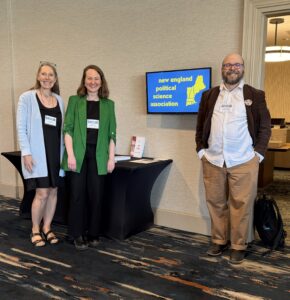
Saint Michael’s Professors Trish Siplon (Political Science and Public Health), Candas Pinar (Sociology), and Bradford Demarest (Computer Science) pose for a photo together at the New England Political Science Association’s conference. (Photo courtesy of Candas Pinar)
Samantha Galle ’29 worked under Demarest’s mentorship this summer, and, like Demarest, comes from a background in linguistics.
“I’m learning the more technical side of it,” Galle said. “I feel like you can’t fully understand how something works, even if you’re zeroed in on a particular subject like we are, unless you look at it from multiple different angles that seem to have no correlation.”
Learning tools like Python and using the SOCKS “Hedonometer” instrument, which measures the happiness of large populations over time by analyzing social media data, Demarest and Galle have been diving deeper into the language Scott used in his speeches. The tools help them determine whether words are “good” or “bad,” “happy” or “unhappy,” and how they relate to other words.
“We found there’s a strong correlation between ‘goodness’ and ‘power,’ as well as a strong negative correlation between ‘goodness’ and ‘danger,’” Galle said. “We gathered all this data, but we can’t really make sense of it just yet until we compare it to a control, which will be transcripts from a non-COVID-era press conference that Phil Scott has done.”
The research continues into the school year, as the grant covers a five-year period.
Looking at where Vermont was lacking
Political Science and Public Health Professor Siplon is probing another question in this same vein with the help of Damascene Niyongere ’27, another student who has been part of this project for two summers. They are looking at where Vermont and Scott didn’t do as well, namely the impact of COVID-19 on the incarceration system.
“What we’re looking at is how Vermont did or didn’t use the same social capital approach with regard to its incarceration system,” Siplon said.
Like many other states, Vermont had to come up with sets of policies and ways of dealing with people who were incarcerated during the pandemic. The incarceration system was one of the highest-risk areas in the state since, like nursing homes, it housed groups of at-risk people in close quarters.
“Vermont doesn’t have the capacity to house all of its incarcerated people in the state, so it essentially outsourced people, and their experience was pretty bad,” Siplon said, alluding to the state’s longtime practice of sending incarcerated people to prisons outside Vermont. “We’re looking at both the policies themselves and how those policies were, and sometimes weren’t, talked about.”

Damascene Niyongere ’27 speaks at the annual summer research kickoff brunch at Saint Michael’s in summer 2026, describing the work he’s doing through the SOCKS project with Political Science and Public Health Professor Trish Siplon. (Photo by Christina Cummings ’25)
Niyongere and Siplon reviewed reports from the Vermont Department of Corrections, public health literature, state policies, and news coverage to discover the impact of COVID-19 on Vermont’s six correctional facilities. Incarcerated individuals were placed in quarantine when exposed to the virus, and the group sought to find out how this affected the people in the facilities.
“While quarantine was an important control measure, our research found that prolonged isolation contributed to increased anxiety, depression, loneliness, and worsened mental health,” Niyongere said.
The research also found higher transmission rates in state correctional facilities, with nearly 70% of those tested in 2020 being found positive for the virus.
“This research showed that Vermont failed to uphold the same level of concern for social capital of incarcerated people that they showed in the general population,” Niyongere explained.
A ‘multi-year, multi-disciplinary, multi-level’ project
This research has been a long and winding journey, but at its core, it reflects the values of Saint Michael’s College, particularly the close student-professor collaboration that occurs on campus.
“That’s why I’m at a place like Saint Michael’s,” Pinar said. “I love the fact that I can work on this project and have people just to check in with. It’s so much more fun and positive, and I think it produces better science, honestly.”
The students, like the faculty working on the project, each bring a unique perspective to the table. From Gates, a Digital Media & Marketing and Sociology/Anthropology double major, to Hershey, a Health Sciences major, the students are branching out beyond their academic disciplines to experience real-world research with myriad applications.
“Being on a research team, I’ve been able to see and experience the process of troubleshooting and backtracking,” Hershey said. “It’s really my first experience doing research like this, and I’ve been able to understand how do you pivot in a different direction? How do you look at something differently?”
Like any research group, the team faced challenges. Galle, who came from a linguistics background, had to learn new computer science tools before using them for the project, which made for less efficient results. Pinar’s team, including Gates, Hershey, and Gaudette, had to decide whether to double down on explicit social capital references or include inferred references. They also moved away from using the CDC’s Tool for Thematic Analysis and found new tools that worked best for their research.
However, despite these challenges, the group still gained valuable research experience and is working toward finishing the final two years of the research grant. They hope their research will provide valuable information about governments’ emergency responses.
“If and when there’s another pandemic, we can take what we learned about effective communication strategies that help to build common ground among people,” Pinar said. “But the work extends beyond pandemics. You can think about any emergency situation.”
For example, Pinar said more climate-related human-generated disasters are likely scenarios that societies will need to face in the future.
“Learning as much as we can about communication strategies that can create an effective, collective response is really important,” she said.
Students had the opportunity to present their research at the University of Vermont last spring, and they hope to present at another conference in New Hampshire in October.
“We have our own little community in its fourth year, and we have great student researchers, and also alumni who have come out of the program interested in what’s going on and in taking their skills into other places,” Siplon said. “This is my 29th year at St. Mike’s, and this is the first time that I’ve been in a multi-year, multi-disciplinary, multi-level project like this. It feels really special for me.”

For all press inquiries contact Elizabeth Murray, Associate Director of Communications at Saint Michael's College.
Related News See more news