Reflecting on What It Means to Be a Catholic College
Catholic higher education is Catholic when the Catholic faith is institutionally present and intellectually operative in the college’s pursuit of truth, formation of persons, and service to the world.

On their way to Emmaus, two disciples of Jesus sought to make sense of all that had happened in the light of their faith in Jesus.
This claim requires careful explanation. To say that a college is Catholic does not mean simply that it teaches the beliefs of the Catholic Church or expects every member of the community to accept them. Nor does it mean that Catholic doctrine supplies predetermined answers to every intellectual, moral, scientific, or social question. Catholic higher education is not catechesis on a larger scale.
Rather, Catholic higher education is grounded in a particular understanding of the relationship between faith and reason. The Catholic intellectual tradition begins with confidence that truth is one, that the world is intelligible, that human reason is capable of discovering truth, and that faith does not require the abandonment of critical thought. Faith and reason are distinct, but they are not enemies. Each can question, correct, deepen, and enlarge the other.
This dialogue is what allows Catholic higher education to be both genuinely Catholic and genuinely academic.
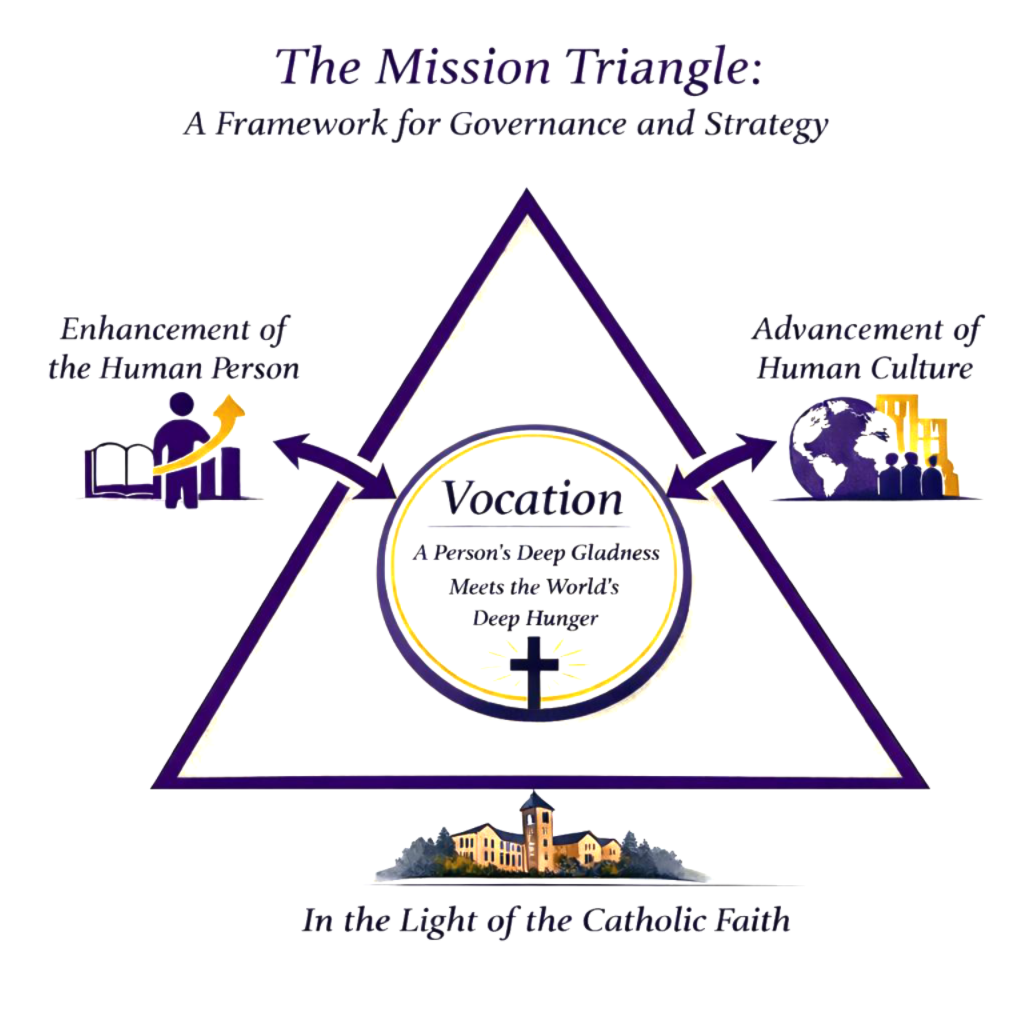
Saint Michael’s College expresses this commitment in its mission “to contribute through higher education to the enhancement of the human person and the advancement of human culture in light of the Catholic faith.” The phrase “in light of the Catholic faith” does not mean that every academic discipline must arrive at explicitly Catholic conclusions. It means that Catholic faith provides an intellectual horizon within which the College asks what education is for, what constitutes human flourishing, how knowledge should be used, and what obligations educated persons have toward others.
The Catholic intellectual tradition is therefore broader than a body of Church teachings. It includes centuries of inquiry in philosophy, theology, literature, science, ethics, politics, law, art, and social thought. It has developed through arguments, disputes, discoveries, failures, reform, and encounters with cultures and ideas beyond the Church. It is not a closed system. It is a living conversation about God, humanity, creation, society, truth, freedom, suffering, justice, and the common good.

We are a pluralistic community of persons who find in diversity a richness to be explored in the pursuit of truth.
To participate in this tradition does not require every faculty member, administrator, trustee, staff member, or student to be Catholic. Saint Michael’s is a pluralistic community. Its members include Catholics, other Christians, people from other religious traditions, agnostics, atheists, and those whose convictions are still developing. That pluralism is not an obstacle to Catholic education. It can be one of its strengths, provided that the Catholic identity of the institution remains clear enough to enter the conversation honestly.
Authentic dialogue requires identifiable convictions. A Catholic college cannot contribute meaningfully to a pluralistic intellectual community if it is unwilling to articulate the tradition from which it speaks. At the same time, it cannot claim to value the dialogue of faith and reason if it treats questioning, disagreement, or criticism as threats.
For faculty, this means more than inserting Catholic material into courses. It means cultivating intellectual habits that resist the isolation of one discipline from another. It means asking how scientific discovery, economic policy, historical interpretation, artistic expression, technological development, and professional practice relate to the human person and the common good. It means asking not only whether something can be done, but whether it should be done, for whose benefit, and at whose cost.
For administrators, Catholic mission must inform institutional culture, policies, budgets, employment practices, student support, and the use of power. Are students treated as whole persons or primarily as customers? Are employees regarded as participants in a common mission or mainly as instruments of productivity? Do financial and strategic decisions advance human dignity, community, justice, and care for those who are vulnerable?
For trustees, Catholic identity is not satisfied by preserving religious language in governing documents. Trustees must ensure that the mission continues to shape institutional priorities, leadership expectations, academic direction, and long-term planning. A mission statement has authority only when it influences choices.

An education in the light of the Catholic faith is not indoctrination but rather the open search for truth in conversation with others.
A college is not made Catholic merely by its name, founding community, chapel, crucifixes, theology requirement, or percentage of Catholic students and employees. These are important signs, but signs can remain after the reality they signify has weakened.
The decisive question is whether the Catholic intellectual tradition remains alive within the institution. Does faith enter into serious conversation with reason? Does reason remain open to questions of meaning, morality, transcendence, and ultimate purpose? Does education form people who can think critically, judge responsibly, act justly, and place their knowledge at the service of others?
Catholic identity is not merely the possession of Catholic beliefs. It is a disciplined way of seeking truth, integrating knowledge, forming persons, and serving the world in the light of faith.
If you would like to make a comment or ask a question, I can be reached at dtheroux@smcvt.edu. Let’s talk!

For all press inquiries contact Elizabeth Murray, Associate Director of Communications at Saint Michael's College.
Related News See more news