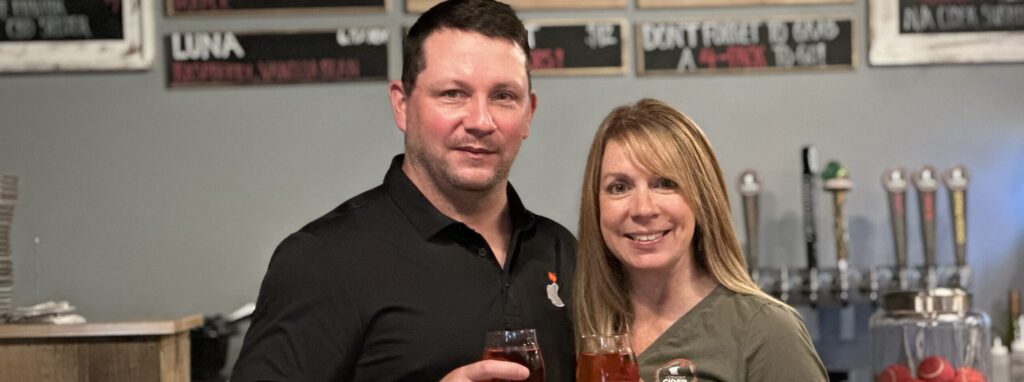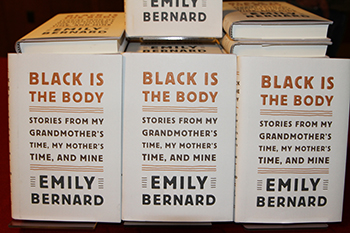
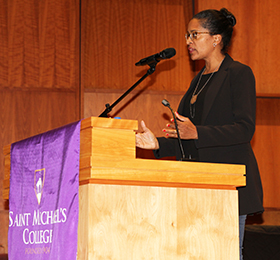
Author and speaker Emily Bernard signs a copy of her book for a student Wednesday in the McCarthy Arts Center Recital Hall in the large photo above the headline. Directly above, Bernard delivers her address. Below is a stack of her latest book ready for the signing that followed the talk. (photos by Ashley DeLeon ’23)
Members of the Saint Michael’s community filled the McCarthy Recital Hall on Wednesday, October 23 to welcome acclaimed scholar, teacher, and writer Emily Bernard to read from her newest novel, Black is the Body: Stories from My Grandmother’s Time, My Mother’s Time, and Mine, and discuss the complexities of writing within the African American tradition.
Introducing the speaker, English Department Chair Lorrie Smith—who is herself known at the College for her comprehensive work with the African American literary model—described Bernard’s work as coming out of “a tradition in which testifying, truth telling, storytelling are at the center of imagining the Black self in a world where blackness and whiteness are always already constructed, but where nothing, in the messiness of actual lived experiences, is truly black and white. Exploring the “often contradictory truths of her own embodied experience” through concise prose, Bernard brings “sharp clarity” to the “blurred edges” of her content, said Professor Smith.
Indeed, storytelling, experience, and blurred edges remained a theme throughout the hour-long event, which comprised readings, lecturing, and a conversational question-and-answer session. From her introduction titled “Beginnings,” Bernard read, “Each essay in this book was born out of a struggle to find a language that would capture the totality of my experience as a woman, a Black American, a teacher, a mother, a wife, and a daughter. I wanted to discover a new way of telling. I wanted to tell the truth about life as I had lived it.” She read and spoke of her desire to displace the archetypal narrative of “Black innocence and white guilt,” reflecting that, while an important concept, “there are other true stories to tell.”

For all press inquiries contact Elizabeth Murray, Associate Director of Communications at Saint Michael's College.
Related News See more news