From St. Ed’s to Sea Turtles: Students Explore Conservation in Costa Rica
If you’ve ever passed by the Institute for the Environment office on the first floor of St. Ed’s, you’ve probably noticed the colorful fliers advertising a variety of scientific expeditions around
 the world. These are more than fun decorations – the I4E is encouraging our students to explore the many opportunities that organizations like EarthWatch and GVI have to offer, to learn more about conservation and environmental science. The best part is, the Institute has scholarship money available to help make this possible for you – linking you to our enviornmental community of practice, expanding your own bank of environmental education, and perhaps even networking for your next academic or work experience!
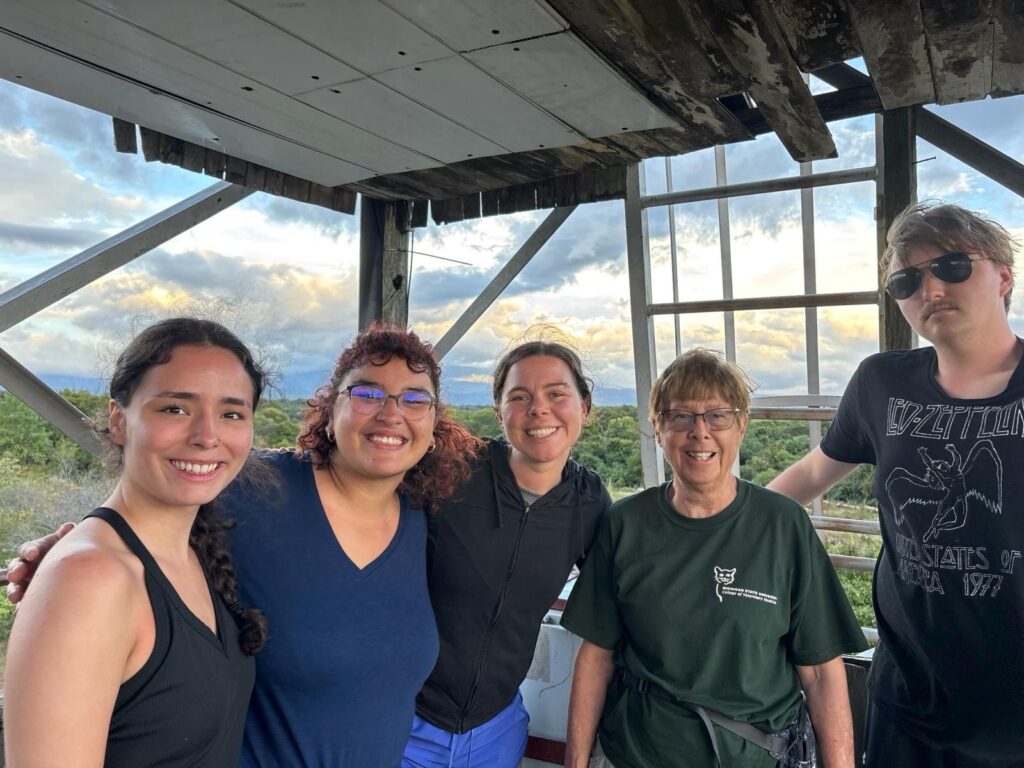
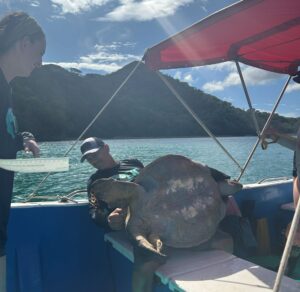
Over this past winter break, I was fortunate enough to attend one of these expeditions, along with two undergraduate students, to Las Baulas National Marine Park in Costa Rica. We took part in EarthWatch’s “Costa Rican Sea Turtle Expedition”, spending nine days working alongside biologists and learning all about the wonders of sea turtles!
Below, you can read a little about each of our experiences on the trip, and be sure to check out the EarthWatch website to see if any expeditions call to you!
Connor Swales
History Major
Signing up for the volunteer trip to Costa Rica through the Leahy Institute has been an eye-opening experience. From working with amazing people to watching massive leatherback sea turtles lay their eggs, it was an incredible experience. As a history major and an environmentally minded person, I am aware of how important biodiversity is to an environment, so watching with my own eyes as sea turtles repopulate themselves with the constant vigilant support of very capable marine biologists was inspiring. 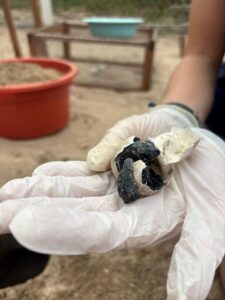
My very last night in Costa Rica with Earthwatch, I went on a night walk, in the hopes of spotting a turtle nest and laying her eggs. After about 3 hours of walking up and down the beach with Biologist Tom, we spotted huge tire-track-looking markings going up the beach, ending around the high-tide line. That’s where we saw an enormous leatherback digging a pit to lie in, called a body-pit. She spent about 20 minutes throwing sand all over the place before she started to dig her egg hole. We would have to get these eggs since the leatherback was nesting too close to the tide line, leaving the eggs at risk. At this point, the entire biologist team had made their way down to the end of the beach to see her. After about half an hour, she was ready to lay, and, much to my shock, they wanted me to catch the eggs. Unfortunately for all of us, the plastic bag I was supposed to use was paper-thin and would certainly rip, but it was too late to double up or get it out, since the giant, immovable turtle was right on top of it. So once it was clear of the inevitability that the bag would rip, we stepped away. We gave the leatherback some space, since now that the eggs were in a bag, we absolutely had to dig it out, or they wouldn’t survive. So, biologist Holly and I patrolled for another 25 minutes or so before we headed back to the nest. For an excruciating 2 ½ hours, we dug out this very deep nest by hand, since a shovel would be too dangerous for the eggs. Only about an hour before dawn, we finally found the nest, got them into a doubled-up bag this time, and carried the eggs back to the hatchery. Truly an incredible end to an already amazing trip.
Hayley Jensen
MATESOL Student
Graduate Assistant at the Leahy Institute for Environment
Sea turtles have always been one of my favorite animals. I started my journey with conservation work through a sea turtle expedition back in 2019 in Greece with the organization, GVI. I ended up working for them again years later in Thailand, helping with their green sea turtle work! So when I saw the opportunity to work with sea turtles again, thanks to the Institute, I jumped at the chance. I was also excited to work with a new organization, having heard many positive things about EarthWatch.
If I had to pick just one favorite memory of the trip, it would have to be the night that we had a sleepover with a leatherback and green sea turtle. The crew had traveled to a more remote research station to learn about another beach where The Leatherback Trust (the community partner we were volunteering with) protected and took data on turtles. I was on the first night patrol, walking with 3 others and the head biologist. We walked the beach for hours, looking for nesting turtles. I could go on and on about this magical night, but I’ll cut to the chase!
We were sitting with a green sea turtle that was bodypitting (the term for a turtle digging her nest), when suddenly, a leatherback sea turtle emerged to nest right next to us! This was their first leatherback on that beach that season and very rare in general, so this set forth a string of excitement to make sure the rest of t
he team got to see her. Before long, all the biologists and volunteers had joined us on the beach (at 1 am!) to catch sight of this beautiful girl bodypitting! She dug around for a long time, never actually nesting, but we all lay on the beach next to her, keeping her company while she tried.
Tatiana Araque-Ochoa
Criminology Major
Psychology and Political Science Major
When I got the news that I was going to go to Costa Rica to help with the conservation of Sea Turtles, I was super excited but also really nervous. I’m a Criminology major with Psychology and Political Science minors, so I haven’t really done anything in the Environmental Science department for my major.
Even though my major isn’t directly related to the environment, being on this trip helped me connect to conservation through human behavior and ways people chose to protect the environment. I was also able to work with a vulnerable population which means I was able to see how exactly I should speak and handle myself which is beneficial for me in the future since that’s the type of population I’d like to work with in the future.
However, I was scared that the most I could do was offer moral support to the biologists. When I got there, I realized I was very wrong! It doesn’t really matter what major I am or what I’m studying; all that matters is that I wanted to be there and that I was motivated to help boost the future generation of turtles to come back to the beaches.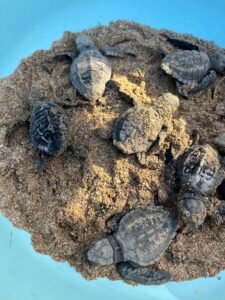
I have two favorite memories:
The first one would have to be on the first night patrol that I walked from 7 pm to 1 am with one of the biologists and another volunteer. That night we walked our rounds about ten times, and I think my brain wanted to see a turtle so badly, that I somehow “saw a turtle” (my brain made up a turtle leaving the water and going to the sand). At first, I was over the moon, but then I blinked, and it was gone! That’s how I knew I was going crazy. If the number of turtles that I “saw” were real, we technically saw 4 turtles that night (two other times, it was logs that I confused for turtles). I think this is one of my favorite memories because of how funny it was, but also that it’s surprisingly common (at least that was what the biologist told me). I also saw so many shooting stars that night, and I’m very thankful for that night.
My second favorite memory does involve a real turtle, don’t worry! It was the last night at the second location, and we had just started our 12 pm to 4 am night patrol, and we saw a green turtle that started nesting and laying her eggs! I really enjoyed being able to see the biologists in action, collecting and relocating the eggs, and just seeing what amazing work turtles have to do just to nest and lay eggs. Overall, I really enjoyed my trip, and I have lifelong memories.



For all press inquiries contact Elizabeth Murray, Associate Director of Communications at Saint Michael's College.
Related News See more news