Learning outside the classroom: St. Mike’s students dive into summer academic trips in Wales and Ireland
Saint Michael’s College and the Study Abroad Office offer numerous opportunities for students to leave the classroom and explore various countries through internships, traditional semesters abroad, academic study trips, and more. These experiences provide students with global understanding and hands-on learning while deepening what they’ve learned in the classroom within real-world settings.
This summer, the College sponsored two 2-week-long academic study trips led by members of the faculty. Biology Professors Declan McCabe and Paul Constantino led a group of Saint Michael’s College students to explore wildlife species and collect water samples along the coastline of Ireland. Meanwhile, Political Science and International Relations ProfessorJeffrey Ayres was accompanied by Environmental Studies Professor Laura Stroup, leading a similar group of students along the historic street of Wales while studying the environmental sustainability of the country.
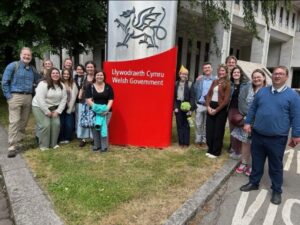
Students traveling on the academic study trip to Wales in May and June 2025 visited important political sites such as the Llywodraeth Cymru Welsh Government building. (Photo courtesy of Jillian Lesinski ’26)
These short-term study trips provide an opportunity for students to have a global experience on a smaller scale.
“It’s a unique opportunity,” McCabe said. “There are students who are athletes, and they are quite busy in one semester, and they’re conditioning in a different semester. There are also students who just don’t have the financial resources to do a full-blown study abroad. And so these two-week opportunities provide a way to make it happen.”
Wales: Sustainability and well-being
The trip to Wales offered students an interdisciplinary look into the environmental policies and community well-being of the citizens of Wales. The trip was preceded by a two-credit class during the semester, and students earned two more credits once in Wales. The class and trip focused on the Well-being of Future Generations Act that was passed by the Welsh Parliament in 2015, requiring all public bodies to consider the long-term impact of their decisions.
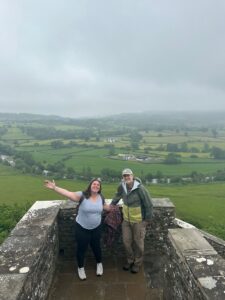
Jillian Lesinski ’26 poses with Political Science and International Relations Professor Jeffrey Ayres in front of a Welsh landscape during an academic study trip to Wales in May and June 2025. (Photo courtesy of Jillian Lesinski)
For Ayres, who has led this trip five times over in the last ten years, it is not only a travel opportunity but also a “high-impact deep learning experience of learning outside the class.”
The course is open to students of all academic disciplines, he said.
“We welcome different majors and perspectives, and they can hopefully find something within the parameters of the course of the learning objectives that they can pursue in terms of their research that aligns with their majors,” Ayres said.
Jillian Lesinski ’26, a Digital Media and Communications major, said one of her favorite parts of the trip was learning about other people’s perspectives and interests across different disciplines.
“I went on this trip with people that I never would have met at St. Mike’s because we do not share classes,” Lesinski said. “I was a really awesome group dynamic, and we did pretty much everything together.”
During the spring semester, students enrolled in the class are required to select a research topic directly related to human well-being or environmental sustainability that they then continue to research while in Wales.
Lesinski chose to examine the differences between maternity leave in the U.S. and Wales to examine the impact on overall health and happiness. Once abroad, students participate in a blend of academic and cultural activities.
The students were also expected to work on their research projects by interviewing locals using questions they crafted during the semester. Lesinski had the opportunity to interview various mothers to learn more about their experiences with maternity leave.
“We met with Welsh government officials, went to Parliament,” Ayres said. “We do a number of visits to historical sites. A big part of this is being outside and hiking, seeing the beauty of the Welsh landscape.”
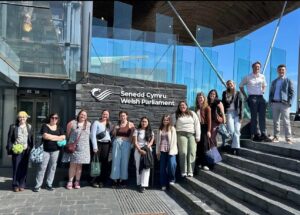
Students traveling to Wales during an academic study trip in May 2025 visited important political sites such as Senedd Cymru Welsh Parliament building. (Photo courtesy of Jillian Lesinski ’26)
The experience brings classroom conversations to life.
“The most memorable part of my trip was 1,000% talking to the local people,” Lesinski said. “I think I learned so much from them, just like in any situation. They were always so excited to meet with us and talk about everything.”
Ireland: Hands-on coastal biology
On the other side of the Irish Sea, Professors McCabe and Constatino led a group of science-focused students on a coastal biology trip to Ireland.
Unlike the trip to Wales, the Ireland trip is a single two-credit summer program with no spring semester class attached. However, each student must take one of the prerequisite courses set by organizers, drawing in many Environmental Science, Biology, and other science-related students.
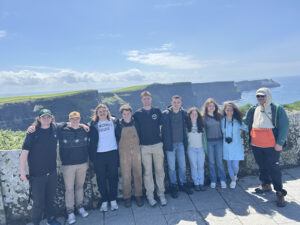
Students visiting Ireland as part of an academic study trip in May 2025 visited famous ecological sites like the Cliffs of Moher. (Photo courtesy of Preston Hewett ’25)
While in Ireland, students explored significant ecological landscapes such as the Cliffs of Moher, as well as geologically fascinating sites like the Aillwee Caves, which took students a mile underground.
“One really valuable experience was going to a place called the Burren, a uniquely Irish habitat,” McCabe said. “It’s raised limestone pavement that occurs naturally, and it’s unclear whether it’s bare because the soil is removed due to poor agriculture, or if it’s just naturally that way. We got a local tour guide to take us through that, and she was amazing.”
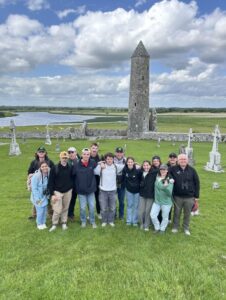
Students and Professors Declan McCabe and Paul Constantino pose for a photo in front of a site in Galway, Ireland, during an academic study trip in June 2025. (Photo courtesy of Declan McCabe)
For Chemistry and Biology student Jacob Gaudet ’26, one day in particular was his favorite out of the two-week trip. Gaudet described visiting the Aillwee Caves, seeing the coastal regions of Ireland at the Cliffs of Moher, and experiencing a falcon demonstration.
“It was just an entire day of doing exactly what the trip was designed for, not just coastal biology but biology of Ireland,” Gaudet said.
Students also visited the University of Galway, where they explored their zoological collection, including some specimens that were collected by Charles Darwin himself.
McCabe, an Irish native, also took the students to his hometown, Athlone.
“I also gave them a walking tour of town, which, you know, obviously I could do without thinking too much about it,” McCabe said. “And in the process of all that, we just bumped into people I knew.”
It was not all data collection and research. The students also had the chance to immerse themselves in Irish culture, attending meals in a castle and listening to traditional music.
“One of the students is an Irish dancer, and so it meant a lot to her to actually dance in the castle to live music, which is kind of fun,” McCabe said.
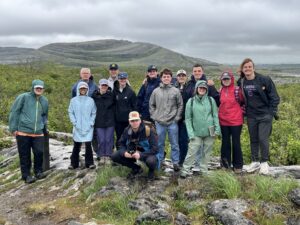
Students on the academic study trip to Ireland in June 2025 visited ecologically significant sites like Burren National Park. (Photo courtesy of Declan McCabe)
More than just a trip
Both two-week study trips make travel more accessible, particularly for students who have never traveled abroad.
“For a number of these students, this is their first opportunity to leave the United States,” Ayres said. “Some haven’t even been to Canada. [It’s the] first opportunity to really leave the U.S., or certainly North America, and maybe the most affordable option.”
By planning early, staying in affordable accommodations like hostels, and using public transportation, professors try to keep the costs of attending the trip as low as possible. Scholarships like the Politi Endowment Fund may also be awarded to students, reducing the cost of tuition, travel, and expenses.
“It’s an easy entryway to do some international travel without having to manage it all yourself,” McCabe said. “It’s almost like going to a museum that’s been curated in some way. We curate the experiences and look at past evaluations and see what was popular with students.”
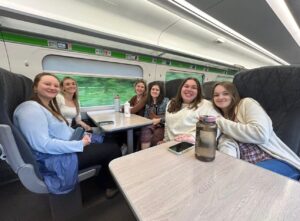
Jillian Lesinski ’26, second from right, rides a train in Wales with fellow participants in an academic study trip in May 2025. (Photo courtesy of Jillian Lesinski)
For Lesinski, who was very nervous about the idea of going abroad alone, she found comfort in traveling with both her fellow students and professors.
“It was really awesome to have to have that structure and be learning so much while you’re there,” Lesinski said. “I would definitely recommend these trips, because it seriously was a once-in-a-lifetime experience.”

For all press inquiries contact Elizabeth Murray, Associate Director of Communications at Saint Michael's College.
Related News See more news