At a Catholic college in Vermont, where forested mountains surround us and the seasons mark the passing of time with crisp clarity, it’s easy to think of the earth as a gift—and it is. But when we turn to the teachings of the Church, particularly those expressed by Pope Francis in Laudato Si’ (On Care for Our Common Home, 2015), we are challenged to remember that this gift is not simply for our enjoyment, nor for our consumption alone. It is a sacred trust meant to be shared, sustained, and safeguarded, not only for future generations but also for those who, today, are denied access to its abundance.
Pope Francis, drawing from the 2001 pastoral statement of the United States Conference of Catholic Bishops (Global Climate Change: A Plea for Dialogue, Prudence, and the Common Good), names a painful global truth:
“Developing countries, where the most important reserves of the biosphere are found, continue to fuel the development of richer countries at the cost of their own present and future. The land of the southern poor is rich and mostly unpolluted, yet access to ownership of goods and resources for meeting vital needs is inhibited by a system of commercial relations and ownership which is structurally perverse. . . . As the United States bishops have said, greater attention must be given to ‘the needs of the poor, the weak and the vulnerable, in a debate often dominated by more powerful interests’” (Laudato Si’, no. 52).
 This is not only a statement of economic imbalance; it is a moral challenge. It names injustice and calls Christians to solidarity.
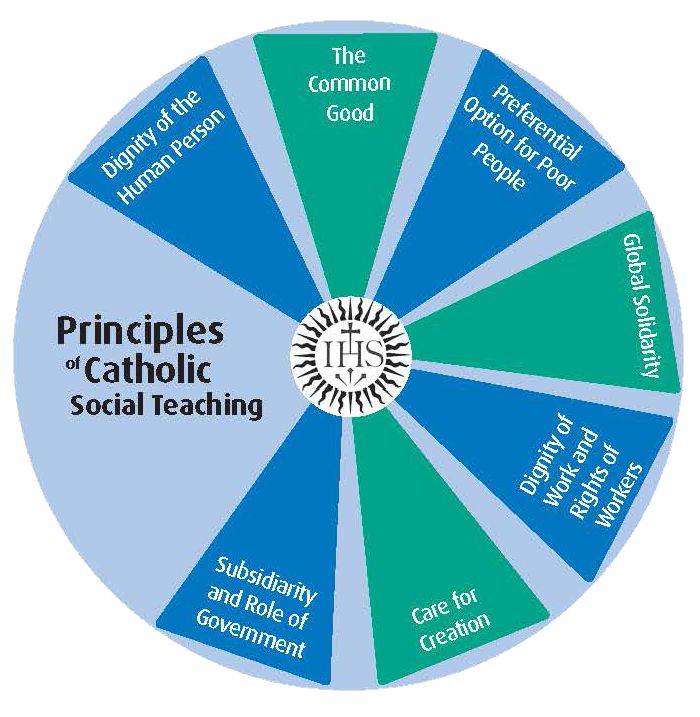
Solidarity is a central principle of Catholic Social Teaching. It is not simply a feeling of compassion; it is a firm and persevering commitment to the good of all and of each person, because we are all responsible for all. As the Compendium of the Social Doctrine of the Church explains, “Solidarity rises to the rank of a fundamental social virtue since it places itself in the sphere of justice” (Pontifical Council for Justice and Peace, Compendium, 2004, 193).
In our current context, solidarity must also include a commitment to diversity, equity, and inclusion (DEI). Though often treated as secular or political concepts, DEI values resonate deeply with Gospel teaching. Diversity recognizes the richness of God’s creation. Equity calls us to correct structural imbalances that violate human dignity. Inclusion seeks to bring all voices to the table—especially those silenced or marginalized. As such, DEI efforts can support and give practical expression to the Church’s call to solidarity. The global Church itself is diverse by nature, with its members living in every nation and culture; true solidarity, therefore, cannot exist without respect for difference and structures that ensure equitable participation.
At our college, where Catholic social teaching shapes our curriculum and our mission, the call to solidarity must move from theory to practice. We educate students not only to succeed, but to serve; not only to compete, but to collaborate; not only to analyze systems, but to challenge them when they fail to honor the dignity of every person.
What does solidarity look like those of us who live in Vermont? It begins with the recognition that we are part of one single human family. That family includes the Andean farmer whose water is diverted for mining operations that benefit far-off investors. It includes the African child whose future is compromised by deforestation in her homeland to meet international demand for palm oil and timber. It includes the islander in the Pacific whose ancestral land is disappearing beneath rising seas fueled by carbon emissions he did not create.
Solidarity, in this context, means refusing to hide behind borders or policies or economic excuses. “There are no frontiers or barriers, political or social, behind which we can hide,” Pope Francis writes, “still less is there room for the globalization of indifference” (Laudato Si’, 2015, 52).
Indifference is one of the gravest temptations of our time (cf. Pope Francis, Laudato Si’, 2015, 52). It allows us to see suffering without being moved. It rationalizes inequality as the cost of progress. It offers us comfort without conscience. But the Gospel and the teachings of the Church call us to something far more courageous: to stand with those whose voices are ignored, whose lands are exploited, whose futures are at risk. To live in solidarity.
For a Catholic college in Vermont, this means educating students to understand the structural injustices that shape our world and equipping them to do something about it. It means connecting environmental studies with ethics, economics with equity, global politics with human dignity. It means forging partnerships with communities in the Global South, supporting fair trade, reducing our own environmental footprint, and listening deeply to those who bear the cost of our consumption.
 It also means prayer. Solidarity is not only a social commitment; it is a spiritual discipline. We are called to see Christ in the faces of the poor and to remember that our salvation is bound up with theirs. As Pope Benedict XVI once said, “Love—caritas—is an extraordinary force which leads people to opt for courageous and generous engagement in the field of justice and peace” (Caritas in Veritate, 2009, no. 1).
That force is what must animate our response to the injustice described in Laudato Si’. Not guilt, but love. Not shame, but responsibility. Not charity alone, but a justice rooted in a love that recognizes every human being as a brother or sister.
This is the path of solidarity. It is not easy. It demands that we confront hard truths about how we live, how we consume, how we relate to the rest of the world. But it is also a path of hope because it leads us toward a more just, more peaceful, and more sustainable future.
As we walk that path together here in Vermont, may we never forget that the cry of the earth and the cry of the poor are one and the same (cf. Pope Francis, Laudato Si’, 2015, 49) and that our response, grounded in faith, must be one of united, unwavering, and courageous love.
If you would like to comment or ask a question, I can be contacted at dtheroux@smcvt.edu. Let’s talk!

For all press inquiries contact Elizabeth Murray, Associate Director of Communications at Saint Michael's College.
Related News See more news