Just as Paris was readying to welcome the world for the Summer Olympics in 2024 – a symbolic gesture of inclusion – an undercurrent of French nationalism and xenophobia was bubbling to the surface.
Ava Lavigne ’26, who was interning abroad there at the time, witnessed the cultural and social tensions come to a head during an election that heralded a shift in political power. This resulted in Muslim families she was serving to become frightened for their futures.
One year later, Lavigne, a Religious Studies major and French minor, is examining what has been giving rise to the unrest in France through a grant-funded summer research project titled “Islam in France Today: Terrorism, Nationalism, and the Secular State.”
Political shift instills fear
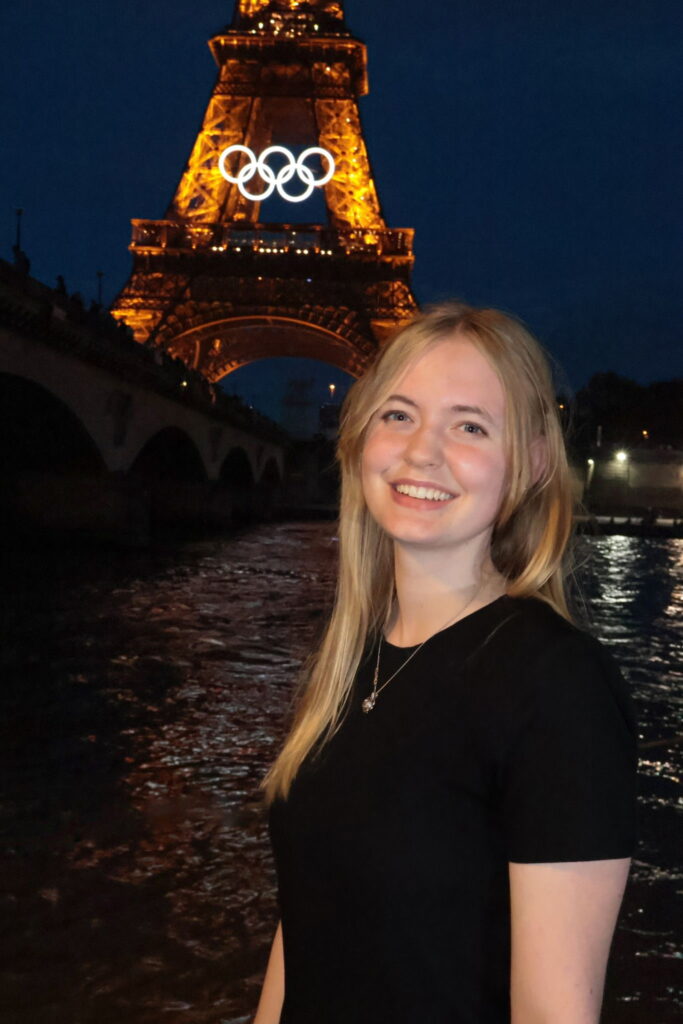
Ava Lavigne’s summer internship abroad in 2024 coincided with the Summer Olympics in Paris. Her experiences abroad helped inform her summer research project in 2025, examining Islam in France. Lavigne will graduate in 2026. (Photo by Hannah Bennett ’26)
While in Paris, Lavigne did much more than explore the City of Lights and practice her French. She interned at a non-profit that served underprivileged families – much like a Boys & Girls Club, she explained. She interacted with women and stay-at-home moms, many of whom were Muslim. She became close friends with a girl of similar age from Egypt and a woman from Tunisia, both of whom moved to France looking for safety and better economic opportunities to support their families back home.
But, events that summer caused ripples of fear in the Muslim community living in France.
An election brought the rise of the extreme right National Rally party (RN). Using the slogan “France is for the French,” the RN nearly won the election, leading in the first round of voting. A win would have unseated President Emmanuel Macron, but the run-off resulted in the RN becoming the country’s second-largest party, and it took 142 seats (of 577) in France’s National Assembly.
“They were telling me what it’s like to be a minority during such a contentious and historic time in France history,” Lavigne said of the women. “They were terrified by the overtaking of the right-wing party because it’s very anti-immigration and instills the fear of outsiders.”
Current tensions built upon more than 200 years of history
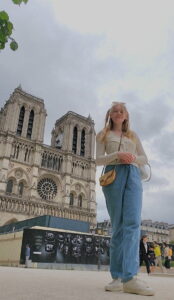
Ava Lavigne ’26, a Religious Studies major and French minor, used her summer abroad in France in 2024 to inform her summer research project in 2025 about Islam in France. (Photo courtesy Ava Lavigne ’26)
About ten percent of France’s population – approximately 6 million people – is Muslim, owing to two major immigration waves: one in the 1940s to fulfill labor demands post-World War II and another in the 1970s to reunite families split across countries.
In the meantime, a rise of nationalism and secularism has influenced much of the populace to identify as French first, with other personal identities subordinate, Lavigne explained.
During the French Revolution in 1789, the government and the Catholic Church split ways, in part, due to the Church’s hoarding of funds while the proletariat went hungry. Laïcité – a separation of Church and State – is a core principle that has been enshrined in the French Constitution since 1905. The concept has been applied to include banning the wearing of religious symbols and garb in public.
Opponents say laïcité in modern times is being used to target Muslims who wear hijabs and burqas – head and face coverings – in schools and in the public square. One example of this in recent history was the controversy over the “burkini,” a modest swimsuit worn by Muslims that was banned at some French beaches, which came to a head in 2016.
The anti-outsider rhetoric in France has gone much beyond threats and Islamophobia, to violent, targeted killings, and on the other end, retaliation from Islamic extremist groups in the form of terror attacks.
Most recently in April 2025, a worshipper was stabbed to death in a mosque in southern France. After the Paris-based satirical magazine, Charlie Hebdo, published unflattering cartoons of the Prophet Muhammad – which Islam is based upon – it was firebombed in 2011, and later, a dozen people were gunned down there in 2015 by radical Islamists.
The intertwining of religion and politics
The study abroad and summer research experiences have revealed aspects of the world that Lavigne said she didn’t see as clearly before. She believes it’s important to understand the differences and similarities between how countries respond to current events. For instance, she said it has been interesting growing up in post-9/11 America, where she’s been aware of some undertones of fear and Islamophobia. In France, Islamophobia is present, but for different reasons, she said.
“We’re so focused on the United States that oftentimes things don’t break through our news cycles from other countries that we’re really closely allied with – as we are with France,” she said. “I think if we can gain perspective on other countries, it can almost help us understand how we can better ourselves and maybe work together to better each other at the same time.”
Religious Studies Professor James Byrne is Lavigne’s mentor on her research. He contends politics and religion often go hand-in-hand. He quoted former U.S. Secretary of State John Kerry, who has said on numerous occasions that if he were to do it over, he’d study comparative religion over political science in college, summarizing that “you can’t understand anything about the major conflicts of the world today without understanding its religious dimension,” Byrne said.
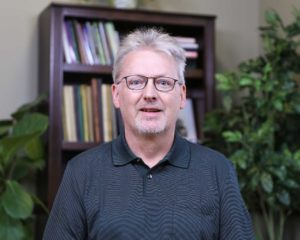
James Byrne, Professor of Religious Studies
Tensions are mounting in France and across the EU, where other countries have seen a precipitous rise of nationalism and a power shift toward extreme right political groups in the past few years. With a global economy at stake and lines drawn around conflicts, it’s important for Americans to be aware of what’s happening, according to Lavigne and Byrne. Those with global literacy skills may be instrumental in the days to come.
Lavigne says whatever she does following college, she wants it to be people-focused.
“I was kind of seeing this project as a foundation for understanding people and global issues on a deeper level,” she said.
Finding a conflict solution is not a goal of hers for this project. However, understanding her role as a global citizen will likely be an asset in her career and life.
Study abroad to summer research to senior thesis to career
Lavigne’s experience in Paris naturally fed into her summer research project. The culmination of this project will be a report she will write as if she were an intern within the U.S. State Department. The report will also serve as her senior thesis that she will present at the Academic Symposium in spring 2026, just before graduation.

Student researcher Ava Lavigne ’26 explains her research into Islam in France during the summer research kickoff breakfast on June 4, 2025. (Photo by Elizabeth Murray)
All of these opportunities have built upon one another, setting her up for a career in non-profit humanitarian service or work in library archives documenting these types of issues – which she says are her current aspirations.
In addition to a more solid understanding of global issues, Lavigne said her critical thinking skills have sharpened, which she can use in any career.
Byrne agrees the dual opportunities of studying abroad and summer research set St. Mike’s students apart, making them in demand in the workplace.
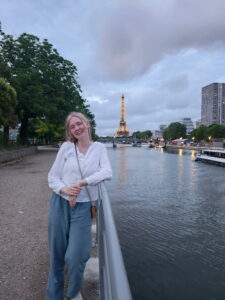
Ava Lavigne ’26 interned in Paris, France, during the summer of 2024. (Photo by Sophie Burt ’26)
“[Studying abroad] can be life transforming for many of them and it can also lead to deeper research, which is what happened in Ava’s case,” he said. “Any student who can possibly do it, I strongly encourage them to study abroad, challenge their boundaries, and get out of their comfort zone. And, she certainly did that.”
The world is swimming in information, Byrne said, but St. Mike’s students are especially equipped to navigate this challenge.
“What we need – and what St. Mike’s provides – is skillful people who can understand and condense that information,” he said.
Byrne said summer research teaches students how to conduct research, analyze complex information, and communicate it succinctly. These are incredibly important, transferable, lifetime skills that will stand up in the workplace, he said, that can’t be adequately replaced by computers.
“AI is a tool. It’s not capable of making ethical judgments, it’s not capable of personal communication, it doesn’t even think…it’s merely an algorithm,” Byrne said, explaining that St. Mike’s teaches students to think and to reason.
Lavigne feels fortunate that her education at Saint Michael’s College has afforded her so many unique and transformative opportunities.
“I studied abroad for free, I’ve done summer research that not many undergraduate students have the opportunity to do,” she said, adding that at other colleges, research is usually reserved for post-grad. “But it’s kind of a little window into what could lie in the future for me.”

For all press inquiries contact Elizabeth Murray, Associate Director of Communications at Saint Michael's College.
Related News See more news