The science of spice: How one St. Mike’s student researcher could revolutionize the saffron industry
Many are familiar with saffron due to its high market value – the spice is more expensive than any other compound on Earth, at about $10,000 per pound, according to Saint Michael’s College Chemistry Professor Shane Lamos.
For student researcher Bethany Hayes ’26, saffron presented an opportunity for a summer research project. Her goal: to establish a standard for purity testing for this luxurious and vibrant spice.
Hayes, in collaboration with her professor, the Patrick ’61 and Marcelle Leahy Institute for the Environment, the University of Vermont, and Middlebury College, has been diving deep into the molecular makeup of saffron. To do this, she has been using nuclear magnetic resonance (NMR) to develop a standardized method of testing and to better understand the compound levels needed for saffron to be deemed “pure.”
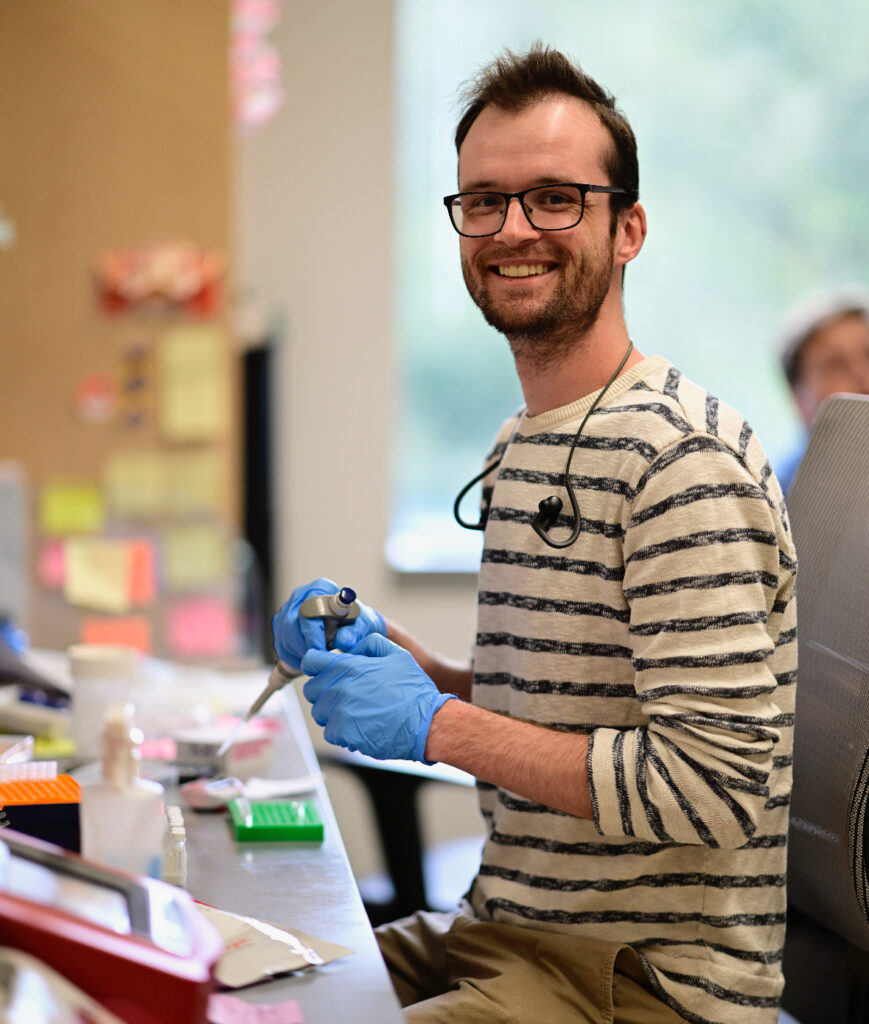
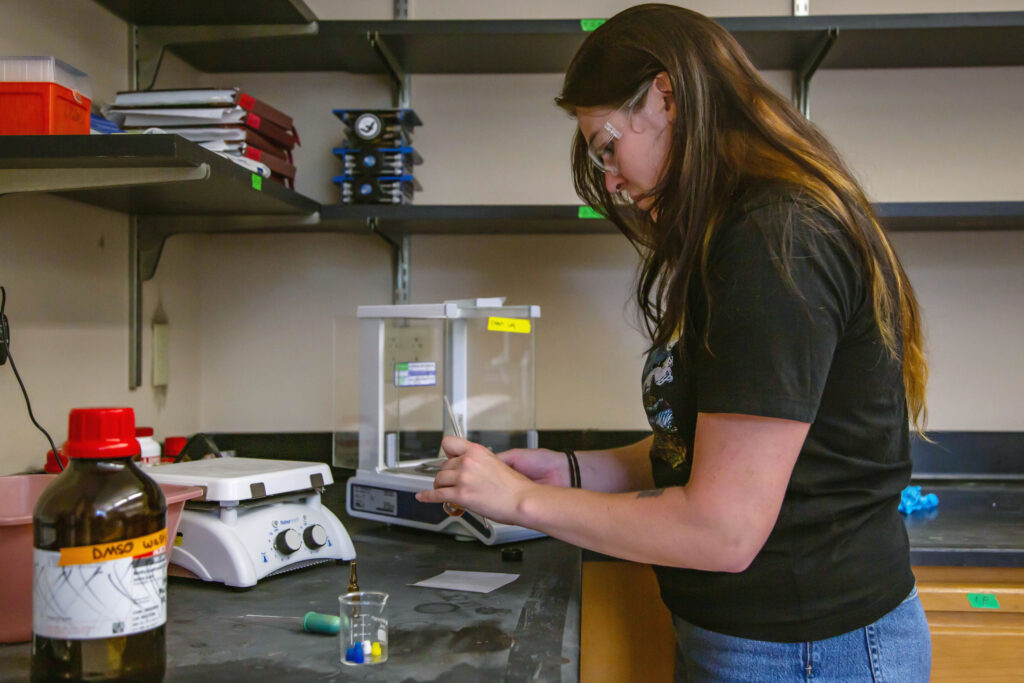
Bethany Hayes ’26 endeavored to create a testing system for saffron purity during her summer 2025 research project. (Photo by Cassie Lathrope ’26)
In simpler terms, Hayes is developing a testing method to ensure that the saffron being sold is true saffron.
“There are a lot of people in the market who are adulterating saffron,” Lamos said. “The farmers who have clean products would like to be able to get value for them. They need some sort of stamp of approval or standard measurement, and so we were working to develop that.”
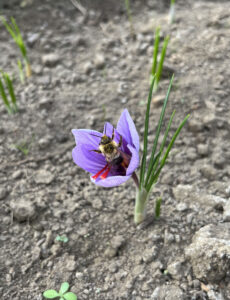
A bumblebee enjoys the inside of a saffron flower grown on The Farm at Saint Michael’s College. (Photo courtesy of Christine Gall)
Testing for saffron purity
The work that Hayes is doing centers on detecting and measuring the quantity of three main compounds found in saffron. These include crocin, which is responsible for the bright red/orange color, as well as picrocrocin and safranin, which are responsible for the aroma and taste.
“We are trying to separate them so we can actually see the different concentrations,” Hayes said.
While conducting this research, Hayes needed a reliable source of the spice to set a compound baseline. That’s where help from the College’s on-campus Farm came in. Hayes was able to use samples of saffron grown by both The Farm at Saint Michael’s and the nearby University of Vermont.
“UVM provided initial saffron samples from their farm,” Lamos said. “They also provided the little bulbs that are planted on our own farm so that we could grow saffron at St Mike’s. So last year, we planted and harvested our first crop of saffron.”
Those bulbs went into the ground at the Farm at Saint Michael’s in early October 2024, according to Christine Gall, manager of the Farm and Food Program through the Institute for the Environment.
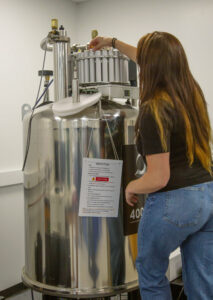
Bethany Hayes ’26 uses Saint Michael’s College’s NMR machine — one of four in the state of Vermont — to separate molecules in a saffron stamen. The machine was donated to Saint Michael’s College by Francis E. Harrison ’52. (Photo by Cassie Lathrope ’26)
“Our team would harvest flowers every few days, then pick out the bright red stigma (this is the actual saffron spice that can be processed/sold) by hand,” Gall said. “Stigma were stored in open glass jars to dry.”
This process has provided Hayes with two individual samples of saffron that can be used for chemical analysis.
“To go out into the marketplace and buy saffron is incredibly expensive, so it’s been nice to bring it in-house,” Lamos said.
Once the saffron is collected, Hayes uses the NMR machine in Cheray Science Hall to separate the main compounds. The NMR is a powerful tool that Hayes said works similarly to an MRI machine by using a strong magnetic field to align the molecules while taking a photographic image.
For Hayes, the most difficult part of her research has been the trial-and-error process of separating the different molecules.
“[The biggest challenge is] trying to get the two peaks apart and accurately calculating how much is there,” Hayes said.
The $400,000 NMR machine that Hayes is using for her research was donated to the College by Francis E. Harrison ’52. According to Lamos, the NMR located on the second floor of Cheray Science Hall is one of four in the entire state.
“It’s such an invaluable piece of our research experience for students here, and it’s used by students in all the sciences to come,” Lamos said.
Why saffron?
The idea for this scientific research topic began as a conversation between Lamos and other colleagues in his field, including Dr. Margaret Skinner, a saffron researcher at the University of Vermont. Skinner has been working directly with saffron farmers to develop a testing method to prove their products’ purity and value to consumers.
“The farming community doesn’t have an NMR. They don’t have a way to do this type of chemical analysis,” Lamos said. “It’s reserved for chemists.”
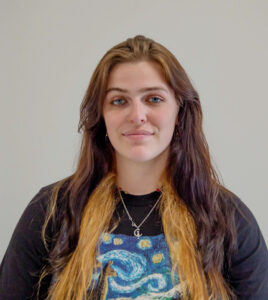
Bethany Hayes ’26 (Photo by Cassie Lathrope ’26)
He added, “If we’re going to support people who are trying to grow botanical products, we have to be the chemical workhorse of that part of the world.”
Hayes, who has always had an interest in plants and agriculture, found this project to be a great blend of her hobbies and educational studies in chemistry.
“Bethany was looking to do a summer research project. I pitched it as ‘we need this project done, and you’re really good with instruments, and we can learn all these new techniques,’” Lamos said.
Hayes’s work over her eight-week summer research project has already yielded a functional testing method, which she hopes to continue to establish by analyzing saffron samples from the Rodale Institute in Pennsylvania.
Hayes’s goals for her research are to allow St. Mike’s to become a reliable analysis hub for the saffron industry.
“I’m hoping that it can be an ISO [International Organization for Standardization] standard, and then we can also have more outreach to people and become a trusted testing site,” Hayes said.
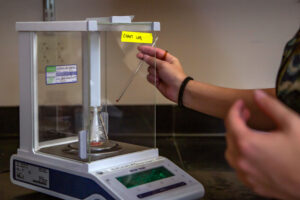
Bethany Hayes ’26 endeavored to create a saffron testing system as part of her summer research project in summer 2025. (Photo by Cassie Lathrope ’26)
Lamos’s aspirations are even farther-reaching, with plans to join Dr. Skinner at the annual University of Vermont Saffron Conference in June to provide the school with a direct connection to the grower community. Additionally, he would like to see this research become a liberal arts opportunity for different disciplines.
“I would hope that we could become maybe a hub for saffron analysis, and we could build a testing center piece out of this,” Lamos said. “I don’t understand the business side, so somebody else would have to develop the marketing for the business. I think it’d be great to partner with people, students, and faculty alike.”
For now, Hayes continues her trial-and-error process, slowly refining her analysis testing that could reshape how the farming and spice industry operate.

For all press inquiries contact Elizabeth Murray, Associate Director of Communications at Saint Michael's College.
Related News See more news