The Right to Organize: Catholic Social Teaching and the Dignity of Workers
At a Catholic college rooted in the tradition of Catholic Social Teaching, we are called not only to study justice but to practice it. One area where this commitment becomes tangible is in the consistent and principled support the Church offers for the rights of workers, especially the right to unionize.
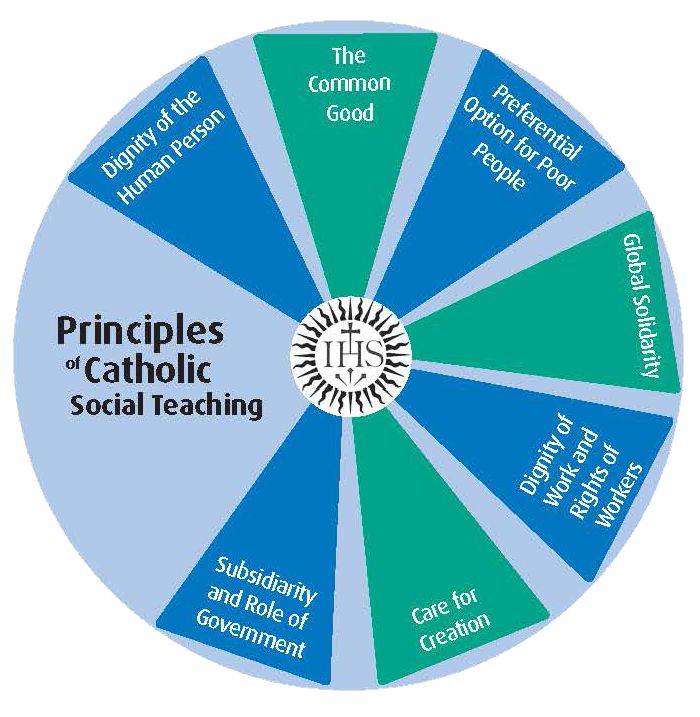
The U.S. Catholic bishops identify the dignity of work and the rights of workers as one of the seven core themes of Catholic Social Teaching. They make clear that protecting the dignity of work means respecting a set of fundamental rights: the right to productive employment, to fair wages, to economic initiative and ownership, and critically, to join and form unions in defense of one’s interests (USCCB, Seven Themes of Catholic Social Teaching).
This teaching is not recent. It has been a cornerstone of the Church’s social tradition since Pope Leo XIII’s 1891 encyclical Rerum Novarum. At a time when industrial capitalism had created widespread economic exploitation, Pope Leo XIII affirmed that workers have a natural right to  form associations, including unions, for their mutual protection and to advocate for just conditions. He saw these associations not only as permissible but as necessary: “To enter into a ‘society’ of this kind is the natural right of man; and the State is bound to protect natural rights, not to destroy them” (Rerum Novarum, no. 51).
Pope John Paul II advanced this teaching in his 1981 encyclical Laborem Exercens, where he emphasized that work is a fundamental expression of human dignity and that unions serve as a legitimate and constructive way for workers to seek justice. “Their task is to defend the existential interests of workers in all sectors in which their rights are concerned,” he wrote, calling unions “an indispensable element of social life” (Laborem Exercens, no. 20).
This perspective was reaffirmed in Centesimus Annus (1991), where John Paul II highlighted the ongoing relevance of unions in protecting workers’ rights, including their right to fair wages, safe conditions, and collective representation. The Church recognizes these rights not simply as policy preferences, but as rooted in the dignity of the person and the moral structure of work.
The Compendium of the Social Doctrine of the Church synthesizes these teachings, making clear that the Church supports the right of workers to organize and bargain collectively. It underscores that unions are not only compatible with the Gospel but are often essential instruments of justice in the face of structural inequality and economic imbalance: “The Magisterium recognizes the fundamental role played by labor unions…” in defending workers’ rights and promoting the common good (no. 305).
The United States Conference of Catholic Bishops has repeatedly reaffirmed these principles. In their document Economic Justice for All (1986), they write: “The Church fully supports the rights of workers to form unions or other associations to secure their rights to fair wages and working conditions… No one may deny the right to organize without attacking human dignity itself” (no. 104).
At its core, Catholic Social Teaching views unions not as a threat to order or productivity but as a moral response to inequality and a means of ensuring that workers are treated with respect. The right to organize is grounded in the Church’s vision of human dignity, solidarity, and the pursuit of the common good.
For a Catholic college community like ours, these teachings present both an invitation and a challenge. They invite us to support the rights of workers, not only in theory but in institutional practice. And they challenge us to ensure that our own economic relationships reflect the justice, dignity, and mutual respect that our tradition upholds.
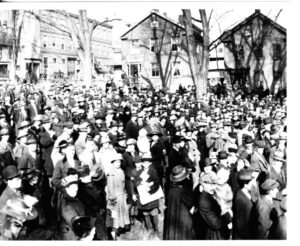
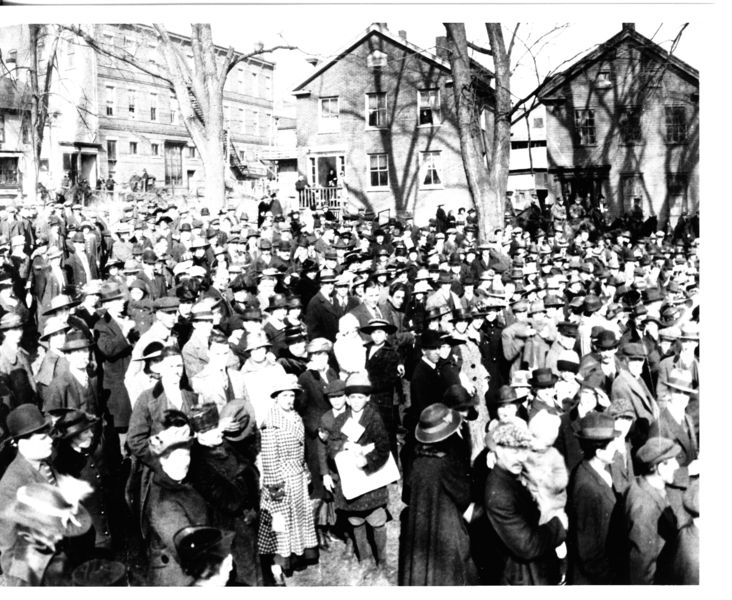
Winooski workers demonstrate to keep the mills open.
Part of the proud tradition of the Society of Saint Edmund has been its support of workers and their right to unionize. To remain faithful to that legacy is to continue affirming that justice in the workplace is a necessary expression of our Catholic identity. Early in the twentieth century, the Society of Saint Edmund ministered to workers in the mills of Winooski, providing care and providing educational services to workers. Students were also involved in the unionization of the mills, activists in the unionization of the mills. (Kaylee Sayers, “Fr. Myhalyk Shares History, Legacy of Edmundite Missions,” Defender, February 18, 2022).
Fr. Lorenzo D’Agostino, SSE, receiving his doctoral degree in social services from Catholic University of America in the late 1940s and head of the sociology department at Saint Michael’s subsequently, was very involved in working for better treatment of workers in Vermont, and represents the long-standing commitment of Edmundites to social justice. In the mid-1950s, Fr. D’Agostino is recorded saying at a meeting

SEIU Champlain College Adjunct Faculty
about the closing of the American Woolen Company mills in Winooski, Vermont, “Capitalism will not live long unless those with the power of money are made to see their social obligations” (Burlington Free Press, September 18, 1954). Although attempts to keep the mills open failed,
Saint Michael’s College continues to recognize the right of workers to unionize. Seven Days noted in a 2012 publication, “For the first time in the Catholic college’s 108-year history, a group SEIU Champlain College Faculty Adjunctsof its employees opted last week to form a union,” reporting on the efforts of the custodial workers at the College to unionize. Adjunct faculty member at Saint Michael’s voted to unionize in 2014, following the successful attempts of Burlington College and Champlain College to form unions (VTDigger, 2014). In both instances, union members have negotiated with the College successfully in achieving better working conditions and pay for all custodial employees and adjunct faculty members.
If you would like to make a comment or ask a question, I can be reached at dtheroux@smcvt.edu. Let’s talk!

For all press inquiries contact Elizabeth Murray, Associate Director of Communications at Saint Michael's College.
Related News See more news