Flipping the channel and changing the frame: St. Mike’s student researcher zeros in on Meta, media bias
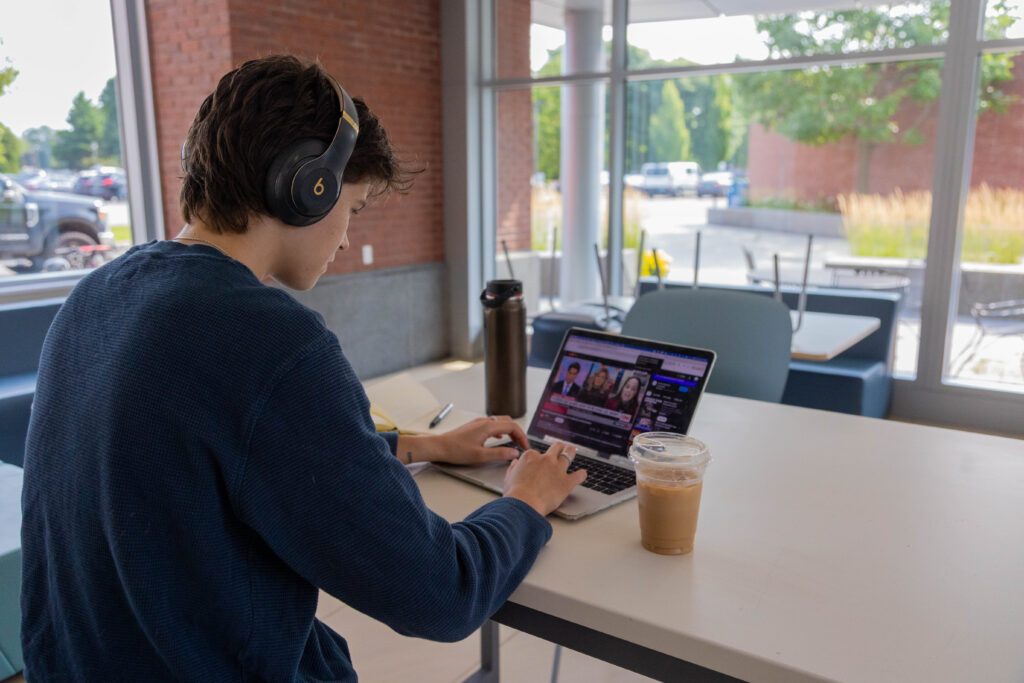
Student researcher Olivia Miller-Johnson ’26 transformed her interest in the complex ways the internet intersects with politics and society into an eight-week, grant-funded research project this summer.
Through her research, Miller-Johnson, a Digital Media and Communications major, asked timely questions about both content moderation on social media and media bias in mainstream news. Guided by Digital Marketing Professor Sebastiaan Gorissen, Miller-Johnson conducted a content analysis of six mainstream U.S. news networks and the methods they used while covering Meta’s 2025 policy shift on content moderation. Meta is the company that owns social media platforms, Facebook and Instagram.
“I’ve always been interested,” Miller-Johnson said. “This topic kind of illuminated itself as a timely and effective way to get a foot in the door in terms of content moderation and algorithms and echo chambers, and just working towards further research on misinformation.”

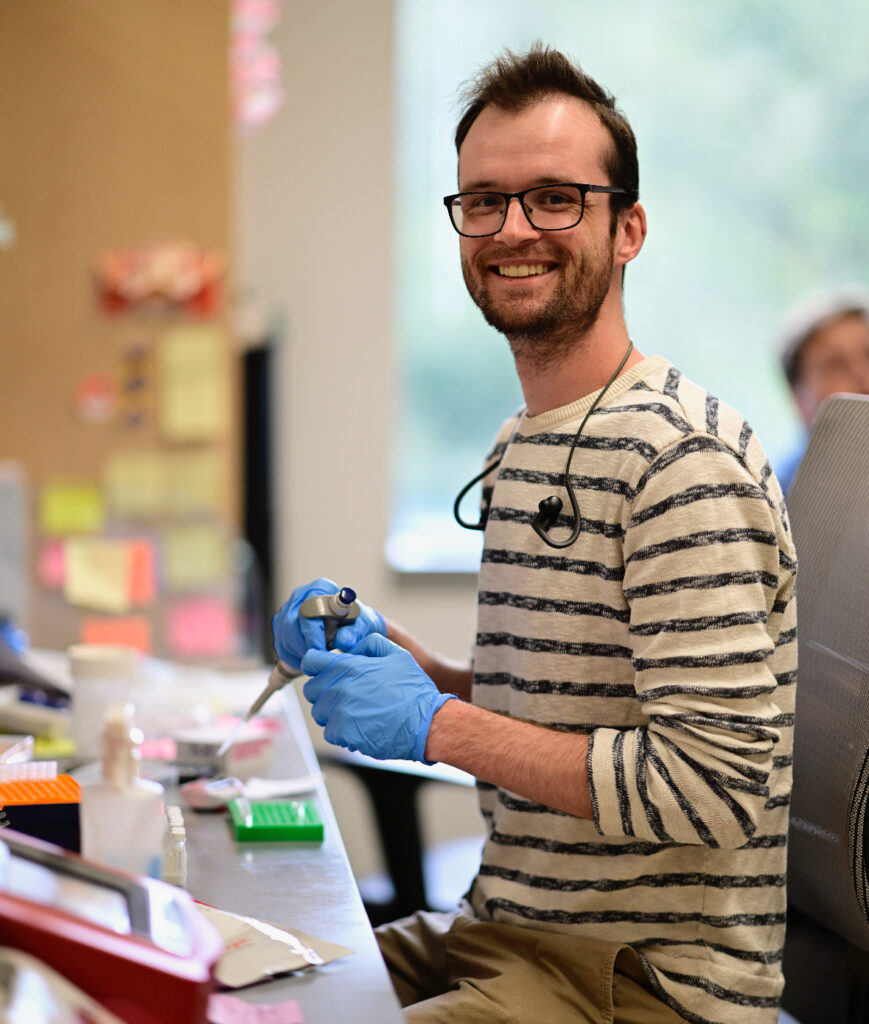
Olivia Miller-Johnson ’26 collects data for her summer research project on the intersection of social media content moderation and media bias. (Photo by Cassie Lathrope ’26)
Narrowing the lens
Miller-Johnson’s research focused on Meta CEO Mark Zuckerberg’s January 7 announcement of content moderation tactics. These changes included the removal of third-party fact-checkers and the replacement of the service with a “community notes” option.
Community notes enable users to share their thoughts and flag potential misinformation. Zuckerberg also announced a redefinition of Meta’s hate speech guidelines and an algorithmic shift in how political and social content is presented on the platform.
Miller-Johnson is most interested in how mainstream U.S. cable news networks covered this shift, and whether it exposes a particular political bias.
“We’re not really looking at Meta at all,” Miller-Johnson said. “What I’m doing is if you only watch CNN or you only watch ABC, what are you learning about this?”
Miller-Johnson’s analysis of U.S. mainstream cable news platforms has included Fox News, CNN, MSNBC, and commercial broadcast networks ABC, NBC, and CBS.
“She found a sort of outside source that indicated these are the news outlets that average Americans see as mainstream,” Gorissen said.
According to Gorissen, one of the most crucial first steps of Miller-Johnson’s research was narrowing her scope. Her initial plan was to include information from the last 20 years of Facebook and Meta platform history, which would have been difficult to complete within the project’s eight-week timeline, Gorissen said.
“Many of the early conversations we had were about really defining the scope of this project,” Gorissen said. “Narrowing down what it is we wanted to talk about, so that we didn’t go for breadth as much as for depth.”

Olivia Miller-Johnson ’26 (Photo by Cassie Lathrope ’26)
Impact of media framing
While conducting this research, Miller-Johnson specifically looked at the framing tactics employed by each mainstream news outlet when covering the policy shift. She examined how each journalist and broadcaster constructed their narratives when reporting on the story.
“We’re looking at it through what kind of frame are they employing when talking about it?” Miller-Johnson said. “Is it an economic frame? Is it a critical frame? Are they vilifying Meta? Are they vilifying Mark Zuckerberg? Is he a hero? How does that change over time?”
Miller-Johnson is also reviewing published research related to this topic to lay the groundwork for deciphering how framing affects the overall message of the stories and how to identify the different types of framing. Miller-Johnson said she is particularly interested in the language each network employed while covering the content moderation changes by Meta.
“If it’s conflict [framing], it’s pretty easy to decipher, because they’re going to try and hit one person versus another,” Miller Johnson said.
According to Gorissen, the goal of the research is not only to recognize these frames themselves but also to help viewers understand the differences in the content that they are consuming.
“I think the primary difficulty is that for a lot of people, they might not be all that aware of the biases that are embedded in news media,” Gorissen said. “Especially because in many ways we are taught this idea that news coverage is or should be objective. Capital O, Objective — which, of course, doesn’t exist realistically.”
The urgency of media literacy
As a student studying media who is interested in how content moderation and media bias intertwine with social media, Miller-Johnson remains optimistic. She admits there is no simple solution to polarization and the spread of misinformation, but she believes teaching media literacy is one of the best places to start.
“It’s one of the most important topics,” Miller-Johnson said. “We’ve seen the exponential growth of the internet, and seeing especially older populations and people who haven’t grown up with the internet struggle to understand how the algorithm can impact them in their social lives, in their emotional lives, and just like in the greater sense of the world.”
In the meantime, Miller-Johnson suggests that people learn to be more empathetic towards others and their beliefs, despite the current polarized political situation, because of the impact their preferred news outlet can have on their outlook.
“Sometimes, while it may seem on face value malicious, perhaps [it’s] not,” she said. “If someone isn’t being hateful towards you in their language, then there’s room for common ground, and we need to take that and talk through it.”

Olivia Miller-Johnson ’26 analyzes news content for her summer research project on social media content moderation and media bias. (Photo by Cassie Lathrope ’26)
Overcoming challenges
One of the requirements of the grant-funded research is that students must write and submit a report with their findings. This is Miller-Johnson’s first experience writing a lengthy academic research paper, but it’s a challenge she’s met with excitement. She’s also able to lean on her faculty mentor, Gorissen, for support.
Miller-Johnson said she hopes that her and Gorissen’s work will continue into the fall semester, with the ultimate goal of getting it published in an academic journal.
“I’m excited to have this be the foundation of potentially future research works because it’s a step in the right direction, and the analysis I do in this project can be used for future projects,” she said.
Miller-Johnson has also expressed gratitude for the opportunity to work alongside one of her professors.
“To be a part of a project that’s also going to be on his record feels like an honor,” she said. “And, it makes me excited for my own academic future.”

For all press inquiries contact Elizabeth Murray, Associate Director of Communications at Saint Michael's College.
Related News See more news