From Rerum Novarum to Nova Rerum: The Dignity of Work in the Age of Artificial Intelligence
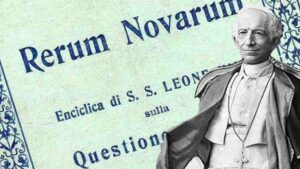 When Pope Leo XIII issued Rerum Novarum in 1891, he did so at a moment of profound economic upheaval. The Industrial Revolution was transforming society, displacing workers, and raising new ethical challenges about labor, capital, and the just organization of the economy. In response, the pope laid the foundation for modern Catholic social teaching. He insisted that workers are not merely instruments of production, but human beings endowed with inherent dignity. Their rights to a living wage, to form associations, to safe conditions, and to meaningful participation in the economy are not granted by employers or the state, but flow from their God-given humanity.
Today, we stand at the edge of another revolution, one no less transformative than the first. This time, the disruption is digital. Artificial intelligence (AI), with its capacity to simulate reasoning, automate labor, and make decisions at previously unimaginable speeds and scales, presents new and urgent moral questions.
Pope Leo XIV, in choosing his papal name, signaled that he sees the challenge of AI as a new social question, one as serious in our time as industrial exploitation was in his namesake’s. He explicitly linked his mission to that of Leo XIII, saying he chose his name to echo the Church’s historic commitment to justice, labor, and the defense of human dignity in moments of sweeping change (Address to the College of Cardinals, May 10, 2025).
From the beginning of his papacy, Pope Leo XIV has framed AI not just as a technological development, but as a spiritual and ethical watershed. His message is clear: AI must not be used to erode the dignity of work, marginalize the vulnerable, or concentrate power in the hands of a few. Instead, it must be directed toward the common good. As he emphasized—echoing Pope  Francis’s 2024 address to G7 leaders—“AI is above all else a tool.” As a tool, AI is morally neutral, taking on the character of the intentions of those who design and deploy it.
In the tradition of Rerum Novarum, Pope Leo XIV calls the Church and the world to discernment. The benefits of AI—personalized education, improved healthcare, streamlined labor—must be evaluated through the lens of integral human development. What matters is not merely what AI can do, but whether it helps human beings flourish in body, mind, and spirit. As Pope Leo XIV explains:
“For its part, the Church wishes to contribute to a serene and informed discussion of these pressing questions by stressing above all the need to weigh the ramifications of AI in light of the ‘integral development of the human person and society’ (Note Antiqua et Nova, 6). This entails taking into account the well-being of the human person not only materially, but also intellectually and spiritually; it means safeguarding the inviolable dignity of each human person and respecting the cultural and spiritual riches and diversity of the world’s peoples. Ultimately, the benefits or risks of AI must be evaluated precisely according to this superior ethical criterion.”
—Message of Pope Leo XIV to Participants in the Second Annual Conference on Artificial Intelligence, Ethics, and Corporate Governance, June 17, 2025
Pope Leo XIV’s vision is deeply aligned with DEI values. When the Church insists that AI’s impact be assessed through the “integral development of the human person and society” (see Pope Francis, Antiqua et Nova, January 14, 2025), it is calling for inclusion, equity, and respect for human dignity across all differences, echoing DEI’s pursuit of belonging and fair access for every member of our global family.
 His recent statement Antiqua et Nova (“Old and New”) offers a theological and philosophical framework for this moment. It reminds us that intelligence, in the fullest sense, involves moral and spiritual openness to truth—not just data processing. The document warns against confusing artificial intelligence with human intelligence, which includes conscience, responsibility, and a soul. No algorithm, no matter how sophisticated, can replace human discernment or moral responsibility.
In the Message of Pope Leo XIV to Participants in the Second Annual Conference on Artificial Intelligence, Ethics, and Corporate Governance, June 17, 2025, the pope also expresses deep concern for the young, especially for their formation in an age saturated with information but often thin on wisdom. With nearly unlimited access to data, today’s students are called not only to learn facts, but to integrate truth into their moral lives. In this light, the pope encourages intergenerational learning, the cultivation of wisdom, and the ethical guidance of youth toward a world shaped by solidarity and human-centered innovation.
At Saint Michael’s College, we find this vision both inspiring and urgent. As a Catholic liberal arts institution grounded in the Edmundite tradition, we are called to equip our students not just with technological literacy, but with the moral clarity to use it well. Pope Leo XIV challenges all educators, engineers, policymakers, and ministers to ensure that the age of AI does not become an age of diminished humanity. Rather, it must be a time when human dignity is protected, when wisdom tempers innovation, and when faith and reason work together to guide the future.
As the Church once rose to meet the upheaval of the industrial age with clarity and courage, so now must we meet the digital age. Today’s rerum novarum may well be artificial intelligence, but the Church’s response, guided by truth both old and new, remains rooted in the unchanging dignity of the human person.
If you would like to make a comment or ask a question, I can be reached at dtheroux@smcvt.edu. Let’s talk.

For all press inquiries contact Elizabeth Murray, Associate Director of Communications at Saint Michael's College.
Related News See more news