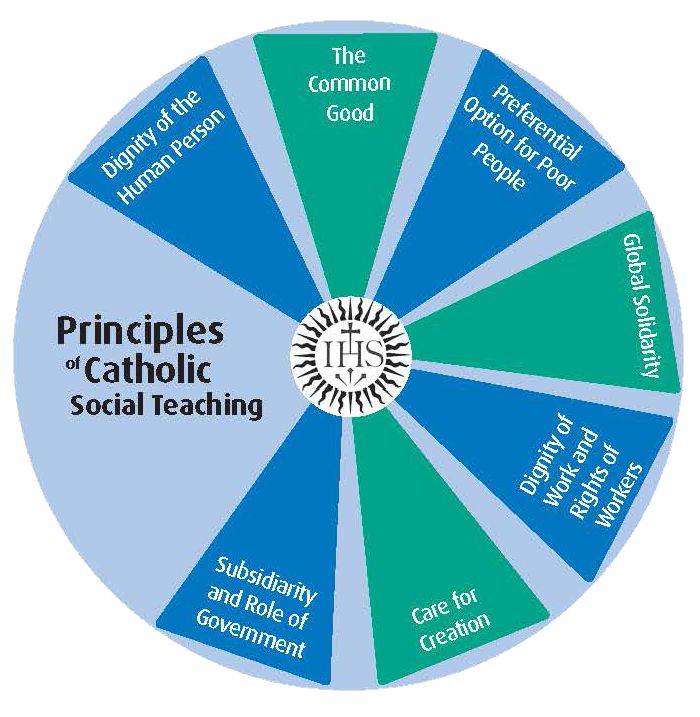
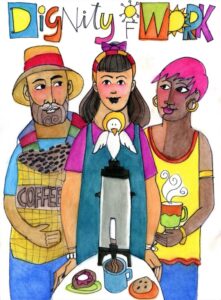
 At Saint Michael’s College, we are called not only to academic excellence but also to a moral and spiritual reflection on the pressing issues of our time. One such issue—central to Catholic Social Teaching—is the dignity of work and the rights of workers. This fifth principle of social justice invites us to see labor not as a mere economic transaction, but as a sacred participation in God’s ongoing creation.
The United States Conference of Catholic Bishops reminds us that “the economy must serve people, not the other way around. Work is more than a way to make a living; it is a form of continuing participation in God’s creation” (Seven Themes of Catholic Social Teaching, usccb.org).
This vision, both in the past and in contemporary society, has shaped Catholic responses to labor from the early days of industrialization to the rise of digital economies and artificial intelligence. In 1891, Pope Leo XIII issued Rerum Novarum, a groundbreaking encyclical that addressed the exploitation of workers during the Industrial Revolution. Pope Leo XIII noted that the condition of the working classes is the question which at that moment engaged the attention and the solicitude of the whole world, stating, “The momentous gravity of the state of things now obtaining fills every mind with painful apprehension (1).
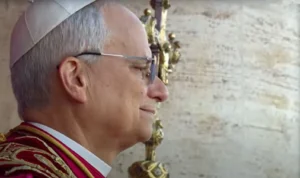
Pope Leo XIV (1955- )
More than a century later, Pope Leo XIV, in a May 10, 2025, address to the College of Cardinals, made clear that his choice of name honors this legacy. He acknowledged that we are facing a new industrial revolution, stating: “The Church offers to everyone the treasury of her social teaching in response to another industrial revolution and to developments in the field of artificial intelligence that pose new challenges for the defense of human dignity, justice and labor.”
These words carry special weight for educators and learners who engage with both the moral foundations and the technological frontiers of contemporary life. They remind us that whether someone works in a classroom, a dining hall, a laboratory, a business office, a custodial shift, or a digital environment, their labor possesses inherent dignity.
 Catholic Social Teaching insists that this dignity is best protected when certain core rights are respected. These include the right to productive and meaningful work, wages that are fair and sufficient to support a family, rest and leisure that allow for human flourishing, the right to organize and advocate collectively, the right to own property, and the right to engage in creative economic initiatives. These are not economic luxuries; they are moral imperatives rooted in our belief that every person is made in the image and likeness of God.
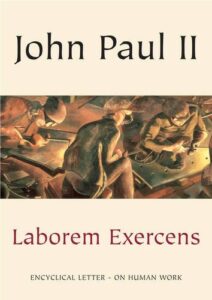
Pope John Paul II affirmed in Laborem Exercens, “Work is a good thing for man—a good thing for his humanity—because through work man not only transforms nature, adapting it to his own needs, but he also achieves fulfillment as a human being and indeed, in a sense, becomes ‘more a human being’” (9). In a notable passage from Fratelli Tutti, Pope Francis exhorts societies to prioritize the goal of access to steady employment for everyone, no matter the limited interests of business or dubious economic reasoning of politicians:
 What is now happening, and drawing us into a perverse and barren way of thinking, is the reduction of ethics and politics to physics. Good and evil no longer exist in themselves; there is only a calculus of benefits and burdens. As a result of the displacement of moral reasoning, the law is no longer seen as reflecting a fundamental notion of justice but as mirroring notions currently in vogue. Breakdown ensues: everything is “leveled down” by a superficial bartered consensus. In the end, the law of the strongest prevails (210).
These teachings resonate deeply with the contemporary pursuit of diversity, equity, and inclusion (DEI). DEI initiatives aim to ensure that all people, regardless of race, gender, background, or ability, have equal access to meaningful opportunities and are welcomed in a community of belonging. Catholic Social Teaching affirms that when we build inclusive workplaces, fair economies, and just systems, we honor the sacredness of human labor and promote the common good.
As a Catholic college, we are uniquely positioned to bridge reflection and action. We are invited to examine our own practices and structures. Do they reflect the dignity of work? Do they support the rights of all workers in our community? Do they prepare students to advocate for justice in the world they will shape?
Work is more than a paycheck. It is a way of becoming who we are called to be: co-creators with God, builders of community, and agents of justice. Let us continue to form minds and hearts that understand this truth, and to model institutions that live it, particularly our own Saint Michael’s College.
If you would like to comment or ask a question, I can be reached at dtheroux@smcvt.edu. Let’s talk!

For all press inquiries contact Elizabeth Murray, Associate Director of Communications at Saint Michael's College.
Related News See more news