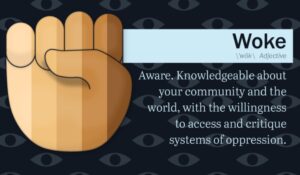
The word woke has in recent years been politicized, mocked, or misunderstood. But in its origin within African American experience, to be woke meant to stay alert to dangers in a world that was not neutral, where systemic injustice lurked behind seemingly ordinary events. To be woke was to be awake, not asleep to the reality of oppression. In this sense, early Christians, especially in the writings of Paul, were called to something remarkably similar.
The Wisdom of Black Experience
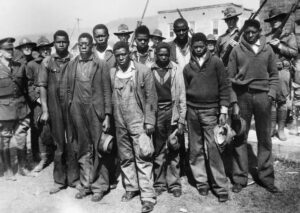
From left to right, the accused are: Clarence Norris, Olen Montgomery, Andy Wright, Willie Roberson, Ozie Powell, Eugene Williams, Charlie Weems, Roy Wright, and Haywood Patterson. Bettman / Getty Images
Ishena Robinson observes in “How Woke Went from ‘Black’ to ‘Bad'” (Legal Defense Fund, 2020) that the word woke first gained its resonance in African American communities. In the 1930s, singer Huddie “Lead Belly” Ledbetter warned his listeners to “stay woke” in a song about the Scottsboro Boys, nine Black teenagers falsely accused of assault on a train. His counsel was not metaphorical but a matter of survival: to be awake meant to be alert to the ever-present dangers of racism in courts, in policing, and in public life.
Over time, stay woke became shorthand for the vigilance necessary to navigate a world shaped by systemic injustice. It described the practice of reading the social landscape, discerning when a neighborhood was safe, recognizing how laws or customs carried bias, and passing on strategies of survival across generations. To be woke, in this original sense, was to be awake to the ways injustice was woven into the very structures of everyday life.
This communal wisdom bears striking resemblance to the way early Christians were urged to read the cosmos. Just as Black communities counseled vigilance in the face of a hostile social order, Paul called believers to recognize how the world around them—its values, hierarchies, and patterns of life—was not aligned with God’s reign.
Paul and the Corrupted Cosmos
Stephen Charles Mott notes that the Greek word cosmos, often translated simply as “world,” carried a much richer meaning (Biblical Ethics and Social Change, 2nd ed., 2011). In classical thought, cosmos meant order—the arrangement of society, the structures that gave life stability. But in the apocalyptic imagination of the early Christians, cosmos had become twisted. What  should protect life was instead complicit in death. Society’s ordering—its economy, politics, and class hierarchies—was not neutral. It was corrupted by values opposed to God.
Paul’s letters repeatedly warn Christians not to be naïve about this reality. “Do not be conformed to this world but be transformed by the renewing of your mind” (Rom 12:2). Evil was not only in individual acts of greed or lust; it was embedded in the very structures of society. As Ephesians puts it, the community once followed “the course of this world [cosmos], following the ruler of the power of the air” (2:2). In other words, they had been caught up in a current stronger than themselves—a system of distorted values shaping their lives.
To be Christian in the first century required something like being woke. It meant recognizing that the social order around you was not God’s order. It meant seeing clearly how wealth, power, and status masked deeper injustices. And it meant living differently, even when it was costly.
Catholic Social Teaching: Staying Awake
Source: Maya Sugarman/KPCC via the LAist story “The Audacity of Woke”
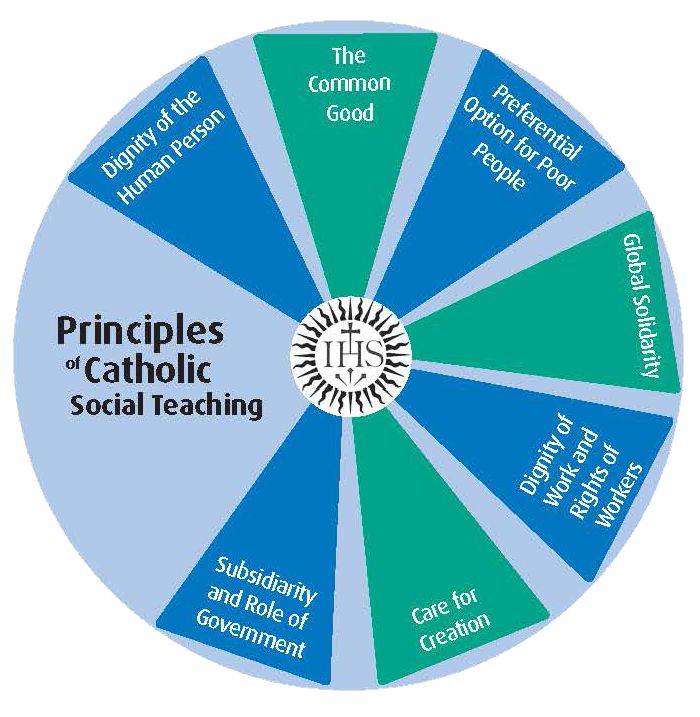
The Catholic principles of social justice echo this same ethical vigilance. To affirm the life and dignity of the human person is to recognize that any social order that treats some lives as disposable is a distorted cosmos (Gaudium et Spes, §25-32). To uphold the call to family, community, and participation is to resist systems that exclude and marginalize (Fratelli Tutti, §94–100). To defend the rights of workers is to challenge an economy that places profit above people (Rerum Novarum, §20; Laborem Exercens, §6). To pursue solidarity and the option for the poor is to stand woke to the ways wealth and status blind societies to the needs of the vulnerable (Centesimus Annus, §11; Evangelii Gaudium, §198). To promote care for creation is to recognize that ecological destruction is tied to distorted social orders (Laudato Si’, §49).
In each case, Catholic social teaching urges us not to drift uncritically along with prevailing cultural values. It asks us, like Paul, to refuse conformity to a corrupted order and instead live in the transforming light of God’s reign.
Awake Then and Now
Today, as in the first century, the temptation is to imagine that the world is fine as it is, that its “order” [cosmos] reflects God’s will. But both the Black tradition that birthed “stay woke” and the early Christian tradition that confronted the cosmos remind us otherwise. The world’s order often masks injustice. To be Christian is to be awake to this truth.
So perhaps Paul’s language can be heard anew in ours: Christians are called to stay woke. Not in the shallow, politicized sense the term has acquired, but in the deep ethical sense both Paul and Black wisdom affirm: to be awake to injustice, awake to God’s transforming Spirit, and awake to the possibility of a new creation breaking into the old.
If you would like to make a comment or ask a question, I can be reached at dtheroux@smcvt.edu. Let’s talk!

For all press inquiries contact Elizabeth Murray, Associate Director of Communications at Saint Michael's College.
Related News See more news