When we talk about inclusion today, whether in education, the workplace, or the wider culture, we often appeal to what is “universal.” We invoke universal human rights, universal values, or universal standards of fairness. These frameworks matter deeply, and they have supported justice movements across history. Yet the word universal carries a logic that is more complicated than it first appears.
The Problem with Universality
The Latin root of universalis (unum = one + vertere = turning) suggests a circle drawn with a compass around a single point. What lies inside the circle belongs; what lies outside is excluded. Universality, in this sense, is inclusive only up to a boundary. To define what counts as universal is also to define what does not count. As Daniel Horan observes, this logic of universality carries “a subtle note of negativity” (Catholicity and Emerging Personhood: A Contemporary Theological Anthropology, 2019).
 This matters for diversity, equity, and inclusion (DEI). When inclusion is framed in universal terms, it often moves in the direction of conformity. A company, school, or church may say: “Everyone is welcome here, as long as they fit our definition of what is normal, professional, or faithful.” The universal standard becomes the measure of belonging, and those who do not conform are subtly (or not so subtly) pushed aside.
We see this dynamic at work today in the U.S. Efforts to ban DEI programs in schools, corporations, and government are often framed as promoting a “color-blind” society. On the surface, color-blindness sounds like fairness: if we do not “see” race, then all are treated equally. But in practice, color-blindness simply sets the dominant culture—whiteness—as the unspoken standard. People of color are welcomed only insofar as they conform to that standard. Their histories, identities, and cultural expressions are sidelined or erased in the name of a supposed universal. This is precisely how the logic of universality excludes even while claiming to include.
The Value of Catholicity
The Christian tradition offers another way. From the earliest centuries, the Church described itself not as “universal” but as catholic—from the Greek katholikos, meaning “throughout the whole.” Ignatius of Antioch famously declared: “Wherever Jesus Christ is, there is the catholic Church.” His insight was that the fullness of the Church did not depend on conformity to one liturgical style, one cultural form, or one geographic center. Catholicity meant that wherever Christ is authentically present, the whole Church is present. The standard of belonging was not sameness but participation in a larger wholeness.
 That insight resonates today. Just as early Christians recognized the Church’s fullness wherever Christ was present, we are called to recognize human dignity and belonging wherever authentic identity is lived out. Catholicity, in this deeper sense, does not demand that all cultures or communities look the same in order to be part of the whole. Rather, it affirms that wholeness is revealed precisely through difference held together in communion and mutual respect.
This distinction between universal and catholic came alive in the Black Catholic Movement of the 1960s and 70s. As Matthew J. Cressler notes in Authentically Black and Truly Catholic: The Rise of Black Catholicism in the Great Migration (2017), many Black Catholics discovered that being Catholic did not mean surrendering their cultural identity, as had been the case for Black Catholics in their striving to belong and to be truly Catholic. Vatican II had emphasized that the Mass need not be celebrated in exactly the same way everywhere for the Church to remain one in Christ. That insight freed Black Catholics to embrace their faith in ways that were both authentically Black and truly Catholic. The spiritual songs, preaching styles, and cultural expressions of Black Catholics did not threaten catholic unity but deepened it, making room for an authentically Black faith that connected with both a long-standing faithfulness to the Catholic Church and the tradition of the Black Church in America.
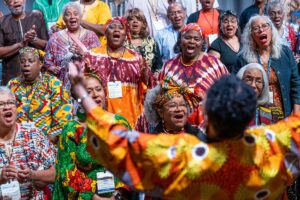 This is catholicity in action: a communion enriched, not diminished, by difference. Black Catholics did not need to conform to a single universal model in order to belong. Their authenticity became a gift to the whole Church. The gift that is the Black Catholic Church was duly noted by the Black bishops of the United States in “What We Have Seen and Heard: A Pastoral Letter on Evangelization by the Black Bishops of the United States” (1984) by their assertion that Black Catholics had something to say to the rest of the American Catholic Church. Rooted in the Black Catholic experience, the message of the Black bishops recounted how Black Catholics contributed through their unique spirituality and life experience a dimension of faith that enriched the whole of the Catholic Church.
Wholeness Includes Difference
For DEI conversations today, the lesson is clear. A “universal” approach to inclusion, whether through color-blindness or standardized norms, inevitably excludes. Catholicity reframes inclusion as the gathering of the whole. It does not begin with a standard by which people are measured as fit or unfit. It begins with the recognition that wholeness already includes difference.
Pope Francis illustrates this with the image of a polyhedron (Fratelli Tutti, 2020, no. 145). Unlike a sphere, where every point is equidistant from the center, a polyhedron has many faces, each unique yet together forming one whole. That is what catholic inclusion looks like.
For Catholic colleges and communities, this is a liberating vision. True inclusion is not about asking people to fit a universal mold. It is about recognizing that the whole is only whole when every person belongs as themselves. Catholicity teaches us that authenticity and communion are not opposites. They are the very conditions of belonging.
If you would like to make a comment or ask a question, I can be reached at dtheroux@smcvt.edu. Let’s talk!

For all press inquiries contact Elizabeth Murray, Associate Director of Communications at Saint Michael's College.
Related News See more news