St. Mike’s received more than $800,000 in funding this fall for science, the arts, and internships abroad
Saint Michael’s College is broadening its reach and providing more dynamic opportunities for students and the greater region, due to grant awards and partnerships announced this fall.
In all, the more than $800,000 in gifts will propel specific projects, and partnerships in the fields of biotechnology, biomedical research, and chemistry, as well as expand internships in Asia, and fund an art project on bee habitats.
“These grants and partnerships are more than individual achievements; they are powerful signals of where our future is headed,” said Ellen Kane, Saint Michael’s College Vice President of Advancement and Communications. “From expanding biotech career pathways in Vermont to opening global internship doors in Asia, from support for our new simulation lab to advancing biomedical research, contributing faculty expertise through cutting-edge industry collaborations, each investment affirms the growing impact and relevance of our college in the community and beyond.”
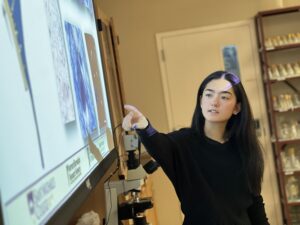
Melanie Winters ’25 points to a screen displaying a PowerPoint while presenting on findings related to neurodegeneration research she has been part of. (Photo by April Barton/Saint Michael’s College)
Science boost reaches further than the classroom
Saint Michael’s College has carved a wide path in the sciences – from a groundbreaking Alzheimer’s discovery, to a NASA project improving the health of astronauts, to being a leading lab working to understand a rare immunodeficiency. And, St. Mike’s is known for offering undergraduate students opportunities to conduct and lead scientific research and author scientific papers, with faculty mentorship.
Now, the College is augmenting science programs even more with pipelines that connect students and academic study directly to work being done at area companies and labs, creating mutually beneficial pathways that drive innovation and economic opportunity across the region.
The National Science Foundation awarded Saint Michael’s College $400,000 to build a biotechnology pipeline in Vermont. The foundation’s EPiiC (Enabling Partnerships to Increase Innovation Capacity) program, will help St. Mike’s identify, develop, and build structures to connect a broad network of partners across a regional innovation ecosystem that will work together on practical research while also sharing technology. St. Mike’s was one of four recipients of this award which lasts until 2028.
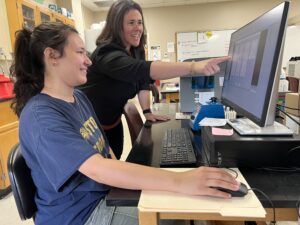
St. Mike’s Biology Professor Lyndsay Avery (standing) points at data while Olivia Goldfarb ’27 runs a report from the flow cytometer to pinpoint specific properties within cells. (Photo by April Barton)
“We have incredibly diverse and capable students right here in Vermont that can contribute to the growing biotechnology industry – they just need training and opportunity,” said Biology Professor Lyndsay Avery, who led the efforts to secure the grant. “At St. Mike’s, we have created a research-based curriculum that perfectly positions students for these lucrative and exciting jobs.”
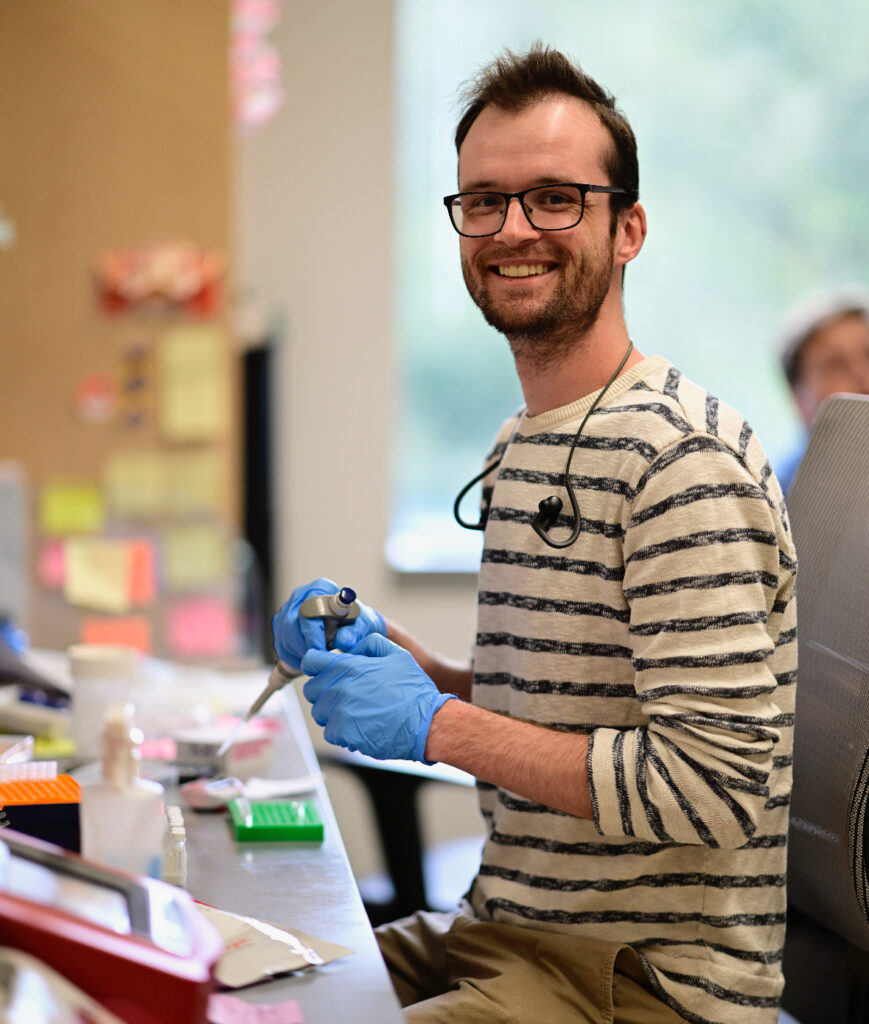
Some of that research curriculum Avery mentioned has been funded by the Vermont Biomedical Research Network (VBRN). VBRN disseminates federal dollars from the National Institutes of Health and this year is giving St. Mike’s $272,879, much of which will fund the research of about a dozen St. Mike’s science professors, and 12 students who are working with professors on that research. The money will also pay for equipment and supplies as well as grants access for St. Mike’s faculty and students to the University of Vermont’s Research Cores, which is a hub for specialty scientific equipment and labs shared across the network.
A collaboration between a Boston-area chemical research company and a St. Mike’s professor puts the College, and, by extension, its students on the cutting edge of the development of plant-based pharmaceuticals.
Saint Michael’s College Research Scientist in Residence, Mark Scialdone, is a recognized expert in Active Pharmaceutical Ingredients (APIs) synthesis and natural products chemistry, and he has invented and patented new classes of naturally-derived compositions. CitraChem Corp. has developed a chemical synthesis platform inspired by plant-based products that can be used to facilitate new drug discovery and development. CitraChem is subsidizing Scialdone’s salary while he carries out research, along with students, in St. Mike’s’ labs and is also making an unrestricted donation to the school.
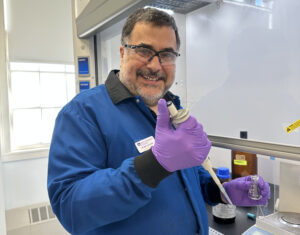
Chemistry Professor Mark Scialdone in the lab in fall 2025. (Courtesy Mark Scialdone)
Students get to help develop medicines that could be used to treat conditions such as cancer, immune disorders, traumatic brain injury, and neurodegenerative diseases like Alzheimer’s, and in addition, they could have the opportunity to intern at CitraChem’s facility in Norwood, Massachusetts and be considered for potential employment.
It’s a mutally beneficial partnership, according to CitraChem. “While our company planned to add personnel down the road, bringing on someone with Mark’s expertise to our team now means we can accelerate our ability to bring active ingredients to drug development companies and researchers,” said CitraChem’s CEO James Winokur. “That acceleration could really only happen because Saint Michael’s is actively looking for industry-sponsored programs, has the faculty, students, and chemistry department to support business needs, and is willing to tailor programs to the specific requirements of the sponsor.”
Increased funding means more students can have internships in Vietnam and South Korea
Saint Michael’s College received a $120,000 gift from the Freeman Foundation – the largest gift so far – for college students to complete summer internships at organizations in Asia. St. Mike’s has been a Freeman Foundation recipient since 2019 along with 33 other colleges and universities across the U.S. In St. Mike’s case, students have interned in Seoul, South Korea; Ho Chi Minh City, Vietnam; and Hong Kong. The mission of the foundation is to strengthen the bonds of friendship through an exchange of ideas and cultural experiences, promoting mutual understanding.
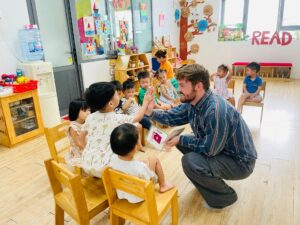
Jarrett Sweet ’25 gives a high-five to one of his students in Ho Chi Minh City, Vietnam, during an internship in summer 2024 funded through a Freeman Foundation grant. (Photo courtesy of Jarrett Sweet)
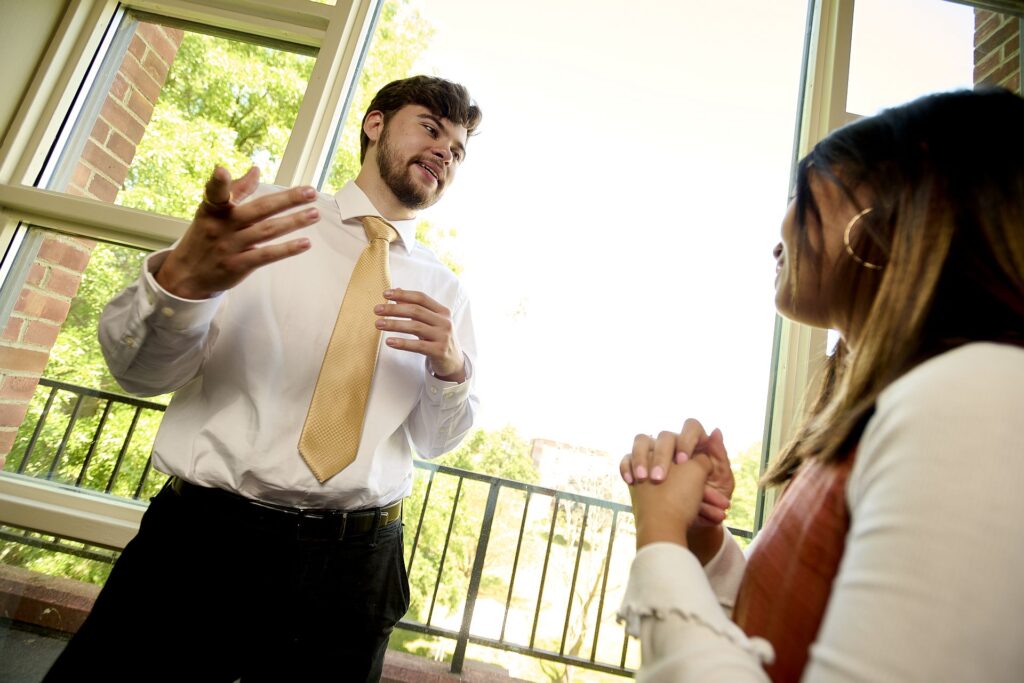
“These scholarships help Saint Michael’s students develop 21st-century workplace-relevant skills such as global and intercultural competency, leadership, professionalism, and communication across a wide range of academic majors and industries,” said Professor Jeffrey Ayres, Director of the Institute for Global Engagement at Saint Michael’s College. “These internships not only enhance a student’s career prospects, but they also advance the College’s liberal arts mission by contributing to the development of a well-rounded individual who is more confident, empathetic, curious, ethical, and adaptable – ideal for tackling the challenges facing us as a national and global community.”
Arts grant funds bee project and lands work in Museum of Natural History
Professor of Art & Design, Brian Collier, received a large – in art terms – and competitive grant for $5,000 from the Vermont Arts Council for his sabbatical project this fall. The creation grant funded materials, equipment, and a research travel trip to the Museum of Natural History in New York City, where he took photographs of some of the millions of bee specimens the museum has preserved. “Essential Strangers” is the name of the collection Collier is working on which resides at the intersection of art and ecology and seeks to educate and inspire people to respect and support native bees. In addition to photographs, ink and watercolor drawings, and sculptures, he also created circular native bee habitats – which are different from how honeybees live – on the grounds of St. Mike’s which are planned to be utilized for scientific observation.
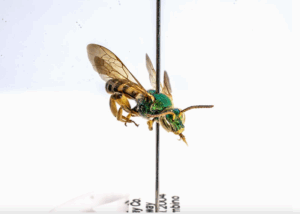
A picture of a Brown-winged Striped Sweat Bee taken by St. Mike’s Professor of Art & Design Brian Collier at the Museum of Natural History in New York City. The picture will be used as part of an exhibit Collier is creating entitled “Essential Strangers.” (Photo by Brian Collier)
An unexpected outcome of the project, the Museum of Natural History decided to incorporate Collier’s specimen photographs into their research photo archive.
“So my photographs from this project are going to be used partly for my artwork, but they’ll also be now a permanent edition to the photo archive collection at The Museum of Natural History for all time,” Collier said. “I’m a contributor to the research collection at the one of the oldest natural history museums in the world – which is super cool.”
Once he collects enough pieces, Collier plans to send out proposals to art and science galleries with the hopes of exhibiting his work. See what he’s been working on at https://essentialstrangers.briandcollier.net/

For all press inquiries contact Elizabeth Murray, Associate Director of Communications at Saint Michael's College.
Related News See more news