Toy Story: Panel of St. Mike’s alumni and toy industry professionals share experiences and advice
The path from college to a career is not always a straight shot. One might go to college hoping to go into the medical field, but instead, wind up working at Hasbro, like Tayla Reo ‘14.
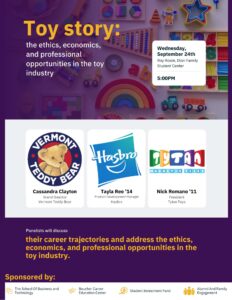
Reo and fellow alumni, Nick Romano ’11, along with a guest from Vermont Teddy Bear, Cassandra Clayton, came to campus on Sept. 24 to share their experience working in the toy industry. The panel was titled “Toy Story: The ethics, economics, and professional opportunities in the toy industry.”
During the discussion, moderated by Associate Professor of Business Administration and Accounting Paul Olsen, the panelists discussed their journey into the toy industry, the adversity they have faced, and any advice they had for the undergraduates in the room.
Reo, who came to Saint Michael’s on a pre-med track, but instead graduated in 2014 with a degree in English, entered the toy industry after exploring other career options after college. Upon graduation, she traveled to Mozambique as a global health volunteer in the Peace Corps – a path she said was in line with the St. Mike’s value of service.
“I was really interested in learning about the stories of the local people, and I would write that down and record them,” Reo said. “So, when I came back, I said I’m going to get my master’s in publishing because I loved to write and I loved reading.”
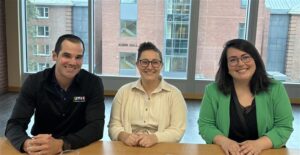
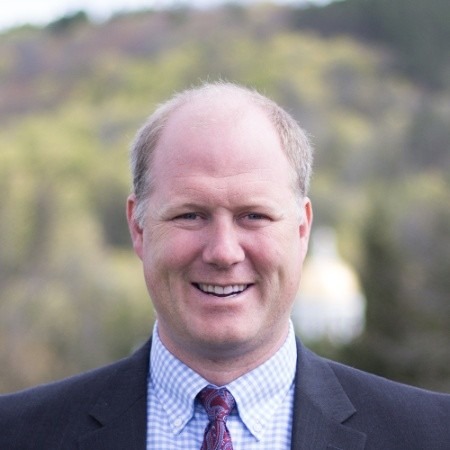
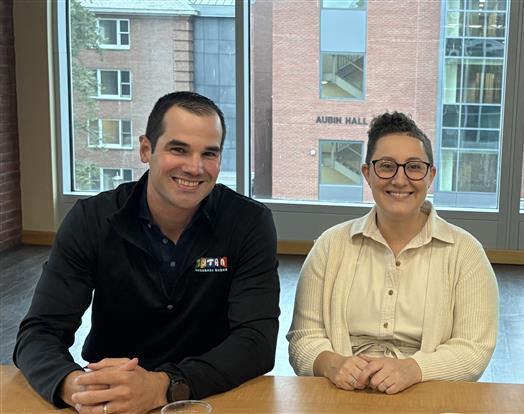
From left, Nick Romano ’14 of Tytan Toys, Tayla Reo ’11 of Hasbro, and Cassandra Clayton of Vermont Teddy Bear, served on a panel at Saint Michael’s College in September 2025. (Photo by Stephanie Snell)
Reo eventually found herself on the publishing team as a Product Development Manager at Hasbro, working with comics, magazines, books, and accompanying toys.
“It was a really roundabout way of getting into publishing and then breaking into the toy industry,” she said.
Fellow panelist Romano, who studied Business Administration at St. Mike’s and graduated in 2011, is now the President of Tytan Toys, a magnetic tile company. He began his post-grad career in the finance industry, working at John Hancock Financial for a year, and he later joined his family’s wholesale business before starting Tytan.
“Instead of selling someone else’s products to these retailers, maybe we should try to make and sell our own products,” he said, detailing his thought process.
Clayton, the sole non-alum on the panel, studied apparel and textile design in school before moving to Vermont as a designer for Pajamagram. She eventually made her way to Vermont Teddy Bear as a designer, then a lead designer, before being promoted to her current position as brand director, in charge of product development and overseas marketing.
Ebb and flow in the toy industry
 Like many businesses, the toy industry faces a number of challenges, from strict safety guidelines to economic uncertainty, including recent federal government tariffs.
“How do you develop a product that you know is going to be economically feasible over the long term when you don’t know what your cost of goods is going to be?” Romano posed, illustrating the conundrum toy manufacturers currently face.
Even Vermont Teddy Bear, which manufactures all of their products at their vertically integrated factory in Shelburne, faced struggles with tariffs.
“There are certain things that, even if you wanted to buy in the U.S. today, you simply can’t,” Clayton said. “So, we are forced to buy some of our base materials outside of the U.S. Even as a ‘Made in the USA’ company, we still find that we are impacted economically by tariffs.”
The industry outlook was much different just a few years ago. The toy industry experienced a boon during the COVID-19 pandemic, a time when most businesses were struggling. Romano noted that COVID is when Tytan Toys saw a huge bump in interest.
“In 2019, we got an opportunity to go into Sam’s Club. Then COVID hit, and it was like everyone was shopping at Sam’s,” Romano said. “Everyone was buying toys, and the brand really exploded. Then we got into Walmart. Today, we’re in over 10,000 stores in the U.S.”
Advice for the next generation
Undergraduates in the audience had the benefit of hearing – and asking for – advice from people who were in their shoes at one point. Many of them will soon be seeking employment in an ever-changing job market.
“My biggest piece of advice would be to send a handwritten thank you card after the interview, and reference one conversation you had,” Reo said. “That really shows people that you are paying attention, and that you’re interested.”
She added that it is important for prospective job candidates to know their goals and values and to thoroughly research companies during the application process.
“The job market is really hard right now. Laser focus on what you want and then go after companies that align with that,” Reo said, and “Once you do get the job, stay interested in people, and be open to experiences.”
The last piece of advice from Reo was to “be willing to admit a mistake.”
Both Reo and Romano urged students to be willing to admit to making a mistake or needing help. Failure and making mistakes, they said, is part of the learning process.
Romano encouraged undergraduates in the audience to show passion and determination during their own job hunts.
“When you’re coming out of school, they’re going to take a gamble to some extent on how you’re going to be in the workforce,” he said. “More than anything, you just want to see that there’s a drive there and that there’s a passion.”

For all press inquiries contact Elizabeth Murray, Associate Director of Communications at Saint Michael's College.
Related News See more news