 I recently attended a presentation on diversity, equity, and inclusion (DEI) by Emiliano Void, founder and CEO of nuwave Corporation, here at Saint Michael’s College. His presentation was one of the clearest I have seen on how DEI works and why it matters. He described DEI not as a set of slogans, but as a process that creates a more productive environment by cultivating psychological safety in the workplace (cf. Amy Edmondson, “Psychological safety and Learning Behavior in Work Teams,” Administrative Science Quarterly, June 1999, 350-383).
What struck me most was the way he described the progression: diversity is the reality, equity is the method, and inclusion is the outcome. That framework raised for me a larger question: how does this align with Catholic teaching on the human community?
Diversity as the Reality of Humanity
Void’s starting point is that diversity is fundamentally the reality of humanity. Every person is unique, with different physical traits, personality traits, gifts, and limitations. Diversity is not a problem to be overcome but the given condition of our existence together.
 Catholic theology offers a parallel insight. The medieval theologians often spoke of the diversity of creation as a reflection of the infinite depth of God’s creative power. Thomas Aquinas observed that “the perfection of the universe is due to the diversity of things” (Summa Theologiae I.47.1). No single creature could exhaustively express God’s goodness, so the variety of creatures together manifests something of God’s richness. Pope Francis makes a related point when he insists that “reality is greater than ideas” (Evangelii Gaudium, 2013, no. 231). Reality begins not with abstract sameness but with difference. Diversity, then, is the condition we share: the common ground of human life.
Equity as the Pathway
If diversity is the starting point, the question becomes: how do we live together across our differences? Here, Void makes a crucial distinction: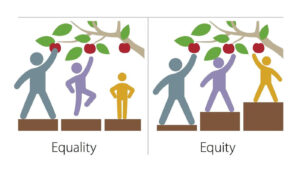 equality is not the same as equity. Equality assumes that everyone has the same needs and can succeed with the same resources. Equity, however, recognizes differences and seeks to provide what each individual requires in order to thrive.
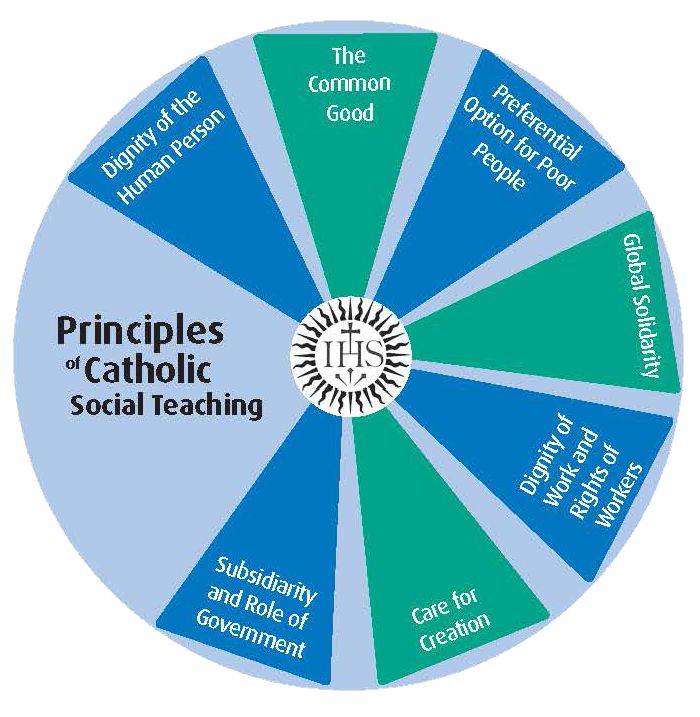
This resonates with Catholic Social Teaching. The principle of the common good insists that social arrangements must allow everyone to participate and flourish: “Every social group must take account of the needs and legitimate aspirations of other groups, and even of the general welfare of the entire human family” (Gaudium et Spes, 1965, no. 26). The preferential option for the poor acknowledges that those with fewer resources need particular attention, and the more fortunate should renounce some of their rights so as to place their goods more generously at the service of others (John Paul II, Sollicitudo Rei Socialis, 1987, no. 42 and 47). The dignity of the human person requires us to treat individuals not as abstractions but as persons in their concrete circumstances. In this sense, equity is a form of what the Catholic tradition calls justice. It is the method by which diversity is honored, and universality becomes possible.
Inclusion as Universality
 When equity is practiced, inclusion becomes possible. Inclusion means creating environments where people feel they belong, where psychological safety allows them to bring their whole selves into community and work, and so too thrive and succeed.
From a Catholic perspective, inclusion is another word for universality. The word “catholic” itself means “according to the whole.” The Church proclaims that all are called into the people of God, without exception: All people “are called to be part of this catholic unity of the people of God which in promoting universal peace presages it” (Lumen Gentium, 1964, no. 13). Bishop Robert Barron has noted that universality is an absolute goal, while diversity is relative (“Why Equity, Diversity, and Inclusivity Are Not Absolute Values,” November 4, 2021). Yet, I would suggest that universality cannot be achieved apart from diversity. To ignore diversity is to ignore the reality of creation itself. As Pope Francis reminds us, we must begin with reality and not with abstraction (Evangelii Gaudium, 2013, no. 231).
The vision here echoes Martin Luther King Jr.’s dream of a Beloved Community —a community of belonging rooted in justice. For Catholics, this vision is communion in Christ, where unity does not erase differences but brings differences into harmony (Pope Francis, Fratelli Tutti, 2020, no 280).
Conclusion
What Void described in his DEI model has clear resonance with Catholic theology. Diversity is the reality of creation. Equity is the path of justice that honors difference. Inclusion is the universality that the Church proclaims and seeks as God’s will for humanity.
DEI, understood in this way, is not a secular ideology opposed to Catholic faith, as some have proposed. Rather, it is a means of living out the Church’s call to universality in workplaces, schools, communities, and families. It is a path to psychological safety, community, and communion. Seen through Catholic eyes, DEI is not only valid but vital for building the people of God in our time.
If you would like to make a comment or ask a question, I can be reached at dtheroux@scmvt.edu. Let’s talk.

For all press inquiries contact Elizabeth Murray, Associate Director of Communications at Saint Michael's College.
Related News See more news