At this moment in American life, conversations about diversity, equity, and inclusion (DEI) are charged with controversy. Across the country, legislators, business leaders, and university administrators are reassessing or even retreating from DEI programs. Some state governments have passed laws restricting DEI offices or trainings in public higher education. Surveys show that while many Americans still affirm the dignity of diversity, they are increasingly skeptical of the effectiveness of DEI as it has been implemented.
For example, a 2024 Washington Post–Ipsos poll found that about six in ten Americans said DEI programs are a good thing for companies, and nearly seven in ten approved when DEI was defined in practical terms like recruitment and mentorship for underrepresented groups (Washington Post–Ipsos, 2024). Yet a 2025 AP–NORC survey reported that only about a third of Americans believed DEI reduces discrimination for women or Hispanic and Asian Americans, and only about four in ten thought it helps Black Americans. Many respondents felt DEI made no difference at all (AP–NORC, 2025). A Pew study confirmed this ambivalence: the percentage of U.S. workers who saw DEI at work as “mainly a good thing” dipped from 56 percent in 2023 to 52 percent in 2024 (Pew Research Center, 2024).
Meanwhile, faculty surveys show strong resistance to requiring “diversity statements” as part of hiring, reflecting concern about compelled speech and viewpoint diversity in academic life (Foundation for Individual Rights and Expression, 2024). Businesses, too, are cautious about speaking out on controversial social issues. In short, Americans are not rejecting pluralism itself, but they are wary of programs they perceive as coercive, ineffective, or overly ideological.
This national debate places Catholic colleges and universities in a challenging but also deeply meaningful position. Do we retreat from inclusion because the culture wars make it difficult, or do we bear witness to the Gospel and to Catholic Social Teaching, which call us to a more radical justice?
Our Mission and Vision
At Saint Michael’s College, our mission is “to contribute through higher education to the enhancement of the human person and the advancement of human culture in light of the Catholic faith.” Our vision commits us to being “an inclusive Catholic college” that equips students to “navigate the complexities of the modern world with skill, professionalism, and empathy.”
This mission and vision give us a clear compass. Even as public opinion shifts and external pressures mount, we remain rooted in the conviction that every human being is created in the image of God and called to flourish in community (Genesis 1:27; Second Vatican Council, Gaudium et Spes, §12). Our fidelity to this truth means we cannot step back from caring for those most at risk of being left behind.
The Catholic Difference
 The parables of Jesus illuminate this stance. In the story of the lost sheep, the shepherd leaves the ninety-nine to search for the one who has strayed (Luke 15:1–7). In the vineyard, the landowner pays all workers the same daily wage, no matter how long they labored (Matthew 20:1–16). The Good Samaritan extends mercy across boundaries of religion and ethnicity (Luke 10:25–37). The prodigal son is welcomed home not with suspicion, but with joy (Luke 15:11–32).
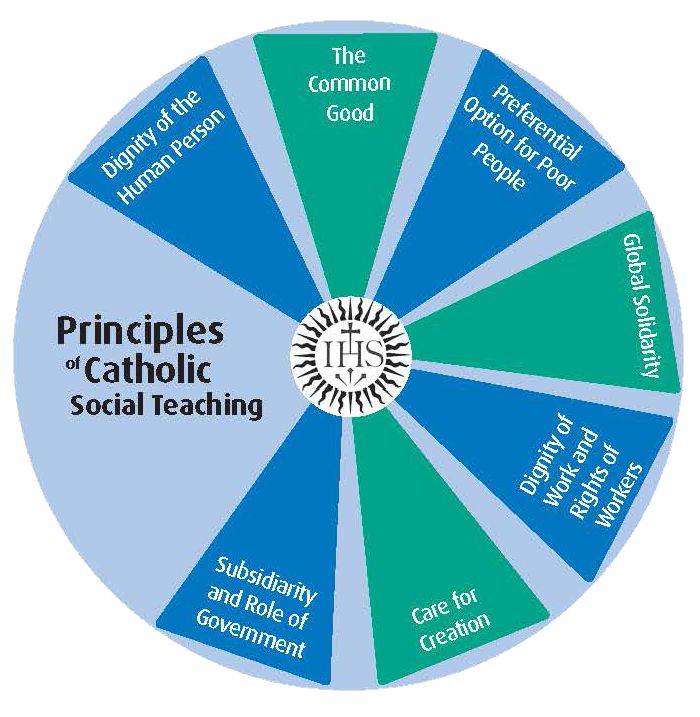
These stories reveal that God’s justice is not measured by arithmetic equality. It is measured by mercy, by attention to the vulnerable, by restoration of those excluded. Catholic Social Teaching names this the “preferential option for the poor and vulnerable” (Pope John Paul II, Centesimus Annus, 1991, §11; Pope Francis, Evangelii Gaudium, 2013, §199). As Pope Francis puts it in Fratelli Tutti, justice must be relational, never satisfied with neutrality when lives are diminished (Fratelli Tutti, 2020, §119–120).
For this reason, Catholic institutions cannot endorse a justice that is capped or rationed. We can, however, exercise prudence and stewardship. Resources are finite; strategies must be effective and sustainable. But the goal—the dignity and belonging for every person—cannot be compromised.
How We Respond
In this context, a Catholic college like Saint Michael’s can respond with both conviction and care:
 We affirm human dignity and the common good, recognizing that every person is a child of God. Thus, our community must reflect this truth in classrooms, residence halls, and offices alike (Gaudium et Spes, §26).
- We embrace academic freedom and dialogue; and we value inquiry and conscience. We reject compelled speech or ideological litmus tests, expecting at the same time charity, rigor, and respect in our conversations (Pope John Paul II, Ex Corde Ecclesiae, §12).
- We believe in effective practices, aligning our inclusion efforts with law and with evidence. We strive to make programs transparent, practical, and periodically reviewed, strengthening programs that work and reimagining those that do not.
- We practice universal fairness, while at the same time offering targeted support. We seek to improve processes that help everyone—clearer admissions criteria, accessible course design, transparent hiring—while also offering specific support for students who face persistent barriers.
- We practice subsidiarity when making decisions. Our community members, especially those most affected by exclusion, should help shape and evaluate our efforts. Inclusion is not something imposed; it is something created together.
- We measure what matters. We commit to tracking climate, retention, graduation, and belonging with the same seriousness that we track enrollment and finances. Data should guide stewardship.
A Witness for Our Times
Some in our nation now speak of the “typical American” or the “average American” as the standard against which others should be measured. Too often, this implicitly means “whiteness,”  middle-class cultural norms, or English as the only valid language of belonging. In the light of the Gospel, we know that God measures differently. God’s justice embraces the one on the margins of the flock, the one welcomed into the vineyard at day’s end, the one in need of healing along the road, and the one celebrated in the banquet of return.
As a Catholic college, we are called to witness to this justice—not justice that is measured by narrow averages, but justice that is ordered by mercy and solidarity. In a polarized moment, this stance may not please everyone. But it is faithful to Jesus Christ and to the Catholic principles of social justice.
Conclusion
Saint Michael’s College has always sought to prepare students to face the complexities of the modern world. Today, those complexities include cultural debates about DEI and pluralism. Our task is not to mirror polarization, but to model a more excellent way, grounded in human dignity, guided by the Gospel, committed to truth, and animated by mercy.
In doing so, we form graduates who can engage the world with skill, professionalism, and empathy—graduates who will not be afraid to embrace all people in their diversity and to measure their worth in terms of their uniqueness. This is who we are. This is who we are called to be.
If you would like to make a comment or ask a question, I can be reached at dtheroux@smcvt.edu. Let’s talk!

For all press inquiries contact Elizabeth Murray, Associate Director of Communications at Saint Michael's College.
Related News See more news