When Pope Francis released his encyclical Laudato Si’: On Care for Our Common Home in 2015, he did more than add another papal voice to the conversation about environmental responsibility. He reframed the entire issue—not as a side concern or technical challenge, but as a central moral and spiritual issue of our time. Laudato Si’ is not just an environmental document. It is a profound call to integral ecology, a vision in which care for the earth, justice for the poor, and inner peace are inseparably linked.
This blog explores the key teachings of Laudato Si’, the third part of a series on the Catholic Church’s growing commitment to care for God’s creation.
A Franciscan Title, A Universal Message
 The encyclical’s title comes from the Canticle of the Sun by Saint Francis of Assisi, the pope’s namesake and a model of ecological spirituality. “Laudato si’, mi’ Signore” (“Praise be to you, my Lord”) reflects the spirit of gratitude and awe with which Francis of Assisi approached the natural world, not as something to be used or feared but as a brother and sister to be loved.
This sense of kinship with creation permeates the encyclical. From the beginning, Pope Francis speaks of the earth as “our common home,” which is “like a sister with whom we share our life and a beautiful mother who opens her arms to embrace us.” However, he warns, this home is being disfigured and violated by human activity, and the most vulnerable are paying the greatest price.
The Ecological Crisis Is a Moral Crisis
Pope Francis makes it clear that the ecological crisis is not merely scientific or political. It is a moral crisis, rooted in human choices, shaped by values, and demanding personal and communal conversion. He identifies the “technocratic paradigm”—an overreliance on technology, control, and profit—as a driving force behind environmental destruction and social inequality.
The throwaway culture, he argues, affects everything: from how we treat consumer goods, to how we treat the poor, to how we treat the earth itself. This culture sees things—and often people—as disposable. It severs our sense of connection, dulls our conscience, and undermines our relationship with the Creator.
Integral Ecology: Everything Is Connected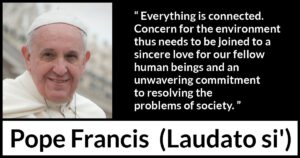
The central insight of Laudato Si’ is that everything is interconnected. Environmental, economic, social, cultural, and spiritual problems are not isolated. They are all symptoms of the same moral and spiritual disease: a failure to see the world as gift, as sacred, as shared.
This leads Francis to speak of integral ecology, which refuses to separate care for the environment from care for the human person. It insists that solving the ecological crisis requires addressing poverty, inequality, and broken relationships. Ecological sin is not just about polluting the water; it’s about ignoring the cry of the poor, exploiting the earth for short-term gain, and forgetting that creation is a communion of which we are a part.
Hearing the Cry of the Earth and the Cry of the Poor
One of the most powerful aspects of Laudato Si’ is Pope Francis’ insistence that we listen to both “the cry of the earth and the cry of the poor” (§49). These are not two separate cries; they are one. The poor are often the first and most deeply affected by environmental degradation: through rising sea levels, polluted air and water, loss of arable land, and climate instability.
Francis challenges developed nations to recognize their historical responsibility and to pursue environmental justice through international solidarity. He calls for structural change, political courage, and a new global economy that serves the common good rather than short-term profits.
Ecological Conversion and New Lifestyles
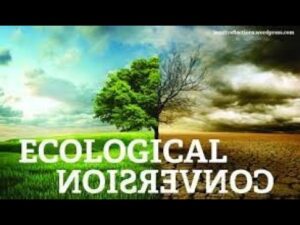 Laudato Si’ also invites each of us to ecological conversion: a spiritual renewal that changes not only how we see the world but how we live in it. Francis writes that “[l]iving our vocation to be protectors of God’s handiwork is essential to a life of virtue; it is not an optional or a secondary aspect of our Christian experience” (§217).
This conversion includes small everyday actions: reducing waste, conserving energy, reusing resources, buying less, supporting sustainable practices, and spending time in nature. These acts, though seemingly minor, cultivate gratitude, humility, and a deeper sense of connection with creation.
Francis also calls us to rediscover Sabbath and contemplation, to “recover a serene harmony with creation” (§225). In a fast-paced world, slowing down becomes an act of resistance and reverence.
A Call to Dialogue and Action
The encyclical does not offer simplistic solutions, nor does it claim the Church has all the answers. Instead, Pope Francis calls for a global dialogue between religions, nations, and generations. He insists that science and faith must work together and that all people of goodwill, not just Catholics, have a role to play in protecting our common home.
He closes with two prayers: one for believers and one for all people, inviting us into a spirit of hope and shared responsibility.
A Prophetic Wake-Up Call
Laudato Si’ is arguably one of the most prophetic documents of our time. It challenges the complacency of the powerful, exposes the illusions of consumerism, and opens our eyes to the sacredness of the earth. Yet it is also deeply pastoral—encouraging us, not condemning us, and inviting all of us into a more integrated, joyful, and just way of life.
As we reflect on this encyclical in the years since its publication, its relevance has only grown. The fires, floods, heatwaves, and rising seas are not abstract warnings. They are now part of our daily reality. And the Church is clear: our response is not only scientific or political; it is a matter of faith.
Caring for our common home is not a fringe issue. It is at the heart of what it means to be Catholic today.
If you would like to make a comment or ask a question, I can be reached at dtheroux@smcvt.edu. Let’s talk!

For all press inquiries contact Elizabeth Murray, Associate Director of Communications at Saint Michael's College.
Related News See more news