The Catholic Intellectual Tradition and Social Justice: An Antidote to Exclusion in Higher Education

 Critics often charge that higher education in the United States has become elitist and overwhelmingly progressive, fostering an environment where students who hold more conservative views feel the need to mask their beliefs in order to succeed. Surveys suggest that a notable percentage of students self-censor in classrooms, citing fear of social or academic repercussions (Samuel J. Abrams, “Self-Censorship on Campus Is Bad for Students,” Inside Higher Ed, April 26, 2021). Whether or not one agrees with the full scope of this critique, it raises a fundamental question for Catholic colleges and universities: how should institutions rooted in the Catholic Intellectual Tradition and Catholic principles of social justice respond?
The Catholic Intellectual Tradition (CIT) is not a partisan framework but a way of seeking truth that is open, dialogical, and grounded in faith and reason. One Jesuit resource, drawing on Monika Hellwig’s work, describes it as a “2,000-year-old ‘conversation’ between the Church and the world, a dialogue between the Christian community of believers and the culture in which it finds itself” (“Catholic Intellectual Tradition,” Jesuit Resource, Xavier University). Catholic education, then, should resist intellectual monocultures—whether progressive or conservative—by fostering genuine engagement across differences.
 Truth, Freedom, and Academic Inquiry
A core principle of the CIT is the unity of truth: all knowledge, whether from the natural sciences, the humanities, or revelation, ultimately points to the same divine source. John Paul II, in Ex Corde Ecclesiae, explicitly stated that the Catholic higher education “guarantees to its teachers and students the academic freedom so necessary to pursue and to communicate the truth without fear” (August 15, 1990, §12). This freedom is not relativism but a responsibility to seek truth within a community of mutual respect. If higher education is indeed struggling with ideological conformity, the CIT offers a corrective: truth is neither progressive nor conservative, but transcendent.
The Dignity of the Person and Intellectual Hospitality
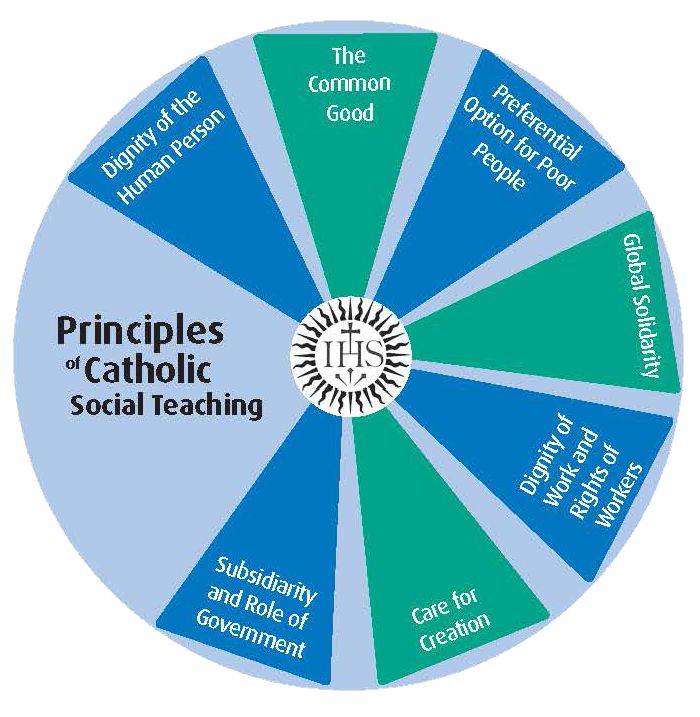
Catholic social teaching begins with the principle of the inherent dignity of the human person, created in the image of God (see Compendium of the Social Doctrine of the Church, Pontifical Council for Justice and Peace, 2004). Applied to higher education, this means that every student deserves respect and a fair hearing. The U.S. bishops, in To Teach as Jesus Did, explained that Catholic institutions must be places where faith and culture meet, where students learn not only to think critically but also to live responsibly and to respect the freedom and dignity of others (United States Conference of Catholic Bishops, 1972, §10). Intellectual hospitality—making space for perspectives that challenge one’s own—is one way of embodying this principle.
When Beliefs Cause Harm: The Limits of Dialogue
Respect for diverse viewpoints is at the heart of the Catholic Intellectual Tradition, but not all claims can be accepted on equal footing. Catholic social teaching insists that the dignity of every person is inviolable. Racism, anti-LGBTQ+ rhetoric, or any ideology that portrays others as inferior is incompatible with this dignity and cannot be treated as simply another side of the conversation (Compendium, §105).
Dialogue does not mean relativism. Pope Francis, in Fratelli Tutti, cautioned that “relativism always brings the risk that some alleged truth or principle will be imposed by the powerful or the clever upon the weaker” (October 3, 2020, §206). If harmful speech is allowed to masquerade as legitimate dialogue, it reinforces marginalization. A Catholic university or college is called to a delicate but necessary task: to foster honest disagreement while drawing clear boundaries against words or ideas that deny the humanity of others. The U.S. bishops underscored this priority in their pastoral letter against racism, declaring that “racism is a life issue” (Open Wide Our Hearts: The Enduring Call to Love, USCCB, 2018).
Thus, authentic hospitality requires two commitments: to listen with respect and to intervene when speech denies human dignity. Catholic higher education is not neutral ground; it is a community shaped by the Gospel call to justice.
Solidarity, Justice, and the Common Good
 Catholic teaching also stresses that human beings are social by nature and flourish in community. The Compendium of the Social Doctrine of the Church defines solidarity as “a firm and persevering determination to commit oneself to the common good” (§193). Within the academy, this means creating an environment where diverse voices can be heard and valued, but never at the expense of those already vulnerable.
Justice in the college context requires ensuring that all students can participate in dialogue without fear of reprisal. It also challenges faculty and administrators to examine whether classroom climates or curricula unintentionally marginalize. Francis, in Fratelli Tutti, explained that authentic dialogue “demands the capacity to respect the other’s point of view and to admit that it may include legitimate convictions and concerns” (§203). Such dialogue is not silenced but guided by the truth that every person is made in the image of God.
Conclusion: A Catholic Way Forward
If higher education is facing a crisis of elitism and ideological narrowing, Catholic institutions are uniquely positioned to model a better way. The Catholic Intellectual Tradition insists on the unity of truth, the dignity of the person, and the necessity of dialogue. Catholic social teaching adds solidarity, justice, and the common good. Together, they provide a framework in which no student should feel pressured to mask their beliefs, and no student should feel diminished by the harmful beliefs of others. By embodying these commitments, Catholic colleges can resist the homogenizing pressures of the wider academy and form graduates who are intellectually competent, morally grounded, and committed to justice.
If you would like to make a comment or ask a question, I can be contacted at dtheroux@smcvt.edu. Let’s talk!

For all press inquiries contact Elizabeth Murray, Associate Director of Communications at Saint Michael's College.
Related News See more news