Applying Catholic Social Teaching to Contemporary Issues: The Supports Families and Working Mothers Actually Need — Beyond Rights Talk
 American public life often argues about the U.S. Supreme Court in terms of whether it has expanded or protected “individual rights.” Some critics worry that, when rights language becomes the only moral vocabulary, it can unintentionally thin out the goods that make freedom livable, especially the stability of family life and the well-being of children. Catholic Social Teaching (CST) is helpful here because it affirms the reality of rights while insisting that rights must be situated inside a thicker account of the human person, the common good, and social responsibility.
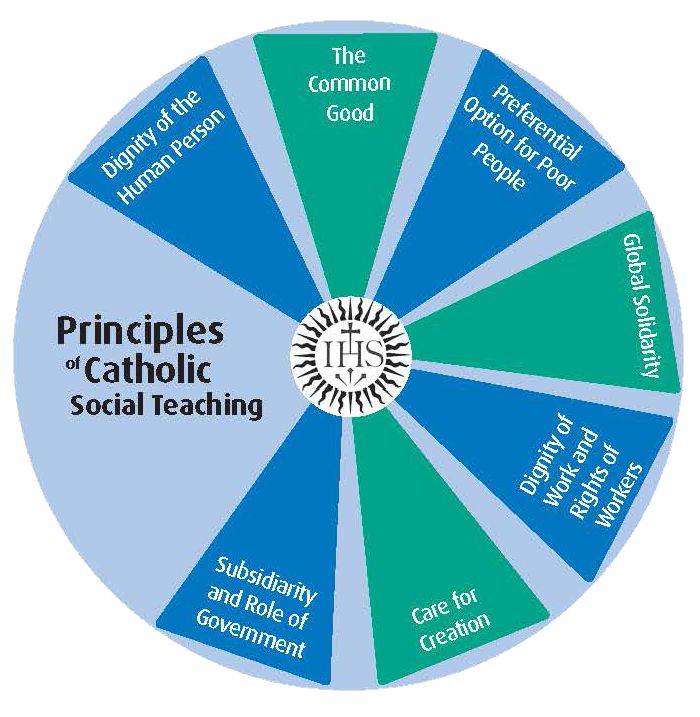
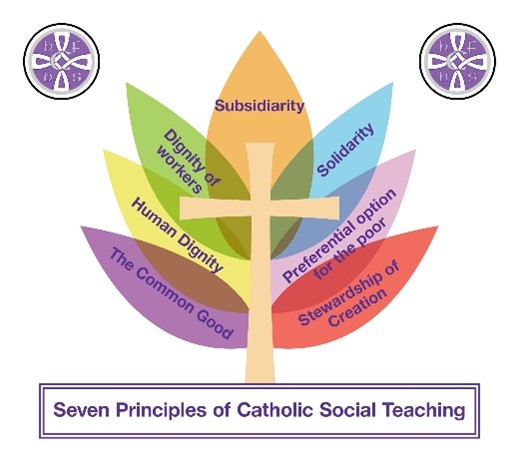
The U.S. Conference of Catholic Bishops summarizes the tradition with a deceptively simple line: the person is “sacred and social” (Seven Themes of Catholic Social Teaching | USCCB). That means dignity is not merely a private possession; it is something public life must respect and concretely support through social and economic arrangements. The bishops’ presentation of the Seven Themes places “Rights and Responsibilities” alongside “Call to Family, Community, and Participation” and “Dignity of Work and the Rights of Workers,” precisely to prevent rights talk from collapsing into isolated individualism.
This matters for debates about divorce and family fragility.  CST does not deny adult agency or the tragic complexity that sometimes surrounds marital breakdown. It does insist that children are never an afterthought. A society can be formally committed to adult liberties and still fail the common good if its legal and economic patterns make children bear predictable harm through instability, impoverishment, or the practical absence of a parent. The Charter of the Rights of the Family frames the family as a social subject whose rights and needs deserve public recognition and protection, not merely private concern (Charter, 1983). In CST terms, the core question is not only what adults are permitted to do, but also what the community is obliged to secure so that children and vulnerable family members are protected.
A parallel CST critique appears in debates about women’s equality and the workplace. For decades, American culture has often treated equality as women’s ability to succeed on terms modeled around a worker unencumbered by pregnancy, childbirth, or early caregiving. That framework can quietly communicate that fertility is a problem to be managed rather than a human good to be supported. Here is the thesis that should guide a CST-shaped conversation: Rights are real, but rights alone cannot bear the weight of human flourishing. A just society builds the conditions in which families can thrive, and women can participate in economic life without being forced to treat fertility as a problem to be managed.

Helen Alvaré, Robert A. Levy Endowed Chair in Law and Liberty, Antonin Scalia Law School, George Mason University
Images by Giovanni Portelli Photography © 2024
This is also where a well-chosen observation from Helen Alvaré fits. In a law review article examining claims that abortion advances women’s health and equality, she cautions against treating children as an entirely private obstacle that society need not accommodate. She writes: “They should not promote the notion that children are women’s private ‘burden,’ such that public and private actors are under no obligation to extend accommodations” (Nearly 50 Years Post-Roe v. Wade, 2022, 167). That sentence captures a key CST insight: freedom is not just having legal permission to choose, but also having the practical support that makes choosing family and welcoming new life genuinely possible.
The Church’s own social doctrine presses in the same direction with concrete policy implications. The Compendium of the Social Doctrine of the Church argues that societies should pursue “important social provisions” that make family life viable, including measures associated with a family wage, family supports, and recognition of the value of domestic work (Compendium, 2005, nn. 250-251). The Catechism of the Catholic Church likewise teaches that political communities have responsibilities toward family life, including social measures that assist families rather than leaving them to fend for themselves (Catechism, 2016, nn. 2209-2211).
In the U.S., these principles show up when the bishops speak in policy terms about the pro-family importance of parental leave and other supports. Notice what CST is doing: it is not simply repeating moral ideals about family, motherhood, or work. It is demanding that public life align with those ideals by building institutions that make them practicable. Paid leave, affordable childcare, fair scheduling, pregnancy protections, wages adequate for family life, and health care access are not optional perks in this framework. They are expressions of solidarity and of a serious commitment to the common good.
If we want a healthier civic argument, CST offers a disciplined reframing. Do not ask only, “What rights does the individual have?” Also ask, “What duties do we owe one another so that dignity is not merely asserted, but sustained?” When that second question becomes central, the conversation shifts from a culture that manages family and fertility as liabilities to a society that actively supports parents, protects children, and makes women’s equal participation in economic life compatible with welcoming new life.
If you would like to make a comment or ask a question, I can be reached at dtheroux@smcvt.edu. Let’s talk!

For all press inquiries contact Elizabeth Murray, Associate Director of Communications at Saint Michael's College.
Related News See more news