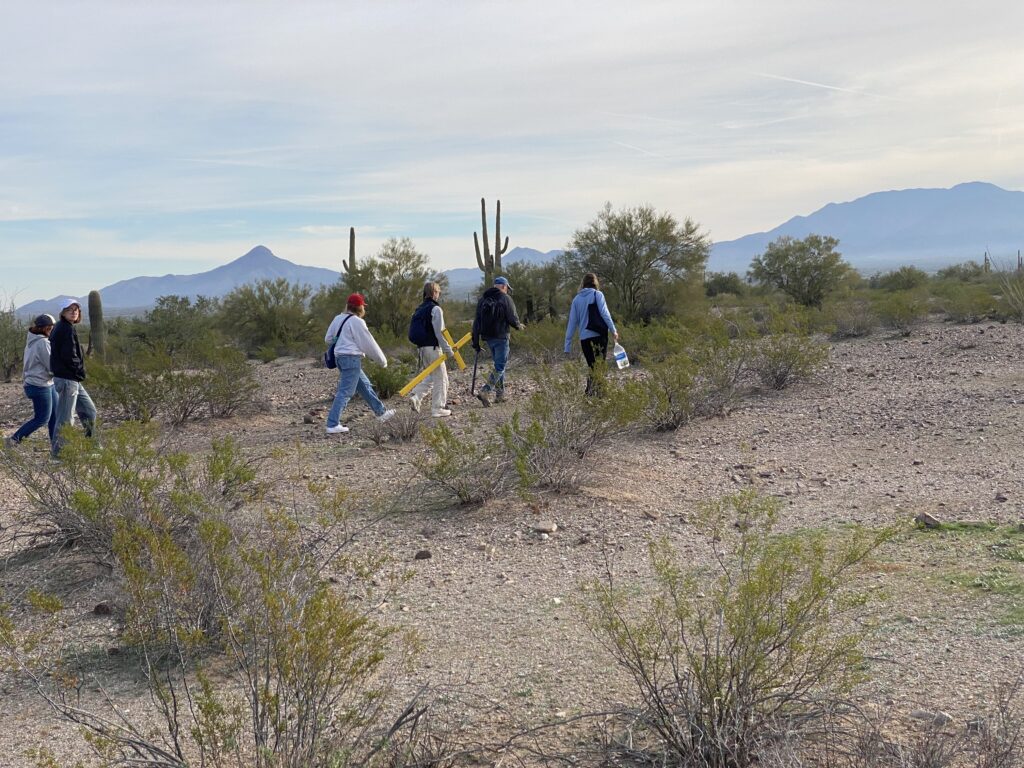
Just over two years after Saint Michael’s College students planted colorful crosses on campus in recognition of migrants who died while crossing the U.S.-Mexico border, a group of students, faculty, and staff traveling near the border this winter participated in a similar exercise – this time in the vast desert where migrants’ remains had been found.
The activity was one of the ways a group of 13 from St. Mike’s on a 10-day academic study trip explored the experiences of people who cross the southern border into the U.S. The trip, connected with the “Migrant Journey” class from the fall semester, was co-led by Allison Cleary, Professor of Digital Media & Communications, and Omara Rivera-Vázquez, Ph.D., Director of the Criminology program.
Saint Michael’s College students on a December 2025-January 2026 academic study trip to areas surrounding the southern U.S. border, with artist and activist Alvaro Enciso, walk to place a cross in the Arizona desert. (Photo courtesy of Professor Allison Cleary.)
The group joined artist Alvaro Enciso, who places crosses as memorials in the desert around Tucson, Arizona, for migrants who died on their journeys across the border. Some people are identified, while others remain unknown. Enciso previously visited the College in 2023 to share how the project dignifies the lives of those who might otherwise go unacknowledged.
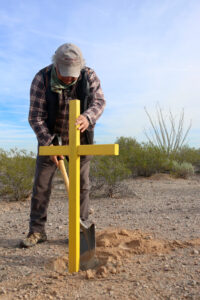
Alvero Enciso steadies the cross as he packs down the quick set cement that was poured around it. Every week, Enciso collects coordinates of where bodies have been found in Arizona’s deserts, and with his team from the Tucson Samaritans, plants a cross in the place they last stepped foot. (Photo by Olivia Miller-Johnson ’26)
The on-location experience this January drove home the importance of Alvaro’s work for participants. Evie Mercier ’26, a Sociology and Anthropology major, shared that experiencing this work firsthand was heavy, but incredibly poignant.
“All of these people were somebody’s sister, mother, brother, or uncle,” Mercier said. “Everyone deserves to know if their loved one is dead. Everyone deserves to be known.”
One of the main goals of the trip was to gain insight into the lived experiences of the immigrant community.
“I have been watching the news around immigration for years, and I have been concerned about how immigrants have been reduced to statistics and reframed as criminals and threats,” Cleary said. “Articles that go deeper and include details about individual people offer much more complex and human stories. Understanding those stories, and recognizing human dignity, was at the heart of the course and the trip.”
Planning for a difficult trip
The study trip ran from December 30, 2025, to January 8, 2026, but the idea flourished long before that when Cleary met Saint Michael’s alumna Mary Joan Picone ’87, a social worker who uses her vacation time to do service work along the southern U.S. border. Cleary first joined Picone at the border in March 2023.
“Funding from the Institute for Global Engagement allowed me to do a bit of an exploratory trip,” Cleary said. “It made me realize how much is happening at the southern border. I started to really think in terms of a concrete project or class.”
Professor Jeffrey Ayres, Director of the Institute for Global Engagement, said that these short-term study trips are an important contribution to the College’s dedication to global citizenship and internationalization, and are valuable experiences for students and faculty alike.
“Such trips provide structured, immersive, oftentimes more accessible international experiences supporting experiential, high-impact learning that encourages student acquisition of global and intercultural competency skills, builds important mentoring relationships between faculty and students, and provides faculty with opportunities for professional growth and curricular innovation,” Ayres said.
Cleary went to the border once more in December 2024, at which point she connected with BorderLinks, a nonprofit seeking to provide education on the causes and challenges of migration. BorderLinks later became a collaborator on the study trip.
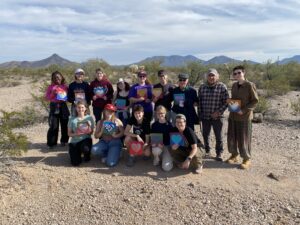
Saint Michael’s community members on a 10-day academic study trip from December 2025-January 2026 pose with artist and activist Alviro Enciso in the Arizona desert. (Photo courtesy of Professor Allison Cleary)
Cleary, at the suggestion of Vice President for Academic Affairs and Provost Gretchen Galbraith, then partnered with Professor Rivera-Vázquez, the Director of the Institute for Equity and Justice at the time, to begin mapping out a course.
“We wanted to connect the students to lived experiences,” Rivera-Vázquez said. “So students can see above and beyond the statistics that we hear so much about, and connect with human beings that are going through this. During our planning and many discussions, we were trying to figure out what the best framework to talk about these issues is, and we landed on Catholic Social Teaching.”
Catholic Social Teaching has seven core principles, all of which emphasize human dignity, social justice, and care for those most vulnerable. The principles, which are also at the heart of Saint Michael’s education and heritage, are: life and dignity of the human person; call to family, community, and participation; rights and responsibilities; option for the poor and vulnerable; the dignity of work and rights of workers; solidarity; and care for God’s creation.
These principles, Rivera-Vázquez said, ultimately aligned with the course’s overall goals.
Fr. Marcel Rainville, S.S.E., who is part of the group of priests that founded Saint Michael’s College, served as a guest speaker during the fall course, as he had spent 20 years of his career working in Caracas, Venezuela, at an Edmundite mission. Rainville also joined the group on the study trip.
“Fr. Marcel was such a wonderful addition to the group because he was really a student along with us, reminding us of the dignity of human beings and how we preserve that,” Cleary said.
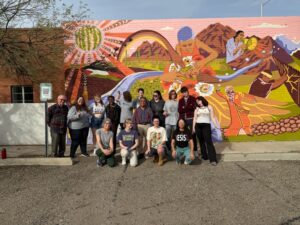
Saint Michael’s College community members pose for a photo in front of a mural during a 10-day academic study trip to Arizona and Mexico from December 2025-January 2026. (Photo courtesy of Professor Allison Cleary)
Creating access to an important experience
The trip’s planning, along with the trip itself, were learning experiences for everyone involved – especially when facing the few challenges that arose in the process.
For example, the initial cost estimates for the trip to the border – about $4,300 per person – seemed prohibitively expensive for some students.
“We worried not enough students would be able to participate,” Cleary said.
Thanks to funding from the Institute for the Environment, which recognized the trip’s connections to environmental justice, the trip’s ultimate cost was significantly lowered for students.
“Suddenly, it shifted from $4,300 to $300, which was an absolute gift to students who would otherwise not have been able to participate,” Cleary said.
Students dive in
In the end, 16 students joined the preparatory fall semester course, 10 of whom traveled to Arizona and Mexico on the subsequent trip. Students were from multiple academic disciplines, bringing their unique perspectives to the table.
Sarah Gardella ’26, a Criminology and Psychology double major, was among them. She is from Maine and intends to go to the University of Maine School of Law next year. Maine has been one of the states hit hard by U.S. Immigration and Customs Enforcement (ICE) activity.
“In Maine, we have Somalian refugees in different communities,” Gardella said. “I wanted to be more aware of the processes that they go through.”
Gardella said that legal services, particularly free or low-cost options, are needed in the immigrant community, and that is one she will be able to assist people.
“With letters we were writing to detainees, some people write you back like ‘Can I have legal advice?’ It’s seeing that need and hopefully being able to fill it later on,” Gardella said.
Mercier, a fellow senior, intends to attend graduate school to earn her master’s in social work, with a focus on bicultural/bilingual social work. Mercier was able to use her Spanish language skills while on the trip.
“I want to work with immigrant populations,” Mercier said. “It helped because I got a better sense of needs, what they want, and their aspirations.”
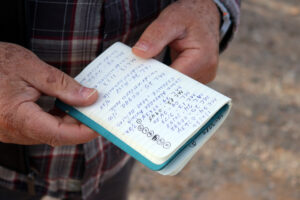
Artist and activist Alviro Enciso carries a notebook containing information about migrants, both named and unnamed, who died in the Arizona desert after crossing the southern U.S. border from Mexico. (Photo by Olivia Miller-Johnson ’26)
The trip began in Tucson, and the first few days included workshops including the long immigration timeline in this country, and a know-your-rights immersion. The group explored local landmarks, hiked through Saguaro National Park, and visited a local church where the sanctuary movement began.
The group was also able to explore the physical border in Nogales, Arizona. By day six, they had a view from the other side of the border in Mexico.
They met a variety of people throughout their journey, hearing firsthand a multitude of experiences. From a nun who founded a migrant shelter to a transgender immigrant in the asylum process who supports queer people being held at a detention center, and an older man working to preserve indigenous languages and traditions, different people sparked different conversations and new perspectives.
“The most impactful was hearing about the individual stories of people’s journeys, like seeking asylum, getting citizenship, getting travel visas,” Gardella said. “You just don’t think about it.”
Cleary said she and Rivera-Vazquez knew the stories that came up on the trip would sometimes be difficult to hear. At one point the group sat through a morning of court hearings where strings of young and old migrants, many of whom had hoped to seek asylum, were being charged with crimes for crossing the border without proper paperwork.
“This was not an easy topic for students to jump into. ‘The migrant journey borderlands experience’ – that’s not going to be all roses.”
Despite the many challenges and tough topics the group explored during its visit, it was the people who continually inspired the students, faculty, and staff.
“Within the actual programming, what gave me hope was just seeing the level of dedication so many people had,” Gardella said. “They were actively involved. It’s a thankless job in many aspects. There isn’t money there. These people are organizing and making noise.”
The group experienced many heavy sights and stories, but also witnessed migrants’ strong spirit and perseverance. One boy they met at a migrant shelter had lost his leg after falling from La Bestia, a freight train that migrants sometimes use to travel north from southern Mexico. However, the boy seemed to be living his life with joy.
“He was on the playground,” Mercier said. “He had done a race in a wheelchair, one of the volunteers there had pushed him, and they came in second. Community can blossom in really hard times; people just keep persevering and building connections. I think that’s really beautiful.”
The group found beauty in the resilience of the people they met, and support in each other. At the end of long, difficult days, Mercier often led her peers in a yoga practice, where they shared thoughts and reflections, and prepared to bring what they learned back to campus.
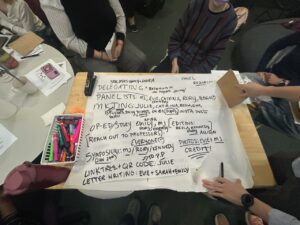
A large paper shows plans for spreading the word about what Saint Michael’s College community members learned during a 10-day academic study trip to Arizona and Mexico. (Photo courtesy of Professor Allison Cleary)
Coming home to Vermont
What comes after such a meaningful trip? For the students and faculty involved, the hope is that they can bring what they learned to the St. Mike’s community and beyond.
“We kept coming back to the fact that we are within 100 miles of a border,” Gardella said, referencing Saint Michael’s College’s proximity to the northern U.S. border with Canada. “We could travel anywhere as U.S. citizens. But if someone in Mexico wanted to come into this country, they would have to go to the U.S. Consulate, and go under rigorous interrogation, and maybe be granted a travel visa. The privilege we don’t realize we have was pretty eye-opening.”
The students had an action-planning session to discuss what they could do closer to home. Since coming back, they’ve been working to spread knowledge and create change in their own lives and communities.
One of their efforts was a panel on Jan. 23, which served as a reflection on the trip during the annual Dr. Martin Luther King, Jr. Convocation week.
“Now we’re trying to put together another panel about ICE, generally, and people knowing their rights,” Gardella said. “We’ve written letters to detainees. Just talking about it in class, and bringing it up out of context.”
The biggest takeaway – and the way participants believe they can help migrants’ stories resonate with others – is to humanize their experience.
“Once you learn how hard it is, you just kind of get it,” Mercier said. “Put yourself in those shoes, ‘what would I do?’”
The trip was also a learning experience for the professors leading the excursion. They were driven by mutual interests, a desire to help others explore beyond the headlines, and later recognized their students’ interest in and commitment to fostering change.
“It’s always so confirming to me what amazing students we have on this campus,” Cleary said. “More than anything, I have hope because students are interested in this. Our students are so thoughtful, informed by all the different classes they’re taking, and really committed to making a difference.”
While there are no set plans for another trip like this, organizers hope it can happen again. Students surveyed after the trip overwhelmingly said that they would recommend the experience to others. Cleary and Rivera-Vázquez also now have ideas for improving the trip next time.
In the meantime, though, they hope that this inaugural trip can bring a new lens to conversations on campus – and hopefully, humanize the experiences of the College’s own community members who may be affected by the country’s immigration policies and practices.
“I think that’s the hope, that we can begin to think about how do we provide better support to our own students, staff, and employees in our community who might be impacted by what’s going on in the country,” Rivera-Vázquez said.

For all press inquiries contact Elizabeth Murray, Associate Director of Communications at Saint Michael's College.
Related News See more news