Copy of – “In the Light of the Catholic Faith” as Intellectual Tradition: A Culture of Inquiry and Integration
It is the Mission of St. Michael’s College to contribute through higher education to the enhancement of the human person and the advancement of human culture in the light of the Catholic faith.
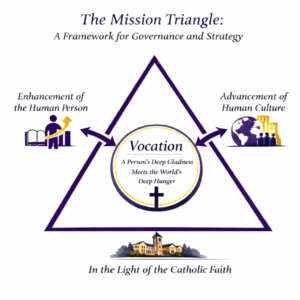 In the first three reflections, we explored the mission of Saint Michael’s College through the enhancement of the human person, the advancement of human culture, and the integrating role of vocation. Each of these dimensions depends upon the phrase that gives the mission its coherence and depth: “in the light of the Catholic faith.” For faculty, this phrase should not be understood as an additional feature alongside the other goals of the College. Rather, it is the binding and underpinning principle that gives them unity and meaning — the intellectual and moral horizon within which formation and cultural engagement take place.
To speak of Catholic identity in this way is to speak of an intellectual tradition, not simply a religious affiliation. The Catholic Intellectual Tradition is a centuries-long conversation about truth, reality, meaning, and human dignity. It is grounded in the conviction that faith and reason belong together, and that the pursuit of knowledge is enriched when disciplines are brought into dialogue rather than kept apart.
John Henry Newman gave one of the most influential accounts of this vision in The Idea of a University (1852). Newman argued that a university is a place where all branches of knowledge belong together because truth is one. In that context, theology is not an optional addition. It fills out what is lacking when knowledge is confined to isolated disciplines and serves as a point of integration, helping the university see the whole rather than only the parts. Without theology, Newman warned, the intellectual project risks becoming fragmented, unable to ask the deeper questions about meaning, purpose, and human destiny that give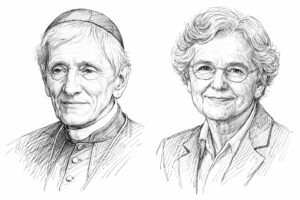 knowledge its full significance.
This does not mean that theology dominates the other disciplines. Rather, it stands alongside them, contributing its own methods and insights, and helping to ensure that the university remains attentive to the fullest range of human questions. In this way, theology helps hold together the intellectual unity that makes education more than technical training.
Monika Hellwig described the Catholic Intellectual Tradition in similar terms (“The Catholic Intellectual Tradition in the Catholic University,” Examining the Catholic Intellectual Tradition, 2000). She emphasized that Catholic higher education is marked by a habit of integration, a way of bringing together faith, culture, and academic inquiry into a coherent vision of reality. The tradition does not impose ready-made answers on every field of study. Instead, it provides a horizon of meaning within which inquiry unfolds. It invites faculty and students to consider how their work relates to questions of dignity, justice, responsibility, and the common good.
Importantly, this conversation is not limited to Catholics alone. The Catholic Intellectual Tradition has always welcomed participation from people of different Christian communities, other faith traditions, and those who do not identify with any faith. What binds the conversation together is not uniform belief, but a shared commitment to the search for truth. Each voice contributes insight, critique, and perspective. The tradition becomes a living dialogue in which scholars from many backgrounds engage fundamental questions about human flourishing and the nature of reality.
 In that dialogue, the Catholic Church does not simply speak; it also listens and learns. The tradition grows stronger as it tests its intellectual stances in conversation with the insights of other faiths and with the questions raised by those who claim no faith at all. Such encounters can clarify assumptions, deepen understanding, and sometimes lead to new insights. In this way, the Catholic Intellectual Tradition remains dynamic rather than static, faithful to its sources while open to the ongoing work of discovery.
Scripture itself models this posture of engagement. The First Letter of Peter calls believers to be ready to give an account of the hope that is in them (1 Peter 3:15), suggesting reflection and dialogue. Saint Paul’s encounter with philosophers in Athens (Acts 17:22–28) shows a willingness to enter into intellectual exchange with those outside his own tradition, drawing connections between faith and the deepest questions of human existence.
For faculty, then, to teach “in the light of the Catholic faith” is not to add a layer of religious content to academic work. It is to participate in a culture of inquiry where knowledge is pursued with the conviction that truth matters, that human dignity is real, and that learning carries moral significance. It means helping students see connections across disciplines and encouraging them to ask the larger questions that give their studies meaning.
Within the mission as a whole, this intellectual tradition holds together the other two dimensions. It shapes the enhancement of the human person by inviting students into a lifelong search for wisdom, not just information. It guides the advancement of human culture by grounding professional and civic life in reflection, responsibility, and concern for justice. In this way, “in the light of the Catholic faith” is not an additional goal alongside formation and cultural contribution. It is the foundation that makes both possible and gives them direction.
To educate in this light is to cultivate a community where inquiry is welcomed, disciplines remain in conversation, and the pursuit of truth becomes a shared task that unites teaching, learning, and the life of the College.
If you would like to make a comment or ask a question, I can be reached at dtheroux@smcvt.edu. Let’s talk!

For all press inquiries contact Elizabeth Murray, Associate Director of Communications at Saint Michael's College.
Related News See more news