Healing communities: MLK Convocation speaker talks environmental justice, community building in nurturing our ‘World House’
Saint Michael’s College is celebrating its 34th annual Dr. Martin Luther King, Jr. Convocation with a full week of events and experiences, starting on Dr. Martin Luther King Jr. Day and continuing through Jan. 23.
This year’s theme is “The World House: The Interrelatedness of All Things,” inspired by Dr. King’s last book Where Do We Go From Here: Chaos or Community?
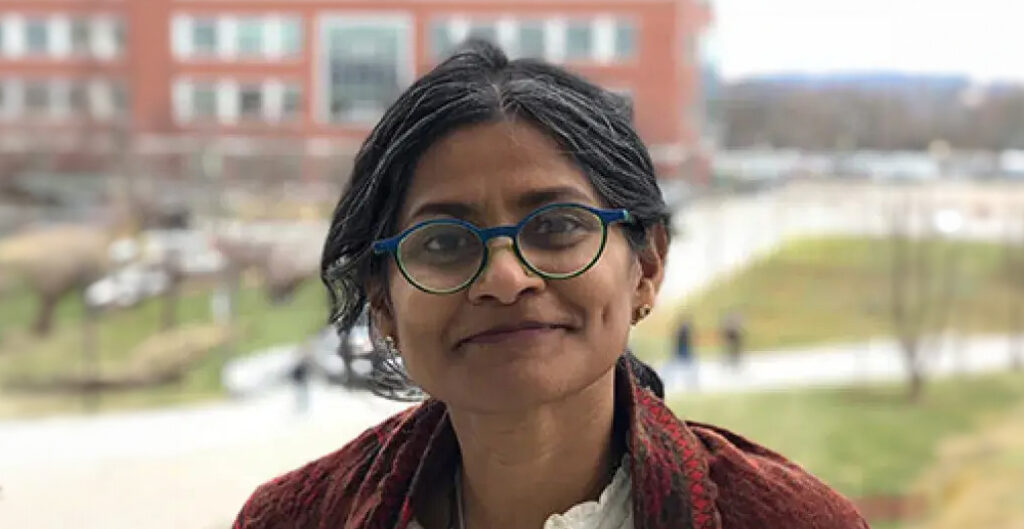
This year’s keynote speaker is Bindu Panikkar, associate professor at the Rubenstein School of Environment & Natural Resources at the University of Vermont.
Her address is titled, “Tuning into our Communities: Improving our Collective Sensibilities of Humility, Care, and Relationality.” The talk, which is free and open to the public, will happen Monday, January 19, at 5 p.m. in the Roy Room in Dion Family Student Center.
We asked Dr. Panikkar some questions in advance of her talk. Get to know her – including her areas of expertise – and a little about the subject matter she’ll speak about through the Q&A below. Dr. Panikkar’s answers have been edited for length and style and reflect her own views and expertise.
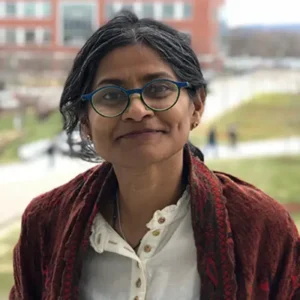
Bindu Panikkar, Associate Professor for the Rubenstein School of Environment & Natural Resources at the University of Vermont. Panikkar will provide a keynote address entitled: “Tuning in to Our Communities: Improving Our Collective Sensibilities of Humility, Care and Relationality” during the 34th annual Dr. Martin Luther King, Jr. Convocation at Saint Michael’s College.
Saint Michael’s College: This year’s Convocation theme is The World House: The Interrelatedness of All Things, inspired by Dr. King’s final book, “Where Do We Go From Here: Chaos or Community?” How do you feel your scholarship and expertise relate to the overall theme?
Bindu Panikkar: Thank you for giving me the opportunity to revisit Dr. King’s last book and to reflect on this important issue on, “Where Do we Go from Hhere: Chaos or Community?”, the most pertinent thing to reflect on at this contemporary moment. Revisiting this book has been a solace for me to better understand this moment we are living through.
Each day, it feels like something traumatic and heart-wrenching is happening in this country. We seem more divided than ever. We are in shock at the turn of events over the past year, and the loss of civil rights in one sweep of executive order after another – concerning immigration, civil rights, healthcare, and the environment.
One of the first moves that the administration made since coming to power was to shutter the Office of Environmental Justice and Civil Rights at the Environmental Protection Agency. All federal agencies were directed to end all Diversity, Equity, Inclusion (DEI) and accessibility offices and programs and to remove all related materials from their websites. Even private institutions and universities have been discouraged from pursuing DEI initiatives and threatened with funding cuts if they don’t comply. These policies have erased what the environmental justice, civil rights, and the Black Lives Matter Movements have struggled to build over the past thirty years. And it punishes people who speak out and peacefully protest these monstrous policies that criminalize innocent people.
So, where do we go from here: build community or live in chaos? This is the most crucial theme for humanity now. This is something that each and every one of us should reflect on. Do we react with fear and hatred, or do we respond compassionately towards building peace and unity? I do not have answers on how to get there. Perhaps we can get there only through love and compassion, but this is not something that they teach us in schools. Racism, capitalism, materialism, and militarism divide us. We have only learned to identify divisions rather than respond to them.
SMC: You are a UVM professor in the Rubenstein School of the Environment and Natural Resources. Do you believe environmental justice (EJ) and social justice are related concepts? If so, can you describe how they complement one another and how they may be connected to the broader concepts Dr. King espoused?
BP: I work at the intersection of environmental justice, environmental health, and science and technology studies. I have been working on environmental justice (EJ) issues for the past 20 years. As an environmental health student, I started working on EJ based on the realization that the environmental and health problems that we face in the world cannot be addressed without also addressing inequities, because the people who are the most impacted by the environmental and health problems or our technocratic approaches are the low-income, communities of color, especially our Black, Latinx and indigenous brothers and sisters in the country.
When I came to Vermont, I wanted to continue examining EJ issues in the state. I was surprised to find that Vermont was one of the few states that did not have an EJ policy. So, this became the first task I tackled. I started a community-based participatory research project working in collaboration with community partners such as Toxics Action Center, Slingshot, Center for Whole Communities, and CVOEO, as well as VT Law School, and the State. We did door-to-door surveys, interviews, and listening sessions across the state. What we found was not surprising, and that Vermont was not an exception. There are widespread environmental and health disparities in this state as well. Communities of color have known this all along, but our work contributed to the passing of the first EJ policy in the state.
EJ is never one issue; it is a maze of interconnected issues of health, transportation, housing, food, employment, etc. Even Dr. King recognized that environmental and social justice are interlinked when he showed up to support the Memphis sanitation workers. Dr. King marched with 1,300 mostly Black sanitation workers demanding better wages, safer working conditions, and union recognition after two of their colleagues, Echol Cole and Robert Walker, were crushed to death by a malfunctioning truck. The first EJ summit, the National People of Color Environmental Leadership Summit held in Washington, D.C in 1991, also recognized this. They defined the environmental issues affecting the people of color to include worker safety, land use, public health, transportation, housing, resource allocation, and community empowerment.
While it is easy to reduce EJ to particular definitions, facts, numbers, theories of (distributional, procedural, and recognitional) justice, or as the norms of economy, or instrumental policy means, we should not forget that justice is inherently about values and the way we order things and structure hierarchies. EJ lies at the intersection of political power, poverty, and pollution. It is about power and powerlessness and underscores an unequal present. The process and politics of meaning-making are what make EJ continually relevant. People must identify the environmental justice issues they are grappling with to make EJ relevant and make meaningful contributions. EJ, in the end, is about yearning for a better future for all and creating a healing path forward for the communities that have been left out and left behind.
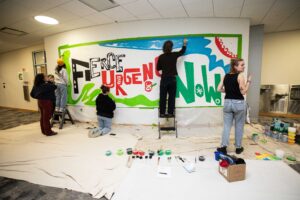
The Fierce Urgency of Now community mural, which was painted to reflect the theme of the 2024 Annual Martin Luther King, Jr. Convocation at Saint Michael’s College. (Photo by Cat Cutillo)
SMC: In the synopsis we have, your talk will focus on humility, care, and relationality. Why did you choose these three concepts? What is it about these areas of community building that you think is important for young adults to address in today’s social climate?
BP: There is an old Sanskrit saying from the ancient Indian text, Hitopadesha, “Vidya dadati vinayam” which translates to “true knowledge bestows humility.” That is, true wisdom makes an individual realize the vastness of the universe and how little we actually know, leading to humbleness and an absence of ego. This is not a literal statement but a profound ethical principle that outlines the path to a meaningful and fulfilled life, where, with humility comes worthiness, prosperity, righteous deeds/actions, and happiness. The verse suggests that the ultimate goal of acquiring knowledge is not pride or arrogance, but a deep sense of modesty and discipline.
Humility in Sanskrit means vinamrita. The verbal root of vinamrata means “to bend,” “to bow,” or “to yield.” In Sanskrit, humility is often explained with the analogy of a fruit-laden tree: “just as a tree heavy with ripe fruits bends toward the ground, a person truly enriched with knowledge remains grounded and humble.” The Sanskrit root here emphasizes a quality of being, of bending, stretching, yielding, and producing. It embodies flexibility in relation to the environment. It recognizes our limitations, acknowledges our interdependence, and values the contributions and knowledge of others, especially our ancestors. It is also the willingness to learn and be changed through relational encounters. On the other hand, the Latin root of the word humility comes from humus, pertaining to earth, soil, ground, and implying an existence of being grounded, being of the earth, and an awareness of our place within a larger world. Together, they hold a continuum of meanings.
Humility in relations grounds us. In its bending, it allows for care, attentiveness, and reciprocity to circulate, and serves as a powerful antidote to domination, extraction, and hierarchy. Studies have shown that a humility-based approach to the environment that entails an appreciation of humanity’s proper place in the natural order could be a solution to the problems created by anthropogenic climate change.
Born and raised in India within a matrilineal tradition, these are the values that I grew up with. I have not fully figured out how to apply them in Western academic research and learning. But there is vibrancy and playfulness in these words and their meanings.
We often think of humility as a weakness in this very performative world of constantly displaying and embellishing our accomplishments and identity on Instagram and Facebook. We are taught to frame our identity, protect individuality, and independence, in this competitive world, but not to forge community. But we always exist in relation to other humans and non-humans, in community. Humility comes from caring about our relations and attending to them. Tich Nant Hanh, the Vietnamese Zen monk, says, “The most precious gift we can offer anyone is our attention. When mindfulness embraces those we love, they will bloom like flowers.”
Overall, humility allows seeing oneself as finite, situated, complex, incomplete, and a work in progress. But humility, patience, attention, and love are also the path forward to community, justice, and peace.
SMC: Can you describe the connection between relationality and collective wellbeing?
BP: Wellbeing is not an individual possession but an emergent property of relationships between people, the collective, and the more-than-human world. No matter how we look at it, we are interconnected, and our wellbeing depends not just on collective wellbeing but also the health and wellbeing of the environment and the planet, the fundamental principle of environmental health.
 This is a unique moment in history. It urges us to wake up, to be socially conscious.
Dr. King writes, “Our very survival depends on our ability to stay awake, to adjust to new ideas, to remain vigilant and to face the challenge of change. The large house in which we live demands that we transform this worldwide neighborhood into worldwide brotherhood.”
Mahatma Gandhi, like MLK, through his principles of ahimsa (nonviolence) and satyagraha (truth-force or holding firmly to the truth) taught us that the pathways to lasting peace cannot be built through domination, but only through understanding and love. The connection between relationality and collective wellbeing is also centered on love, care, attention, and humility. The presence of compassion is an active recognition of our shared humanity.
To guard against the theft of relationality, we must attend more to matters of care, listening, repair, reciprocity, and attentiveness as practice to rebuild our relational capacities necessary for collective wellbeing in a fractured world.
SMC: Today’s young adults are inheriting a world with strong social divisions. Based on your own experience and expertise, do you have a piece of advice about building community that you believe you would have benefited from in your early-20s? Does that advice still stand for this current generation?
BP: David Brooks, the New York Times columnist, recently posted an essay on the great detachment. He writes that, “Americans took [the] desire for individual freedom and focused it on the realm of life where it’s easiest to feel autonomous: your career,” while forgoing attachments to place, family, and friends.
He says that this has resulted in a loss of faith in the work grind, in one another, and plummeting levels of social trust, producing the well-documented surges in anxiety, loneliness, and a fear of emotional intimacy in the current generation.
I think each of us has to reflect on the things that divide us from others. What are the difficulties we have in forging bridges? When your neurophysiology is focused on winning, you have a narrow lens, and you may lose perspective on the larger meaning of things.
Work is a basic human right; it shouldn’t be exploitative, always asking for more ways to maximize revenue. Instead, we should have new avenues of work and measures of success that are based on values of care, compassion, and kindness in service.
Many of the Indigenous communities I work with in Alaska have survived by practicing an ethos of care, interdependence, and commitment to collective wellbeing that also recognizes our relationality with non-humans and land while embodying respect, reciprocity, and humility in all relations.
Can we prioritize an ethos of love, care, interdependence, reciprocity, humility, and commitment to collective wellbeing in our workspaces and in our relations? Labor becomes relational when communities share responsibility for supporting one another, a process that strengthens interdependence.
Humility cannot flourish in spaces of constant urgency. Slowness and reflexivity open space for humility to take shape.
Lastly, according to MLK, justice is essential to creating this community of care: “love that does not satisfy justice is no love at all,” and similarly, our justice efforts should be impassioned by love.
SMC: What do you hope attendees will take away from your message?
BP: Nurture your soul. Drawing from the eastern wisdom traditions, we have to be the peace and love that we want the world to be. Humility in our relations will help us get there. According to Tich Naht Hanh, “Our own life has to be our message.”

For all press inquiries contact Elizabeth Murray, Associate Director of Communications at Saint Michael's College.
Related News See more news