A medieval town in southern Italy, Fontecchio, once fortified against invaders with walls of stone and mortar, couldn’t protect itself from a devastating earthquake almost two decades ago.
Now, it’s looking to a new type of salvation to bring this historically beautiful hilltop town back to life – art.
And, those wielding it in ways that inspire connection and creation.
Artists like Brian Collier, Professor of Art & Design at Saint Michael’s College, have been called upon to help rebuild – not by repairing the 600 to 1,000 year-old buildings, as much of that has been done, but rebuilding a sense of excitement, purpose, and possibility to encourage the locals to stay and visitors to experience a unique mix of old and new.
Many serendipitous conditions conspired to put Collier in a position to become Fontecchio’s artist-in-residence for the month of October, this past fall. The experience left a permanent impression, and he hopes to return with St. Mike’s students someday. He also hopes to incorporate what he learned from the community and fellow artists from around the world into developing artists here in Colchester, Vermont.
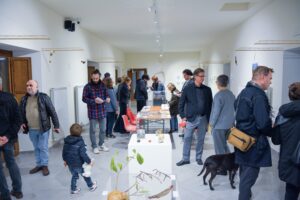
Brian Collier (right of center in black suit coat) talks with visitors and artist participants of the “Our Personal Nature” exhibit in Fontecchio, Abruzzo, Italy. Photo courtesy Brian Collier.
The Vermont-Italy Connection
In the art world, opportunities sometimes come about through chance meetings, interesting connections, and a willingness to say yes – all of which converged in Collier’s case.
It began with Todd Thomas Brown, a Vermont-born visual and performing artist who became well known in the San Francisco art scene for the Red Poppy Art House – a space encouraging artistic cultural participation. Brown moved to Fontecchio in the Abruzzo region of Italy in 2019 to work on a related project that would establish an international artist residency, playfully called the Fontecchio International Airport.
Brown was back in the U.S., in Stowe, Vermont, visiting his sister, when he attended a gallery opening at The Current: A Center for Contemporary Art, where he met Executive Director Rachel Moore. He invited The Current to partner with the ARCA project – which brings in about a dozen artists each year to 14 communities across the Abruzzo, Italy region, including to Fontecchio.
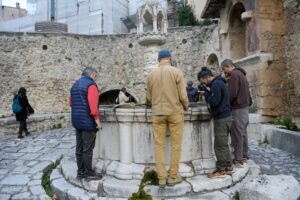
Fontecchio residents contemplate what is nature as they take pictures of objects during a walk through town which included visiting an old architectural fountain. Photo courtesy Brian Collier.
Moore soon mentioned this opportunity to Collier when they met to catch up over coffee. Moore has served as a visiting critic and lecturer for art classes at St. Mike’s in the past. In a normal academic year, Collier wouldn’t have been able to go. But, as it happened, he was on sabbatical for the fall 2025 semester.
Le stelle si sono allineate – the stars aligned.
Making art with dozens of new Italian friends
The opportunity seemed tailor-made for Collier, both in interest and execution. Fontecchio is in the greenest part of Italy surrounded by national parks, which was certainly a draw for Collier, whose creations are ecology-focused. Engaging local residents in participatory art is something Collier had experience with, and it gave him the opportunity to launch a project idea he had already been developing for his art students.
“Our Personal Nature” was the name of the project, and the goal was to deepen human connection to nature. In Collier’s words: “Humans are inherently part of the natural world and cannot live without it…If we forget our connections to nature, we may forget we should not damage it.”
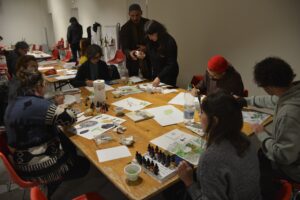
During a final workshop, Fontecchio residents prepare their materials for display. Photo courtesy Brian Collier.
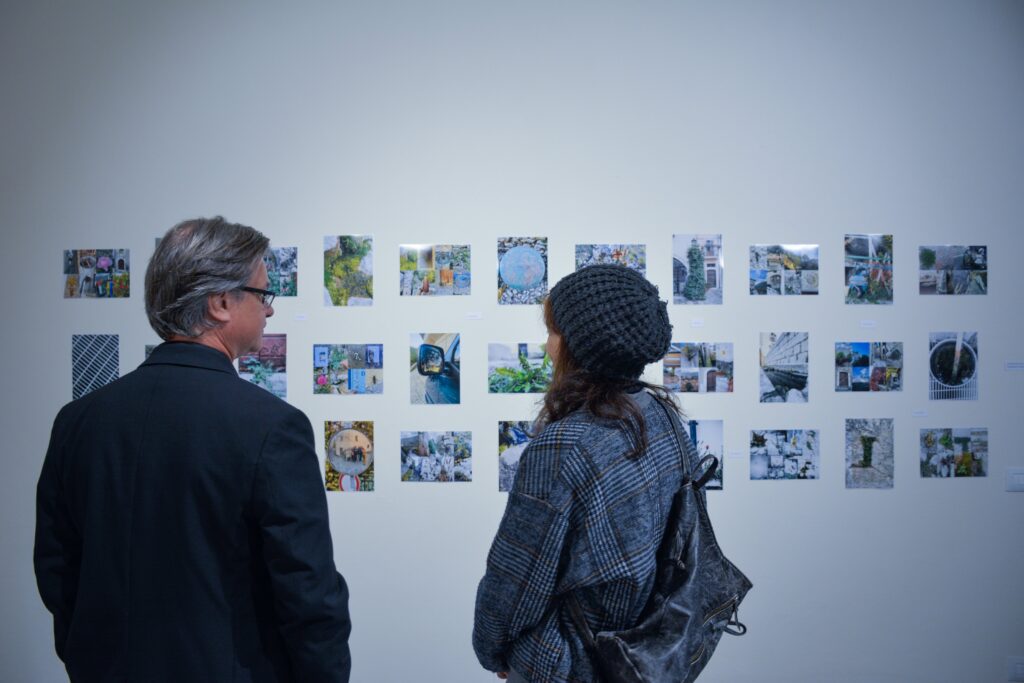
He started with a workshop that had participants thinking about the term nature, asking them to define it and whether they consider themselves, their pets, and house plants nature, for instance. Next, the group of 25 traipsed around the ancient, cobblestone town, taking photos. Their challenge was to identify plants and animals, human-made objects designed to look or represent natural objects, and places where natural and human-made objects had merged. In a third workshop, he instructed his budding artists how to press and mount plant specimens for display, along with items they brought from home that included a natural item and a man-made item made to look like something from nature.
These items, photos, videos from the walk, paintings, and the journals each person kept throughout the process, Collier used to create an exhibition. He also contributed 12 wooden sculptures to look like the cranes seen all across the region, which have been used to help rebuild since the massive earthquake devastated the area in 2009. These “cranes” supported the hanging of natural pieces that were collected, in another melding of products of humans and nature.
Galli gallery
You could say the artistic creations were given palatial treatment. They were displayed in the Palazzo Galli, a palace dating back to 1700.
The exhibition was a triumph, according to Collier, who said it was supposed to stay up for a couple of days at the end of October, but the mayor requested that it remain on display through the Christmas holiday. Collier also helped preserve some pieces that would remain as a permanent installation elsewhere in the town.
“My mind kept being blown by how successful this ended up being,” Collier said. “So, all these different communities are going to be able to experience it. You can’t really ask for more success than that.”
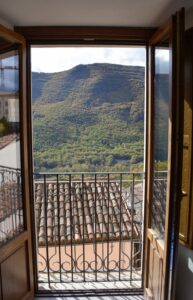
Looking out the window of Palazzo Galli, where the exhibition took place, toward the lush mountainside landscape that surrounds Fontecchio, Abruzzo, Italy. Photo courtesy Brian Collier.
Abbraccio Abruzzo
More than leaving pieces behind, Collier was struck by how much remained with him when he left. This one-month adventure that came together quickly almost on a whim, taught him about community – in the way the Italians went all out for birthdays and were quick to invite people over for a home cooked meal. It also gave him a chance to explore artistic expression through different media and perspectives with the other artists whose residencies crossed his: a Chilean textile artist living in Spain, Iranian documentary filmmaker and animator who lives in Germany, and an experimental percussionist from Philadelphia.
The region felt familiar in the way it resembled Vermont with small towns nestled in the mountains and an agricultural history, albeit with an old-world beauty.
“Abruzzo – one of my favorite places in the world now. It’s just spectacularly beautiful,” Collier said. “It’s these huge mountains with incredible, picturesque medieval villages.”
He said many Italians look down on the area as old and backwater, with its stone buildings, particularly the younger generations who are leaving for more cosmopolitan places like Rome, which is a two-hour drive away. However, he feels St. Mike’s students would love it there.
Bringing Italy back to St. Mike’s – and vice versa
Collier is proposing leading a study trip to Fontecchio for his Art & Ecology class. He would love to bring students there for a couple of weeks to experience what the region has to offer. He started building a team of people who St. Mike’s students could learn from on the trip, made up of connections he made while there. A botanist who is doing regionally specific plant collections and a former World Wildlife Fund employee who now leads environmental education tours through forests examining the old trees of the Abruzzo area are interested in participating. Collier says there is also plenty of space to put the students up in inexpensive housing.
In addition, he has a number of ideas and experiences he plans to bring into the classroom to share with students. First, he plans to change the first major project in his spring 2026 Art & Ecology class to reflect what he did with the community in Fontecchio.
He said interactions he had with professional international artists provided some great information that he plans to share with students in his Professional Practices in Art & Design course.
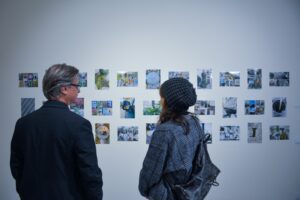
Brian Collier (left) talks with Silvia Di Gregorio, one of the people who was instrumental in bringing him to Italy as an artist-in-residence. The two stand in front of a display of photos participants took in Collier’s workshops. Photo courtesy Brian Collier.
Collier also invited a Peruvian artist he met in Fontecchio to exhibit in the McCarthy Art Gallery this year, with plans to have the artist interact with students and give a public lecture on campus.
He plans to continue developing relationships he forged there, which broadens the horizons of his art students, as well as the local art community here in Vermont, through his connections.
Since returning home, Collier created a comprehensive digital website archive of the “Our Personal Nature” project to capture all that he and the townspeople accomplished together. Check it out at https://ourpersonalnature.briandcollier.net/.
“I am still processing all of it, all the people I met, the unique experiences I had, the beauty and history of the place, and the experience of navigating language barriers to lead a community to make a collective artwork,” Collier said. “It was amazing.”

For all press inquiries contact Elizabeth Murray, Associate Director of Communications at Saint Michael's College.
Related News See more news