Unpacking the Mission Statement: Why Saint Michael’s Is More Than a Degree
The mission of Saint Michael’s College is to contribute through higher education to the enhancement of the human person and the advancement of human culture in the light of the Catholic faith.
Saint Michael’s mission statement is not branding. It is an institutional charter that authorizes priorities, disciplines tradeoffs, and establishes accountability. The phrase “in the light of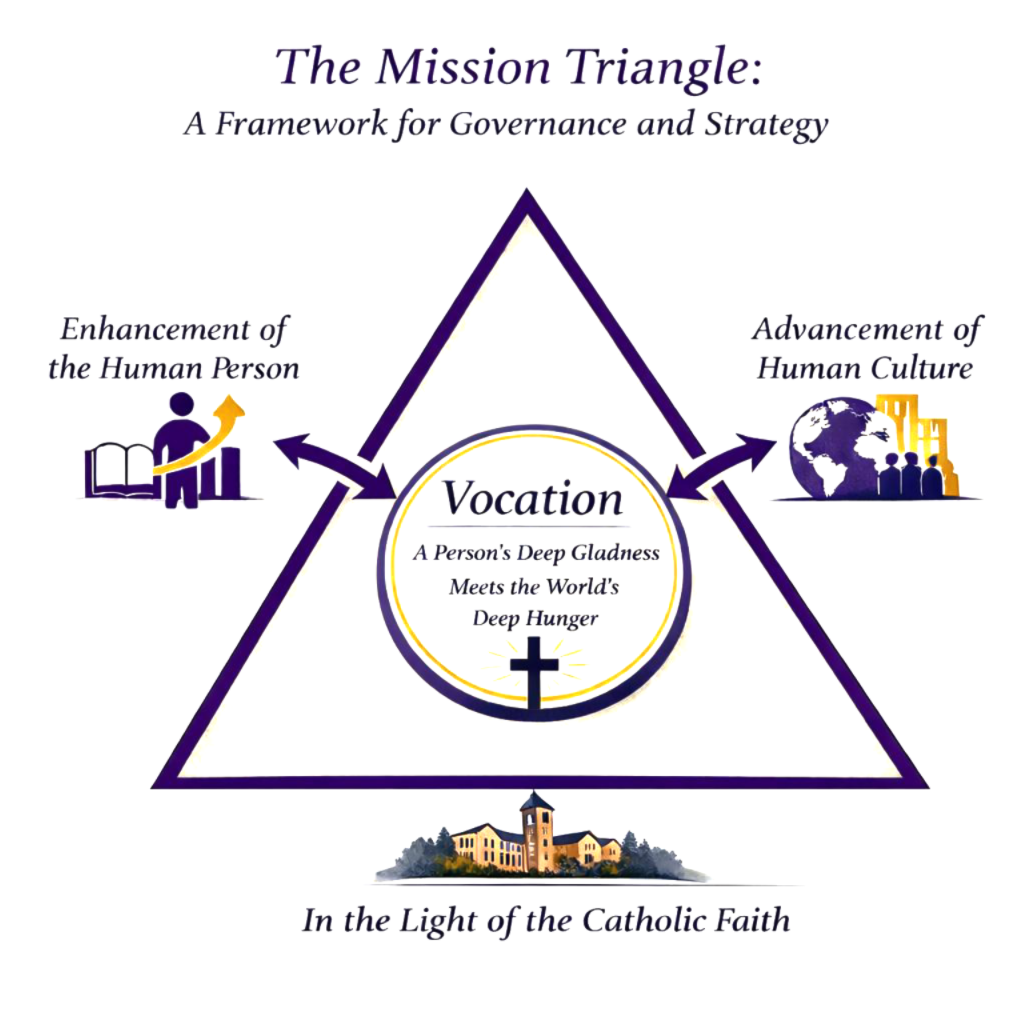 the Catholic faith” is essential, but it does its work most effectively when read in full context: enhancement of the human person and advancement of human culture.
A useful approach to grasping the full intent of the mission statement is to render the mission as a triangle with an integrating center. This is not a rhetorical device, however. It is a way to prevent fragmentation and to clarify what “mission integration” should mean operationally across curriculum, co-curriculum, hiring, budgeting, assessment, and advancement.
First vertex: Enhancement of the human person
The mission claims an anthropology. Students are not merely consumers of credits. They are emerging adults undergoing identity formation, moral development, and vocational discernment. Sharon Daloz Parks describes this stage of human development as the movement toward mature meaning making (Big Questions, Worthy Dreams: Mentoring Emerging Adults in Their Search for Meaning, Purpose, and Faith, 2011). Building on the work of James 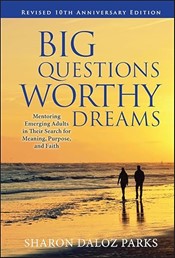 Fowler’s developmental account of faith, Parks highlights the transition from inherited frameworks of family and hometown to the reflective commitments of mature adults.
A Catholic college can translate this into institutional outcomes: intellectual judgment, moral agency, relational maturity, and the capacity for discernment and commitment. Luke 2:52 offers a succinct integrative template. In recording the early developmental years in the life of Jesus, Luke noted Jesus’ growth in wisdom, maturity, and favor, a multidimensional account of formation that resists reduction to a single metric.
Second vertex: Advancement of human culture
The mission’s cultural claim broadens the horizon beyond employability while still requiring seriousness about work and professional preparation. Culture includes economic life, civic institutions, family life, and the practices that shape a society’s moral ecology. Jeremiah 29:7 frames this as responsibility for the common good of society: “Seek the welfare of the city to which I have exiled you; pray for it to the Lord, for upon its welfare your own depends.”
For institutional leaders, this vertex invites questions about curricular coherence, experiential learning, professional ethics, civic engagement, and the cultivation of competencies that serve the common good. It also invites a critical posture. Advancing culture does not mean affirming whatever is rewarded by prevailing markets or ideologies. It means strengthening what supports human dignity and reforming what deforms it.
Third vertex: In the light of the Catholic faith
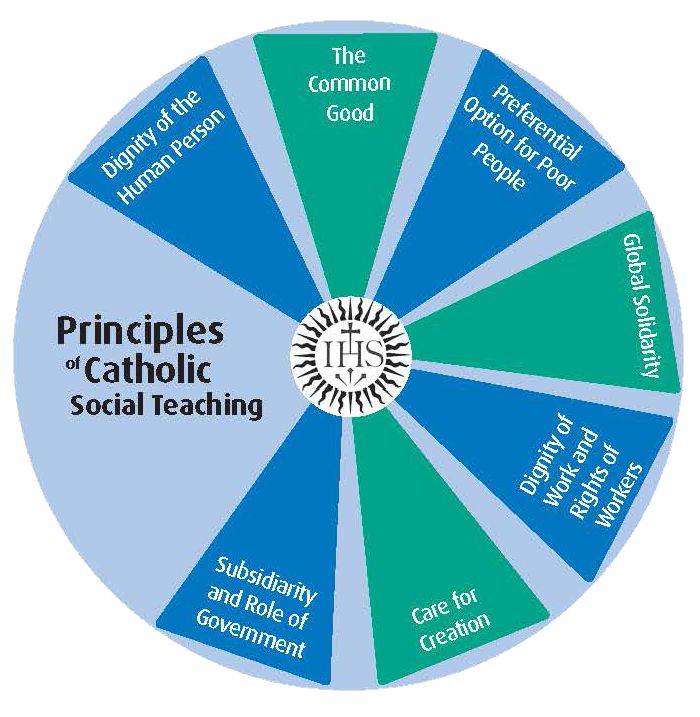
This phrase functions as the governing horizon and integrative grammar of the first two parts of the mission statement, not simply one value alongside others. In Catholic intellectual tradition, faith and reason are mutually illuminating, and inquiry is not constrained by fear but ordered toward truth. Catholic social tradition provides normative content for institutional decision-making, including the dignity of the person (Genesis 1:27), solidarity, subsidiarity, and the common good. In framing discipleship as a call to be a light for the world, not to be hidden but of use to all, Matthew 5:14–16 frames institutional identity as a public illumination, not private sentiment. The practical implication is that Catholic identity is not located only in campus ministry. It belongs in educational design, institutional culture, and leadership formation.
The center: Vocation as integration
Frederick Buechner offers a definition that functions well as an institutional integrator: vocation is “the place where your deep gladness meets the world’s deep hunger” (Wishful Thinking: A Seeker’s ABC, 95). Stated in those terms, vocation is not reducible to the selection of a major or initial job placement. It is a framework for aligning personal formation with public responsibility. The phrase “deep gladness” points to gifts, strengths, and enduring motivations that education can clarify through rigorous learning, mentoring, reflection, and developmental support. The phrase “the world’s deep hunger” names concrete human and cultural needs that graduates will encounter in workplaces, civic institutions, communities, and families. When used as a mission-centered organizing principle, this definition supports a coherent student success narrative without collapsing into careerism.
Curricular pathways and co-curricular experiences can be designed to help students identify gifts and cultivate competencies, while internships, community-engaged learning, and professional formation translate those gifts into the accountable service of real needs. In a Catholic college, “in the light of the Catholic faith” further specifies the discernment process by offering a normative account of authentic flourishing and the common good, helping the community evaluate which “hungers” are most urgent and which forms of “gladness” are genuinely life-giving rather than merely self-affirming.
For those in college leadership and classrooms of instruction, the triangle can become a disciplined evaluative tool. Every major initiative should be able to answer three questions. What human capacities does this measurably develop? What cultural contribution does it enable, and by what pathways? How is it explicitly shaped by the Catholic intellectual and moral tradition, rather than merely compatible with it?
The benefit of the triangle is institutional coherence. It provides a stable framework for prioritization, protects against mission drift through fragmentation, and makes the mission discussable in concrete terms. When the mission becomes an operating system rather than a slogan, the College can speak with clarity to a plural community while remaining unmistakably Catholic in identity and purpose.
If you would like to make a comment or ask a question, I can be reached at dtheroux@smcvt.edu. Let’s talk!

For all press inquiries contact Elizabeth Murray, Associate Director of Communications at Saint Michael's College.
Related News See more news