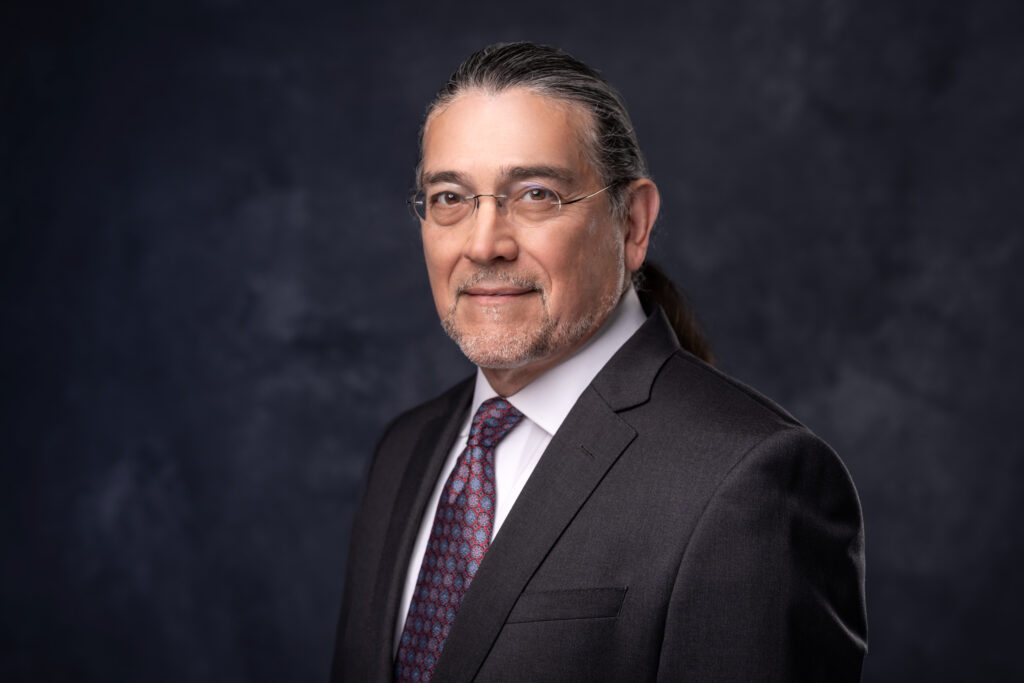
The former Director of the U.S. Census Bureau – a career-long statistician and data scientist – will speak at Saint Michael’s College as part of an annual endowed lecture series.
The Honorable Robert L. Santos, the first Latino and person of color to serve as the Senate-confirmed director of the Census, will explore how considering culture and values in data have made him a better statistician and leader. Santos’ talk is part of the Sutherland Lecture Series, which brings leading thinkers and scholars to campus to speak about issues in the liberal arts and sciences.
The talk, “Telling our stories: How culture and values made me a better statistician and a better leader,” will take place at 4:30 p.m. on March 31 in the McCarthy Arts Center Recital Hall.
Much of Santos’ career has focused on making sure underserved populations are represented in data and research. At the Census, he worked on adding queries about sexual orientation and gender identity and worked to revise questions about race and ethnicity in official government collection.
The Hon. Robert L. Santos, former Director of the U.S. Census Bureau. (Courtesy of Robert Santos)
In addition to his time with the Census from 2022 to 2025, he has also been President of the American Statistical Association and the American Association of Public Opinion Research, as well as Chief Methodologist for the Urban Institute, a prominent, non-partisan research organization in Washington, D.C.
Santos’ career in survey sampling began as a graduate student research assistant at the University of Michigan Survey Research Center (SRC), which is part of the larger Institute for Social Research. While there, he designed and selected the area of probability for the National Chicano Survey, the first-ever national survey of people of Mexican descent. After that, his first professional job was as a sampling statistician at Temple University’s Institute for Survey Research. Santos holds a Bachelor’s degree in Mathematics from Trinity University in San Antonio, Texas, as well as a Master’s of Statistics from the University of Michigan.
In advance of his visit, we asked Santos questions about his career and the data science industry, including how best to use data. The questions and his responses below have been lightly edited for length and grammar.
Saint Michael’s College: What have been the highlights of your career as a data scientist, and what are you most proud of?
Dr. Robert Santos: This is an interesting question because the term “data scientist” was coined in 2008, while my career started 30 years earlier (1978). I am a statistician, and in a real sense, statisticians were data scientists before there were “data scientists” as we know them today
I was pulled into survey sampling by receiving a research assistantship as a graduate student at the University of Michigan Survey Research Center (SRC), which is part of the larger Institute for Social Research. I am incredibly proud of being the person who designed and selected the area probability sample for the National Chicano Survey, the first-ever national survey of people of Mexican descent. This project positioned me at the forefront of rare-element sampling and oversampling of minority populations.
My first professional job as a sampling statistician was at Temple University’s Institute for Survey Research. I cherished my experiences there, including the metamorphosis from being an “office statistician” who draws samples for surveys to becoming a project director who oversees all aspects of a survey from proposal development, design, sampling, and data collection to data processing, analysis, and report writing. The two projects in my seven-year tenure that stood out to me were, first, the 1987 National Survey of Families and Households. I designed and drew the area probability sample for this renowned large study directed by Larry Bumpass and Jim Sweet from the University of Wisconsin Center for Demography and Ecology. The second was the 1989 Latino National Political Survey, where I was Project Director and the sampling statistician who designed the study approach.
Another highlight of my career was being the first Director of Survey Operations at the University of Michigan SRC. This position supercharged my leadership skills, as I oversaw an in-house staff of 125 and a national interviewer workforce of about 300, all at the age of 35. At SRC, I designed and implemented one of its largest reorganizations, creating the Survey Operations Center within SRC. The reorg basically took the survey infrastructure from being paper-pencil interview-oriented to being a computer-assisted interviewing operation.
Other prominent highlights included serving as Vice President for Statistica and Methodology at NORC University of Chicago, being a private business owner of a social science research center in Austin, Texas, and serving as Vice President for Methodology at the Urban Institute in Washington, D.C. Throughout these major career transitions, I was privileged to work on important studies to help vulnerable people, and to do so most areas of public policy research. And as part of that process, I found great value in community-based participator research and more generally in community engagement. These experiences taught me the incredible value of learning the challenges and problems faced by people from their own perspectives. I learned that real, pragmatic research-based solutions can only be reached when you address them from the community’s perspective.
Perhaps my proudest moment was becoming the 26th Director of the U.S. Census Bureau and serving my country. I brought all of my experience as a statistician and policy researcher, and combined it with my culture, values, and life experience to lead the Bureau through challenging times.
SMC: In what ways can data inform how we see the world or help us make decisions?
Santos: Interestingly, data itself cannot inform how we see the world. It’s how we use and interpret data that matters most. Data can be extremely useful in providing evidence of effectiveness or for planning. For instance, the Community Resilience Estimates (CRE) tool that is produced by the Census Bureau helps emergency planners identify neighborhoods that are most vulnerable to natural disasters like wildfires, hurricanes, or floods. The CRE brings together data from many sources and creates estimates at the census-tract level to allow for such planning. It is a unique database that – until its creation – had not existed. And once it was created, it provided insights for decision-making that had not been possible. This product literally helps save lives.
The CRE example illustrates how data can provide new perspectives of the world that answer questions that previously could not have been answered. Data has the potential to provide new lenses with which to view our world. But these insights are only as good as the data that are used. That is why it is so important to understand the strengths and weaknesses of the data that go into decision-making.
SMC: In what areas would you like to see data used more?
Santos: I would like to see more efforts to combine data from multiple sources (like the CRE mentioned above). The Census Bureau has created a data lake that includes all administrative and census/survey data it collects, both on people and businesses. The possibilities are endless for new data products that can shed new light on our people and economy.
SMC: In your opinion, and based upon your years of experience in the field of data science and statistics, how is data used to best effect? (Specifically thinking about data being paired with storytelling, combining qualitative and quantitative data in order to provide context, making sure particular groups and perspectives are included, etc.)
Santos: I have spoken on this topic many times. Data is best used when the process of gaining insight (through the generation of data products, analyses, and data collection) is guided by gathering different perspectives from experts, policy-makers, and community representatives. To bring the resulting insights from data to fruition (e.g., policy recommendations, decision-making), storytelling is key. Different stories can be told based on the same data results, by the way. And each rendition can provide valuable insights. That is why it is so important to include in the research process different perspectives in different dimensions – technical (e.g., sociologist, political scientist, statistician, economist, health expert, etc.) and cultural (race-ethnicity, sex, gender, age groups, community members, etc.).
SMC: Can you provide a specific example from your career when data was used particularly effectively to illuminate information or tell a story?
Santos: My lecture does this almost exclusively. I am particularly fond of telling the story of how a folk-medicine blessing from my Mexican grandmother when I was four years old eventually – upon reflection when I was adult – revealed to me that I should bring my “whole self” to the table as a statistician and a leader. This means bringing my culture, my values, my life experiences as a Mexican American, and combining all that with my technical training to produce a “unique me.” She had done exactly this as a grandmother to help her grandson… so why should I not do the same as a statistician? The results were profound and have helped me greatly to become a better statistician and leader throughout my career.
SMC: We’ve seen examples of data being cherry-picked to support a specific point of view/organization, or used as a tool to augment or decrease power (for example: gerrymandering). In your opinion, how can one use data ethically? And, conversely, how does one validate that the source providing the data is representing it ethically?
Santos: Context is everything, which is why it’s so important to gather diverse perspectives when designing and implementing a study, analyzing the data, and interpreting the results. In this day, cherry-picking results seems to be a common approach to promote or defend a position on an issue. This can be unethical, but there is not much that can be done by either the federal government or the statistical profession. Our nation is grounded in the principle of free speech, whether ethical or not. Cherry-pickers have the right to promote their limited viewpoint, as tenuous as it might be.
This leaves the consumer – the public – with the obligation to be discerning, to use their values and critical thinking to assess the veracity of whatever data results they are presented. Our obligation as statisticians is to ensure that consumers of our data understand the strengths and limitations of the data and the research being produced. And part of that obligation is to present data visually and otherwise in a way that the public can best understand the story being told and the limitations of the data. This speaks to scientific integrity and transparency – core values for any statistician/data scientist.
SMC: For students who are planning or considering going into the fields of data science and/or statistics, what would you like them to know? What qualities make for an accurate, insightful, and ethical statistician? Do you have to be great at math to be a data scientist?
Santos: Being good at math can certainly help, but it is not as essential as this one element I am about to share. That element is critical thinking. More than anything, being a good statistician/data scientist (or an effective member of any other career, for that matter) is reliant on one’s ability to think critically for themselves, to formulate unique perspectives, to learn from mistakes and from successes. And the superpower that everyone has, but too often goes unrecognized, is understanding the value of your whole self. No one has your combination of culture, values, life experience, and technical training. This allows you to develop unique perspectives and critical thinking that no one else can offer. Invoke these and just “be yourself.” Doing so will be a catalyst for a great career. Interestingly, as someone who came up the ranks nurturing “imposter syndrome,” it took me a couple of decades to realize this one secret. Please use it wisely.
SMC: What else would you like people to know?
Santos: One way to expand your ability to develop deeper critical thinking is to be active outside your career. Get involved in new things like photography, painting, music, outdoor activities like camping, hiking or fishing, sports, volunteering at a local food bank or pantry, tutoring students in high school or middle school, or joining a club. Diverse experiences will allow you to meet and interact with folks who have different perspectives on life. Such engagements and learning can also trigger new, creative ideas and perspectives. I found this especially true as a live music photographer for the SXSW Festival in Austin, where I worked as a side gig for nine years. The creativity of photography and learning from fellow artists who have their own style and approach has proven valuable for me as both a statistician and a leader.

For all press inquiries contact Elizabeth Murray, Associate Director of Communications at Saint Michael's College.
Related News See more news