The Line We Must Not Cross: Applying Catholic Social Teaching to Contemporary Issues

Jemelle Bouie (1987- ), New York Times Columnist
Are we approaching a line we must not cross as a nation?
That is the question raised by Jamelle Bouie’s warning about immigration detention in the United States in a New York Times opinion piece (The Depravity of Trump’s Immigrant Detention). His concern is not a careless comparison to extermination camps. It is a warning about political and moral trajectory. When detention becomes more central to how a nation deals with undocumented immigrants and also with persons who are in the process of establishing legal status, and when public rhetoric increasingly stereotypes immigrants as criminals or threats to national life, we must ask not only what is legal, but what kind of country we are becoming.
Catholic Social Teaching gives us a disciplined way to ask that question. It recognizes that nations have a right and duty to regulate borders for the common good. The Catechism of the Catholic Church states that political authorities may make immigration subject to juridical conditions for the sake of the common good (n. 2241). The U.S. bishops also affirm that countries have the right to maintain borders and regulate immigration. The bishops insist that this must be done with respect for the sanctity of life, the dignity of every person, and protection for refugees and asylum seekers (Backgrounder on Humanitarian Protections).
That balance matters. It resists simplistic talking points by requiring us to hold two truths at once: the legitimate role of the state and the non-negotiable dignity and rights of migrants and asylum seekers. It means that not every use of state power is morally equivalent. A nation may enforce immigration law, but it may not preserve order by degrading people or by treating whole populations as if they were inherently suspect.

President Donald Trump tours the immigration detention center nicknamed “Alligator Alcatraz,” Tuesday, July 1, 2025, in Ochopee, Florida. (Photo by Daniel Torok/White House)
The present danger is that detention is becoming not simply a limited legal instrument, but an increasingly central strategy of governance. Reuters has reported plans for a massive expansion of detention infrastructure, including about $38.3 billion in spending and a projected increase in Immigration and Customs Enforcement (ICE) detention capacity to 92,600 beds by the end of 2026 (ICE to spend $38.3 billion on detention centers across US). Reuters also reported that federal courts have ruled thousands of times that ICE unlawfully detained immigrants, including many non-criminal immigrants and asylum seekers, even as large-scale detention continues (Courts have ruled 4,400 times that ICE jailed people illegally). Whatever one’s political position on immigration levels, these developments should force a moral examination of detention as a default response.

Robert Jay Lifton (1926-2025) and Andrea Pitzer (1968- ).
This is where the work of two historians deserves close attention—Robert Jay Lifton and Andrea Pitzer—because they clarify how a society can normalize detention and reinterpret it as necessary. In The Nazi Doctors: Medical Killing and the Psychology of Genocide, Lifton showed how Nazi ideology used a medicalized moral language in which the state imagined itself as healing a social body by removing what it labeled diseased. That analogy is horrifying not only because of what is justified, but because it made cruelty sound like responsibility. Pitzer’s One Long Night: A Global History of Concentration Camps helps clarify the institutional danger before one reaches extermination. As she writes, “A concentration camp exists wherever a government holds groups of civilians outside the normal legal process—sometime to segregate people considered foreigners or outsiders, sometimes to punish” (p. 5). Read together, Lifton and Pitzer help us see the line more clearly. The danger begins when a state normalizes exceptional detention of a targeted civilian group and when the public is taught to view that group less as neighbors under law and more as a social problem to be removed.
That line is crossed gradually. It is crossed when immigrants are described primarily as a criminal mass rather than as persons whose cases differ widely. It is crossed when harshness becomes a political performance. It is crossed when detention expands more rapidly than due-process protections, legal access, medical care, and independent oversight. It is crossed when the public becomes accustomed to the idea that vulnerable people may be held out of sight for long periods while leaders gain support by portraying them as threats because of who they are.
Photo by Leo Patrizi/Getty Images
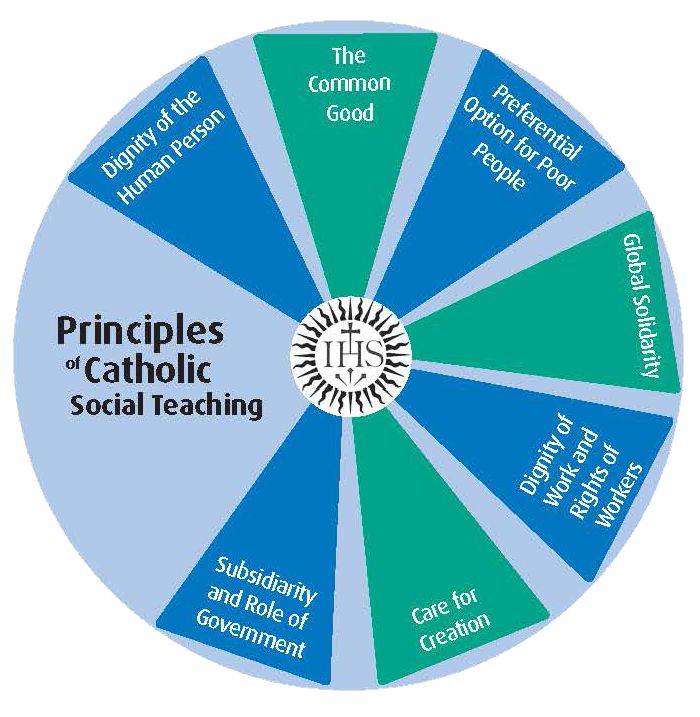
Catholic social justice insists on a different moral grammar. As stated by the American bishops, the life and dignity of the human person is the fundamental principle to be followed (Seven Themes of Catholic Social Teaching). A person does not lose God-given dignity because of immigration status. The U.S. bishops state plainly that the dignity and rights of undocumented immigrants must be respected (Migration and Catholic Social Teaching (CST). The common good also does not permit dehumanization. A nation can secure borders and still preserve due process. It can enforce law and still reject stereotyping. It can distinguish between genuine threats and families, workers, asylum seekers, and long-time residents navigating a broken system.
Solidarity is equally important here (Seven Themes of Catholic Social Teaching). Solidarity does not mean ignoring law. It means refusing to treat any class of human beings as morally disposable in order to reassure the majority. Once detention becomes a broad tool of social sorting, and once rhetoric trains citizens to accept that sorting as normal, the nation has already begun to cross the line.
A nation has a right to borders. But no nation has the right to defend itself by teaching its people to stop seeing the humanity of those in detention.
That is the line we must not cross.
If you would like to make a comment or ask a question, I can be reached at dtheroux@smcvt.edu. Let’s talk!

For all press inquiries contact Elizabeth Murray, Associate Director of Communications at Saint Michael's College.
Related News See more news