Pamela Carroll ’85 uses AI in biotechnology to tackle formerly “undruggable” drivers of disease

Pamela Carroll is a 1985 Saint Michael’s College graduate and Board of Trustees member whose distinguished career in the sciences led to her current role exploring the use of AI in biotechnology. Read in this Q&A how she became involved this emerging field, how AI is changing medicine development, and what advice and takeaways she has for those who are interested in a similar career.

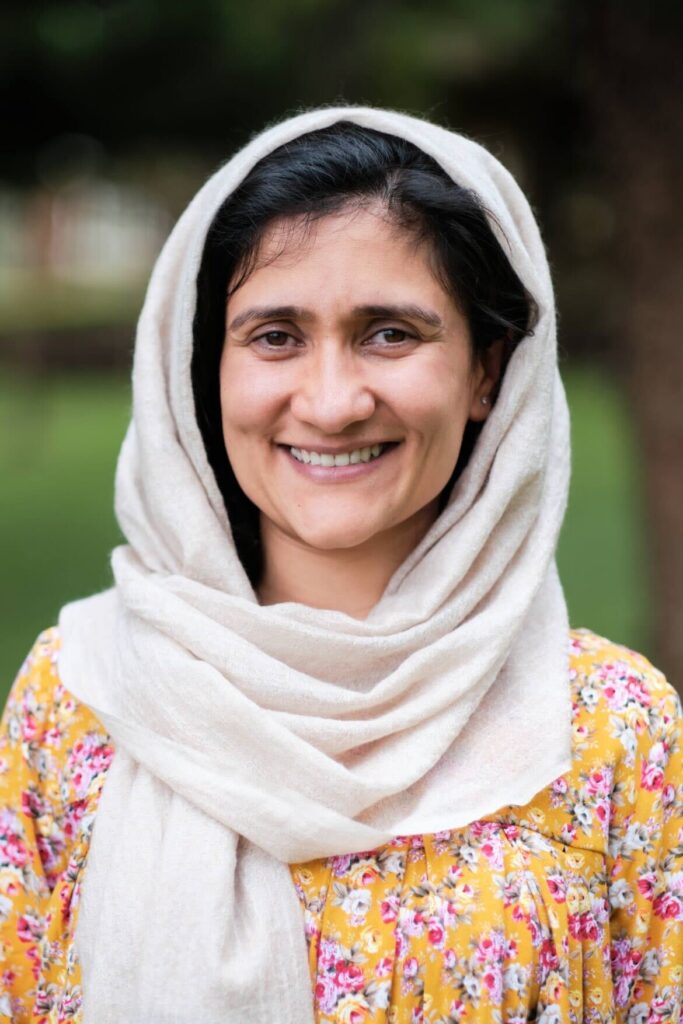
Pam Carroll is a 1985 graduate and member of the Saint Michael’s College Board of Trustees. Photo by Jerry Swope.
Saint Michael’s College: Can you walk us through your journey—from Saint Michael’s College to graduate study and postdoctoral research—and how those experiences led you into biotech leadership and entrepreneurship?
Pam Carroll: My journey from St. Mike’s to the long career in biotechnology started at the National Cancer Institute, where my work as a research technician solidified my fascination with cell biology. That spark led me to Stony Brook University for my PhD in cell biology and later a postdoc in genetics at Stanford University. I remember being captivated by the 2000 release of the Human Genome Project; it felt like a roadmap for a new era of medicine. That drove me to join a pharmaceutical company that had made significant commitments to lead in this genomics era. About a decade ago, I pivoted from “Big Pharma” to the world of biotech. I love the agility of smaller teams—it allows us to stay hyper-focused. Also, I made a deliberate move toward the business side of biotechnology. I was increasingly drawn to the strategies and business decisions that allow scientific breakthroughs to reach patients. This pivot proved to be my “secret weapon.” It allowed me to move into the high-tech world of AI without being a computer scientist or an AI expert myself. Instead, I bring a deep, fundamental understanding of drug development, disease biology and business knowledge, to the table.
[SMC]: How is artificial intelligence currently showing up in your work, from research and discovery to decision-making or commercialization?
[PC]: My career has always been fueled by the desire to solve “unsolvable” problems. I entered the field of AI drug discovery just as the industry reached a historic tipping point: the solution to the protein-folding problem called AlphaFold. For decades, predicting how a protein folds into its 3D shape was a baffling scientific mystery. With the team that discovered AlphaFold—which earned the 2024 Nobel Prize in chemistry—we launched Isomorphic Labs in London. Our mission is to build AI systems that will revolutionize the development of new medicines and the understanding of diseases. Traditionally, finding a single drug candidate has been like searching for a needle in a haystack—except the haystack is the size of a galaxy. At IsoLabs, we use an AI drug design engine to simulate trillions of molecular interactions in silico [via computer simulation]. This doesn’t just speed up the process; it allows us to tackle “undruggable” disease targets that were previously unapproachable by human researchers. IsoLabs is currently on track to begin our first clinical trials of an AI-designed drug by the end of 2026. Most recently, I joined a venture capital firm to build future AI-biotech companies.
[SMC]: Where has AI had the greatest impact in biotech so far—speed, accuracy, cost, or something else?
[PC]: AI will eventually improve the speed and quality of new medicines, as well as lower costs to the healthcare system. The field is not there yet but is moving rapidly. We still rely on expensive and slow lab experimentation to test the accuracy of our AI models. In the next few years, scientists should be able to create truly foundational models where a drug can be designed in a month, not four to eight years.
[SMC]: Looking ahead, how do you see AI reshaping biotech innovation over the next decade?
[PC]: While AI has achieved landmark moments in protein design and chemical synthesis, it faces a steeper climb in disease biology, where the sheer multiscale complexity of living systems and the inherent noise of biological and clinical data remain formidable hurdles. I expect in 10 years, we will have a much deeper understanding of disease biology.
[SMC]: Do you think AI lowers barriers for biotech startups—or raises the stakes?
[PC]: Generalized AI tools for drug discovery will eventually be commoditized. To succeed, the next generation of biotech will leverage AI tools and deep data integration, enabling scientists to have a singular focus on solving specific problems. If we can design drugs quickly and at less cost, a team can test many more hypotheses. This will reduce the currently high failure risk of drug development.
[SMC]: Biotech already carries ethical complexity. How does AI amplify those responsibilities?
[PC]: At the forefront of AI integration in biotechnology, data security and algorithmic integrity must be considered. Some AI tools learn from personal genetic and clinical info, so we have rock-solid legal guardrails to protect privacy and ownership. Furthermore, the risk of algorithmic bias poses a significant threat to equitable healthcare. The industry has to be completely transparent and we must ensure the data we’re using is as diverse as the patients we’re trying to help.
[SMC]: AI wasn’t part of the curriculum when you were a student—how did your education at Saint Michael’s prepare you to adapt to transformative technologies?
[PC]: Saint Michael’s liberal arts education cultivated in me an intense curiosity to imagine the possible. In this new era, the most critical scientific skill isn’t data processing—it’s the human curiosity required to frame the right hypothesis.
[SMC]: Which skills or ways of thinking from a liberal arts education have proven most future-proof in your career?
[PC]: While my career is rooted in science, introductory economics and finance courses provided tools that allowed me to pivot to business leadership. Beyond the classroom, the mentorship and close faculty interactions at St. Mike’s instilled a sense of professionalism that is the cornerstone of leadership.
[SMC]: What advice would you offer Saint Michael’s students who want to lead in biotech and AI-driven fields that are still emerging?
[PC]:To those looking to lead in the emerging fields of biotechnology and AI, I recommend developing a solid understanding of the fundamentals of AI and data science. Additionally, I encourage you to read widely across various disciplines. Staying informed beyond your core curriculum will help you better anticipate the direction in which these fields are evolving and merging.
Read the collection of stories on AI at Saint Michael’s College. This story was published as part of the Spring/Summer 2026 edition of The Saint Michael’s College Magazine.

For all press inquiries contact Elizabeth Murray, Associate Director of Communications at Saint Michael's College.
Related News See more news