St. Mike’s Education program has a profound impact on Vermont schools – so much so, one K-8 school is practically turning purple
Shelburne Community School Humanities teacher Meg O’Donnell ’88, flitted back and forth across her colorful, book-filled classroom between students working on their world religions unit test on a Friday morning at the end of January.
Instead of giving her students the answers they sought when some were struggling with completing the work, she asked them questions that helped unlock their knowledge and make connections they could, then, articulate. She did all this while engaging in a side conversation with a student about the ethics of using AI for schoolwork and spending a few moments catching up with a former student – who is now in college – who dropped by to say hello.
The flurry of activity was a calm chaos the 32-year veteran middle school teacher managed with aplomb. Much of O’Donnell’s education about education, she received at Saint Michael’s College. She obtained her undergraduate degree in history from St. Mike’s in 1988, received certifications in racial equity & educational justice as well as holistic restorative education, and will soon have her Master of Education this spring. She has been an adjunct instructor at St. Mike’s – teaching the teachers – all while spreading her Purple Knight pride across her many educational networks.
Meg O’Donnell ’88 is a leader in Middle School education in Vermont. (Photo by April Barton.)
At Shelburne Community School, a K-8 school, O’Donnell may be the most senior of the more than 20 teachers who have a direct connection to Saint Michael’s College. Purple and gold runs deep there – as it does in other schools, too – proving that St. Mike’s’ Education program has had a significant impact on Vermont K-12 schools.
SMC to SCS
Among current Shelburne Community School (SCS) educators, the St. Mike’s ties are taut.
Evaluating current staff in January 2026: as for degrees, 10 different individuals had a St. Mike’s degree – whether undergraduate or graduate – and for half of them, they attained both their bachelor’s and master’s at St. Mike’s. Three people received post degree certificates and endorsements or their Certificate of Advanced Graduate Studies from St. Mike’s, and at least seven had taught in some capacity at St. Mike’s as an adjunct instructor. Shelburne teachers have also served as mentors for St. Mike’s students – 11 had welcomed college students into their classroom as student-teachers, and 12 had hosted education students for observation.
Among the roles of St. Mike’s-affiliated educators at SCS, many are classroom teachers. However, there was also one school principal (elementary level), an art teacher, four special educators, a couple of paraeducators, a counselor, an administrator, and a substitute teacher.
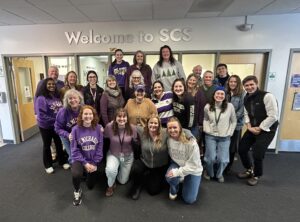
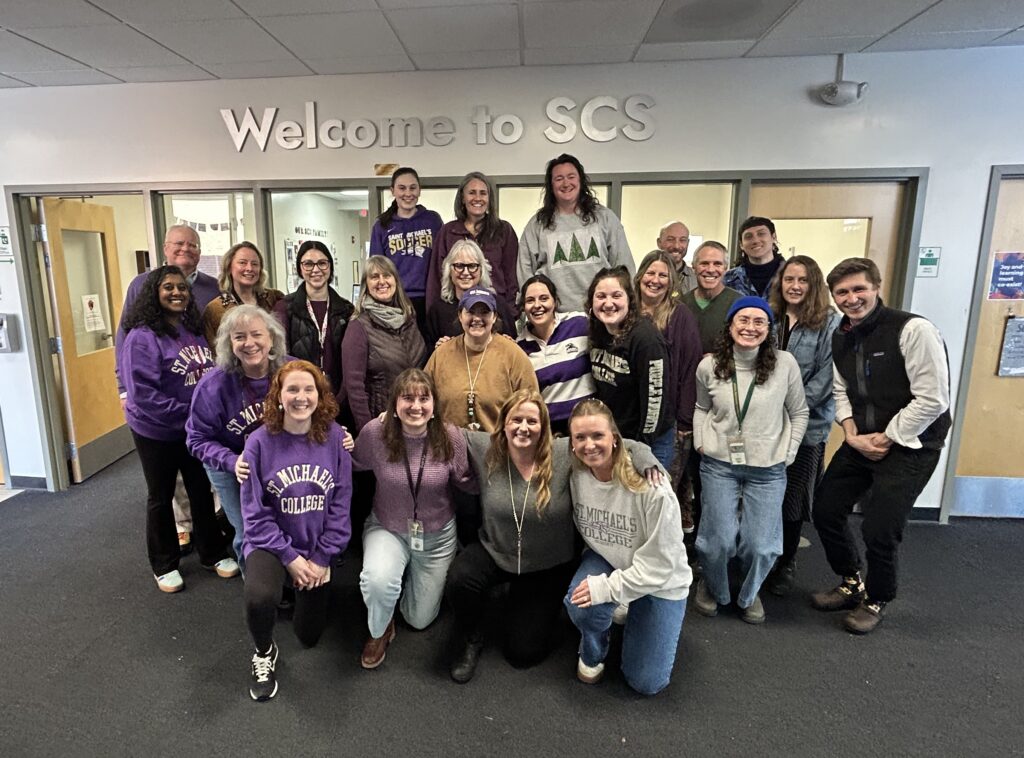
Shelburne Community School educators who have a connection to Saint Michael’s College, pictured Jan. 2026. Many wore their purple and gold in honor of St. Mike’s Purple Knights.
[Front Row: Devon Morrill, Celeste Matte, Sarah Williamson, Kristin Funsten. Second Row-ish: Meg O’Donnell, Megan Maynard-Jacob, Julia Costes, Carissa Casey, Gina Pandolfo. Third Row-ish: Vasanthi Meyette, Eric Brunvand, Jenn Roth, Antonia Trono, Rue Kendrick, Kim Elia (skip over Julia and Carissa), Nancy Nakhleh, John Madden, Wendy Hallock, Parker Cadwell. Last Row-ish: (standing on the bench) Brigid McNamara, Alicia Cernosia, Olivia LeClerc, (standing on the ground) Sam Nelson, Matty Edkins.] (Photo courtesy Shelburne Community School.)
And, turns out, Shelburne isn’t the only school where this pattern exists: Jericho Elementary School, Winooski Schools, Hiawatha Elementary School and Essex Middle School in Essex Junction, and Champlain Elementary School in Burlington were others top of mind for Amy Saks Pavese, Saint Michael’s College’s Director of Graduate Education.
Why the high concentration of SMC grads
The numbers speak for themselves, but it is difficult to pinpoint a reason why so many St. Mike’s folks have ended up in one place. It’s likely a confluence of factors and a testament to Saint Michael’s College’s strong Education program and reputation. Certainly, proximity is a factor as some students may have already been Vermonters and stayed here for their career, or they student-taught at or had connections to local schools and decided to stay in Vermont after graduation when a job became available.
You could conclude the same for the University of Vermont, which is known to produce numerous education graduates. During May 2025 Commencement, UVM conferred 222 education degrees across bachelor’s, master’s, and doctoral programs, while St. Mike’s graduated 66 scholars with bachelor’s and master’s degrees, which amounts to about 30% of UVM’s total. At St. Mike’s, Education is one of the top five most popular programs and one of three master’s programs. The College certainly has an outsized impact upon the community, and, according to those most familiar, personal connections and word of mouth are key.
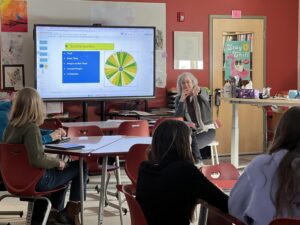
Meg O’Donnell ’88 calls on a student during an opening activity in her 7/8 grade Humanities class as Shelburne Community School. (Photo by April Barton.)
Take O’Donnell, for instance, whose classroom was described at the top of this story. She received her National Board Certification – something only 3% of teachers have achieved. She is the past president for the Vermont Association for Middle Level Education (VAMLE), and she teaches at Vermont’s Middle Grades Collaborative Institute each summer.
In addition to being – as Saks Pavese describes her – “a school leader without being in a traditional school leadership role” in Shelburne, O’Donnell has amassed a vast network of educators across the state. And, just as she asks her students to be open to learning every day, she is constantly learning and models that to new and experienced teachers alike. She has championed progressive educational ideals and evolving the profession to meet the needs of modern students.
What St. Mike’s ed grads are known for
Meg O’Donnell is a phenomenal example of what a Saint Michael’s College graduate can aspire to, and she continues to pass on her breadth of knowledge and experience to others. After she obtains her master’s this spring, she hopes to teach more college courses.
Are there characteristics that define St. Mike’s-educated grads that make them appealing hires? That question is difficult to answer, however, middle school Principal Cluff made some parallels between St. Mike’s-connected educators at his school.
“I don’t know if this is middle-level people, in particular, or Shelburne, or St. Mike’s, but the people on that list strike me as just really, really creative,” Cluff said. “This moment in education and for young adolescents, in particular, requires us to try different things, to never be stuck in our ways, and be insanely flexible – and that’s what I think of when I think of the folks in Shelburne that have that St. Mike’s connection.”
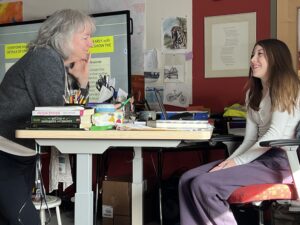
Shelburne Community School Humanities teacher Meg O’Donnell ’88 has a discussion with a student about what they learned in a world religions unit. (Photo by April Barton.)
He said at the middle school level, it is important to listen to students’ voices because during that developmental phase, they are exploring their thoughts, ideas, and opinions about how the world should work.
“I think the places we have seen the most success as a school community is when we listen to those voices,” he said. “And, the teachers who have that St. Mike’s connection, I think, are some of the people who do that most intentionally, most regularly, and most effectively.”
Cluff added that all these educators shared a commitment to not just delivering content but getting students involved in the process and being responsive to their needs.
Benefits of having so many St. Mike’s grads in the building
Having multiple Purple Knights in one school building is beneficial and has likely fostered an increase in the ratio.
Having mentors that are late-career, mid-career, and brand-new teachers who all have shared experiences can be invaluable for longevity when burnout can be a career ender. The first few years of a teacher’s career can be especially challenging, and having examples of others who’ve weathered the difficulties is crucial. A shared alma mater creates a natural bonding experience.
“Teaching can feel lonely and isolating, even when you’re part of a team because at some point that door closes, and it’s just you with these kids,” O’Donnell said. “I’ll never forget my first year of teaching having that person in the building to just lay it straight – to nest me but also be like ‘Get back in there. You had a hard day, but you got to get right back in there.’”
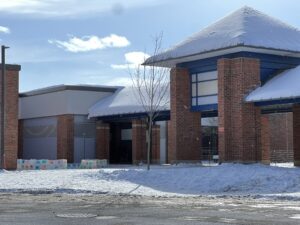
Shelburne Community School pictured in late January 2026. (Photo by April Barton.)
Cluff said another challenging time can be for those who decide to pursue their master’s while being a full-time educator. Having others to turn to who’ve taken on the workload and can speak to the specifics of the St. Mike’s program and give insider tips and tricks may make a difference in the person sticking it out to attain their degree.
Because there are so many SCS educators who are instructors at St. Mike’s or curate best practices at the state level, the continuity between college and the classroom further prepares graduates for success. It’s likely that a new St. Mike’s hire comes in already familiar with some of the SCS staff, having encountered them through the College.
What makes St. Mike’s’ education program so strong
Saint Michael’s College’s Education department has a strong reputation across the state and region, which extends to educator circles. Acclaim has grown organically over time, and that positive word of mouth starts with a strong curriculum.
In addition to bachelor’s degree majors in Elementary Education, Secondary Education, and Education Studies, a new Secondary Science Education major will roll out for Fall 2026. At the graduate level, one can get a Master of Arts in Teaching (MAT) or Master of Education (MEd), or go through the MAT + 1 program, which allows students from any discipline to add a fifth year to receive their master’s and a teaching license (or, if already pursuing licensure, an additional endorsement).
There are three post-grad certifications for 12 to 30 additional credits focused on specific topic areas, including leadership endorsements for Principal, Director of Curriculum, and Director of Special Education.
Saks Pavese says St. Mike’s provides educational support for teachers at every stage of their career so they can step into whatever role they want whenever they are ready. She said some “complete their whole career ladder with us.”
One thing that Saks Pavese believes sets the program apart is the way in which it builds into the curriculum the framework to complete a state-required licensure portfolio for which teachers provide evidence to demonstrate how they have met ten core teaching standards. By working on expressing what they’ve accomplished throughout, this better prepares them for job interviews.
“I think they can speak articulately, deeply, analytically, reflectively about their teaching,” Saks Pavese said. “I think what’s unique about our program is how we’ve been so intentional in supporting students from very early in the program with that kind of thinking: teacher thinking, teacher analysis.”
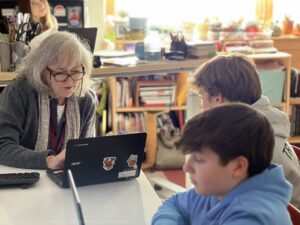
Meg O’Donnell ’88 goes over what a student has written during a middle school Humanities class at Shelburne Community School. (Photo by April Barton.)
Cluff, who was raised in Vermont and returned five years ago, spent 15 years of his career teaching in New York City. Based upon his experience there, he said college programs in other places don’t put as much priority on experience in the classroom.
“To me, the number one thing that makes people better teachers is practice teaching in front of kids in a real-world scenario and getting feedback on that from the kids, from yourself, and from an expert,” he said. “I love that the St. Mike’s’ program is so consistent, and it doesn’t just rush people to a degree. It’s really deliberate about having the solo week and all the different touchpoints.”
That’s really important, Cluff said, because, otherwise, some people enter the profession without feeling prepared and then don’t last.
At St. Mike’s, students – particularly in the MAT program – learn from regular faculty and working classroom teachers, like Meg O’Donnell.
“The feedback we get from students about that is how significant and meaningful having someone who is an expert in the field teaching their courses is. How much they appreciate and see the value in that in terms of their own learning,” Saks Pavese said.
She said because of the smaller size, St. Mike’s cohorts can become very close and stay in touch as they start their careers, which is one more level of support.
O’Donnell cherishes the relationships she’s had with her student-teachers and stays in touch with them over time. She enjoys learning from them as they infuse a fresh perspective into her way of thinking.
She is certainly paying it forward.
“I love that connection to folks just starting out in the field because that’s what we need to do – is promote young people who have a passion for being with kids,” O’Donnell said. “Supporting them in their journey as I had people support me in mine.”
Find out more about St. Mike’s education programs. For interest in bachelor’s programs, visit here. For master’s and beyond, here.

For all press inquiries contact Elizabeth Murray, Associate Director of Communications at Saint Michael's College.
Related News See more news