Crystal L’Hote sees philosophy as uniquely positioned to help students navigate between extremes when it comes to artificial intelligence.
The Director of the Philosophy and Ethics said people can fall into opposing camps — “AI boosters,” who embrace the technology uncritically, and “AI pessimists, who don’t want to touch it.”
In her classes, L’Hote advocates for a middle approach that seeks to use AI responsibly in service to the greater good.

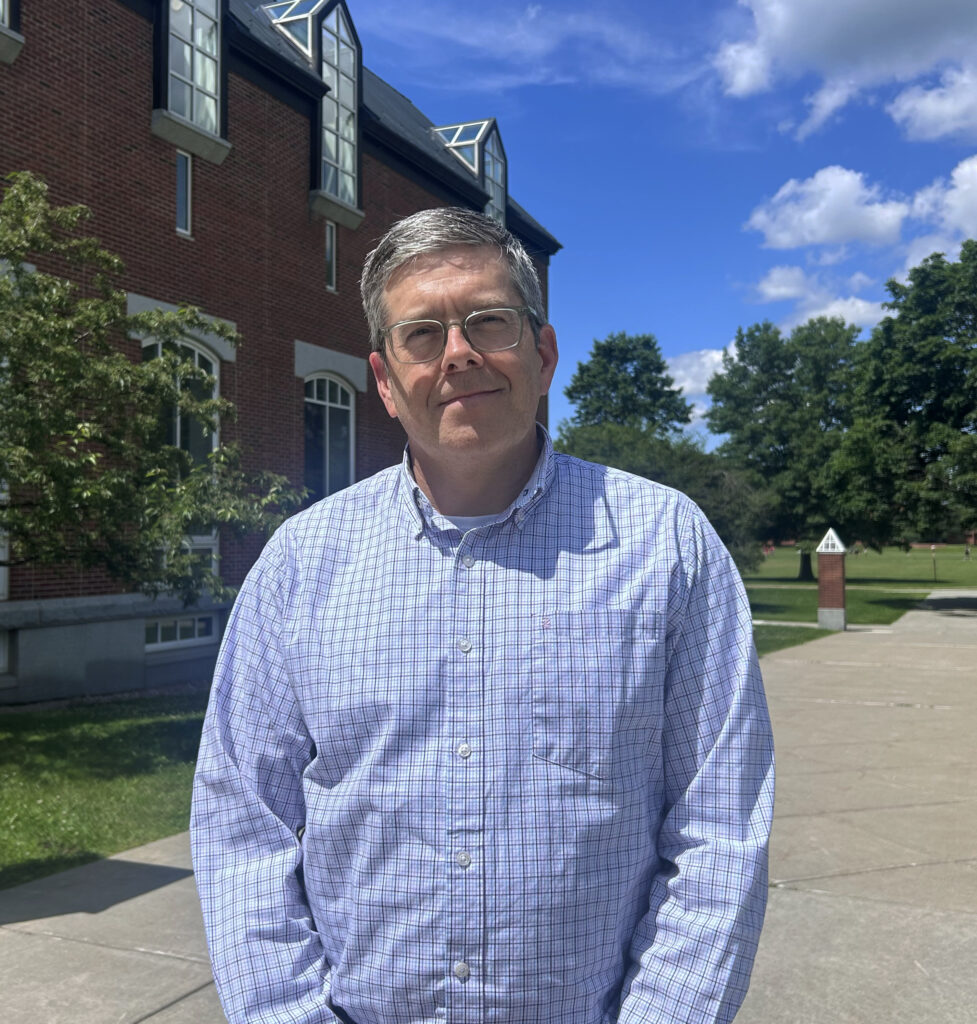
Professor Crystal L’Hote
St. Mike’s students are required to take an Ethics course – which provides the basis for all other learning at St. Mike’s – since most academic disciplines require some knowledge of ethics.
Additional Philosophy and Ethics classes build on the introductory-level Ethics course, including L’Hote’s AI Ethics and Policy course. In that course, students explore theoretical and practical dimensions of artificial intelligence.
The students discussed the ethics of chatbot use and deepfakes (digitally altered photos and videos meant to impersonate someone to spread misinformation), about using AI agents, and AI Co-Scientist “as a way to think about broad philosophical questions, like the nature and value of human thought and human creativity,” L’Hote said.
“We talked about work and the implications that AI will have on the workplace and on the availability of work, and what to do about that,” L’Hote said.
The course examines different policy approaches, comparing frameworks in the U.S. and Europe, including the EU’s Artificial Intelligence Act. Students also study practical dimensions such as cybersecurity risk management and ethics toolkits used by businesses and other organizations. L’Hote integrates Catholic texts alongside other resources to ground discussions in multiple ethical traditions.

Photo by Caleb Kenna
One of the most revealing components of the course is a hands-on “red teaming experiment,” in which students conduct AI audits.
Working in interdisciplinary teams that might include physics, business, and psychology majors, students attempted to expose biases in AI systems. One team tested a Gemini application called Nano Banana, designing prompts to probe for racist or anti-religious imagery. They tested for bias against Christianity, Islam, and Judaism.
The students were “red teaming for the common good” to reveal biases, L’Hote said.
Another team worked on Grok, which proved easy to manipulate “with their sophisticated experimental design.” Students also created “ethical heat maps” to visualize their findings.
The results surprised the students themselves. While technology has become increasingly reliable, L’Hote said the students “didn’t realize that hallucinations are not just a bug, it’s a feature of the of the tech.”
Students also complete individual projects tailored to their specific majors, connecting ethical frameworks to their future professional contexts. This personalization “really made it a high-value experience for them,” L’Hote said.
By the end of the course, L’Hote’s goal is ensuring students are equipped with analytical tools for using AI critically.
“My job was not to tell them this is right and this is wrong, and so on, but to give them tools for thinking about ethical dimensions of the situation,” she said.
L’Hote references Oxford philosopher Shannon Vallor’s book, “The AI Mirror,” noting that Vallor says, “AI reflects us back to ourselves, not perfectly,” perhaps like “a funhouse mirror.”
Read the collection of stories on AI at Saint Michael’s College. This story was published as part of the Spring/Summer 2026 edition of The Saint Michael’s College Magazine.

For all press inquiries contact Elizabeth Murray, Associate Director of Communications at Saint Michael's College.
Related News See more news