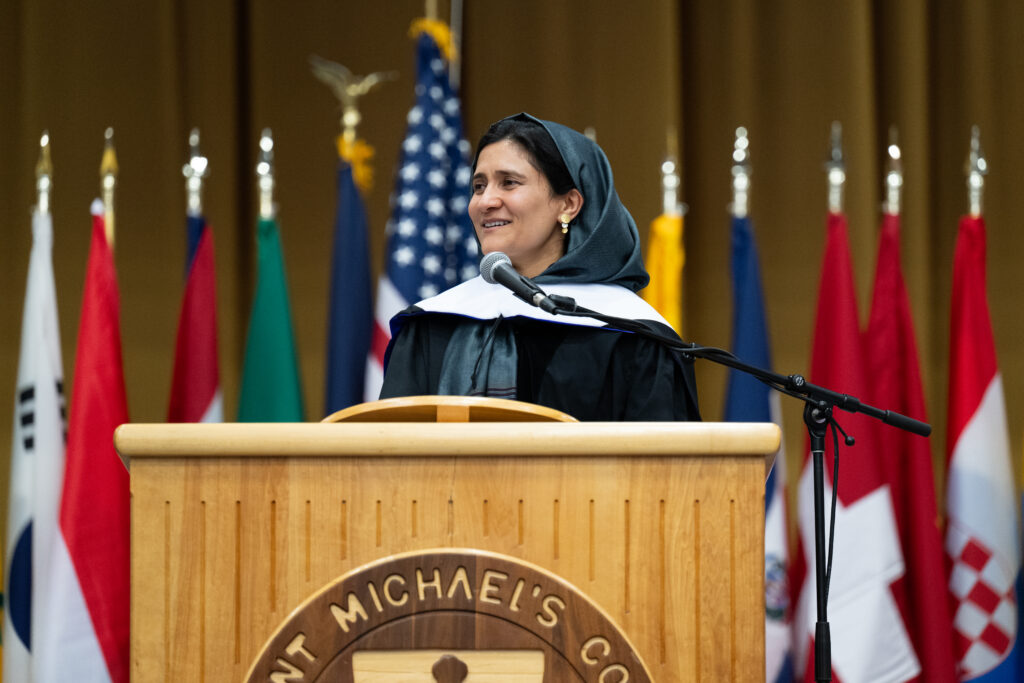
This year, all first-year students got an introduction to AI ethics, benefits, and pitfalls through their required First-Year Seminar courses.
The current “common text” – a shared reading assignment for first-years – is AI Snake Oil: What Artificial Intelligence Can Do, What It Can’t, and How to Tell the Difference by Arvind Narayanan and Sayash Kapoor. The book emerged from the authors’ own independent testing of AI products, said Kristin Dykstra, Director of First-Year Seminar.
Dr. Narayanan came to campus as a guest speaker in the fall to discuss the book with students and faculty.
Dr. Arvind Narayanan of Princeton University speaks about the benefits and pitfalls of AI during an event on Sept. 11, 2025. (Photo by Sophie Burt ’26)
Dykstra said when she reviewed the book for consideration, she found it gave her a perspective she wasn’t getting from the AI industry.
“It’s a challenging book in many ways, but it … also gives you examples from real life,” Dykstra said. A computer science professor noted to Dykstra, “This book approaches the topic by teaching you something about how and why the tools work.”
AI Snake Oil distinguishes between generative AI tools like ChatGPT and predictive AI applications, encouraging skepticism toward claims of AI miracles. It also challenges AI hype, helping students distinguish between effective, safe AI tools and “snake oil” applications that are ineffective or harmful.
The authors, Dykstra said, “have become known for … taking a very even-handed approach to a topic that causes a lot of anxiety and confusion.” In AI Snake Oil, she said, the authors counter that panic with measured perspective. They encourage people to start a gradual process of integrating.
“Part of what they’re talking about is empowering more people to understand enough about these tools that they can really advocate for things that do and don’t work in their fields,” Dykstra said. “And they can also call for more responsibility from the industry.”

Professor Kristin Dykstra, director of the First-Year Seminar Program at Saint Michael’s College, introduces Dr. Arvind Narayanan during an event on Sept. 11, 2025. (Photo by Sophie Burt ’26)
That balance is particularly important given how rapidly AI has entered everyday life. The goal is to ensure AI serves society rather than the reverse, said Dykstra.
“We need to demand that products be more adapted to what we’re actually trying to do, rather than us changing what we do to fit some companies’ product,” Dykstra said. “That’s where it comes around to these issues of AI serving the common good instead of us all becoming servants of AI.”
Indiana University professor Russell Valentino – whose expertise includes using generative AI for translation – also came to campus as a guest speaker this spring, sharing his insights with first-year students and others.
“If you want AI to do good things for your society, you’re going to have to work for it, and it can’t just be a few of the people in computing,” Dykstra said. “It has to be people in every sector who feel increasingly empowered to step up and call for the things that would lead to the positives that we really want.”
The ultimate message is one of empowerment rather than fear.
“This is about being smarter than your tools. It’s not about throwing them away,” Dykstra said. “How can we work to ensure that AI serves the common good?”
Read the collection of stories on AI at Saint Michael’s College. This story was published as part of the Spring/Summer 2026 edition of The Saint Michael’s College Magazine.

For all press inquiries contact Elizabeth Murray, Associate Director of Communications at Saint Michael's College.
Related News See more news