Academic Freedom, Part II: Utah and the New Reach of Conscience Claims

This post is part of a series: Applying the Principles of Catholic Social Justice to Contemporary Issues.
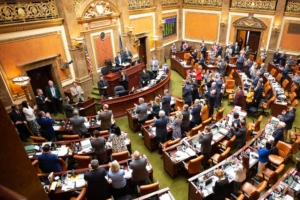
Photo by Trent Nelson/The Salt Lake Tribune file photo
Recent debates about higher education have often centered on institutional policies, diversity offices, accreditation, or state restrictions on certain kinds of teaching. Utah’s passage of H.B. 204, a revision of a former law governing when students may be excused from school due to the practice of a religious faith, raises a somewhat different question. It moves the conversation more directly into the classroom by expanding protections for a student’s “sincerely held religious and conscience beliefs” and by requiring accommodations when assignments or activities conflict with those beliefs, unless the accommodation would amount to a “fundamental alteration” of the course, program, or degree (2026). As of March 12, 2026, the bill was enrolled, and it has been widely read as opening a new chapter in the relationship between academic requirements and individual conscience claims.
For a Catholic audience, this is not a simple matter. Catholic teaching has a great deal to say about conscience, and much of it would initially seem sympathetic to the instinct behind the law. Vatican II’s Dignitatis Humanae teaches that the human person is not to be forced to act in a manner contrary to conscience in religious matters (1965, no. 2). The Catechism of the Catholic Church echoes that teaching (1992, no.1782). In that sense, the state’s concern is not foreign to Catholic thought. A student should not be compelled to make a personal religious declaration, perform an act of advocacy as advocacy, or violate a deeply held moral conviction merely to complete an assignment. Respect for conscience is a serious moral obligation, not a concession to personal sensitivity.
Yet Catholic teaching also complicates the picture. Conscience, in the Catholic tradition, is not simply a private preference or a personal exemption from unwelcome demands. Dignitatis  Humanae states that persons are bound to seek the truth, especially religious truth, and to form right judgments of conscience (1965, no. 3). Gaudium et Spes describes conscience as the place where one hears the law of God, but it also warns that conscience can go astray when one grows careless about truth and goodness (1965, no. 16). In other words, conscience is to be respected, but it is also to be educated, tested, and deepened.
That is why the Utah measure touches something central to the meaning of higher education. There is a moral difference between protecting students from compelled assent and giving students broad authority to avoid difficult course requirements. A university should not require a student to say, “I believe this,” when the student does not. It may, however, require the student to read, interpret, analyze, and understand material that challenges the student’s convictions. Education, especially liberal education, involves precisely this encounter with what is unfamiliar, unsettling, or resistant. If conscience becomes a wide-ranging right to withdraw from those encounters, then the educational project itself begins to change.
For Saint Michael’s College, this is where the issue becomes especially important. Our own educational mission presumes that students will meet ideas, arguments, and traditions that they  do not already affirm. That includes Catholic thought, theological claims, moral disagreements, and the demands of social analysis. A student’s dignity requires that such encounters never become coercive. But a student’s growth also depends on not being insulated from serious intellectual challenge.
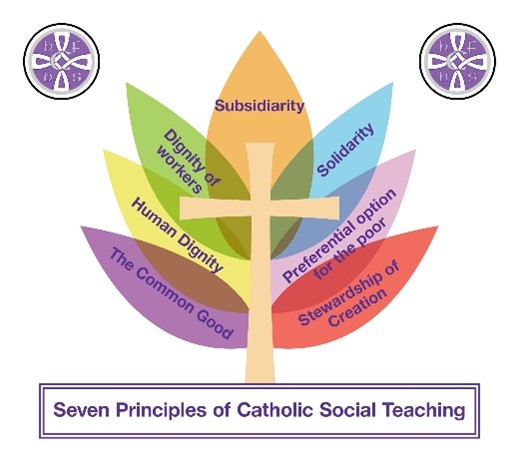
Catholic Social Teaching helps here. The dignity of the human person supports respect for conscience. The social justice principle of rights and responsibilities reminds us that rights are paired with obligations. Participation suggests that students are not merely consumers of agreeable content, but members of a learning community. The common good is served when higher education remains able to educate students through rigorous study, honest debate, and sustained engagement with difficult ideas (USCCB, Seven Themes of Catholic Social Teaching).
Utah, then, is not just a local controversy. It is a signal case. It asks whether conscience will be understood narrowly, as protection against coercion, or more broadly, as a claim against academic requirements themselves. Catholic teaching would strongly support the first. It would be much more cautious about the second, however. A college or university must be morally serious enough to honor conscience, but also intellectually serious enough to preserve the integrity of learning. If those two commitments are not held together, both conscience and education suffer.
If you would like to make a comment or ask a question, I can be reached at dtheroux@smcvt.edu. Let’s talk!

For all press inquiries contact Elizabeth Murray, Associate Director of Communications at Saint Michael's College.
Related News See more news