This post is part of a series: Applying the Principles of Catholic Social Justice to Contemporary Issues.
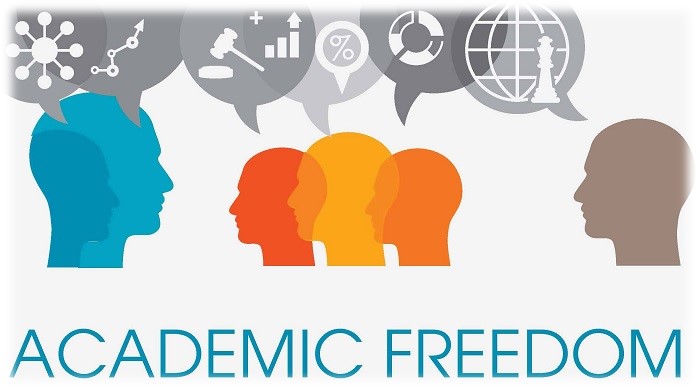
 One way to clarify the present debates about higher education is to ask a simple question: who has a claim to academic freedom? The answer is more complex than it first appears. In public discussion, academic freedom is often treated as the possession of faculty alone, or occasionally as a shield for institutions. Yet the reality is more layered. Government has a legitimate role in securing justice and civil rights. Institutions have a mission and a responsibility to preserve the integrity of their curriculum. Students have rights as learners and persons of conscience. The tensions now emerging in American higher education come largely from the fact that each of these claimants can overreach.
Government’s role is the easiest to recognize and the hardest to limit. A democratic state has reason to ensure lawful nondiscrimination, due process, access to education, and the fair expenditure of public resources. Catholic Social Teaching does not deny that role. Indeed, the common good requires public authority. But Catholic thought has also long resisted the temptation to let the state absorb the proper functions of other communities. This is the principle of subsidiarity. Higher forms of authority should support, not displace, the proper work of lower associations. A university is one such association. Its work is not merely administrative. It is intellectual, moral, and formative. When the state goes beyond securing just conditions and begins prescribing what may be taught, emphasized, omitted, or institutionally valued, it enters territory that Catholic thought would view with caution (USCCB, The Seven Themes of Catholic Social Justice).
 The Catholic Church’s own teaching on higher education points in the same direction. In Ex Corde Ecclesiae, Pope John Paul II speaks of the “institutional autonomy necessary to perform its functions effectively” and defends freedom in research and teaching according to the principles and methods of each discipline (Part I: Identity and Mission, no. 12; Part II: General Norms, Art. 2, §5). This language matters because it frames academic freedom not as a private indulgence for scholars but as part of the social vocation of higher education itself. A university or a college serves the common good by pursuing truth with rigor and breadth. That service becomes difficult when external power begins determining in advance which lines of inquiry are politically acceptable.
Institutions, however, can overreach as well. A college or university has a right to sustain its mission, shape its curriculum, and ask students to engage the traditions and disciplines it considers central to its identity. But mission does not justify everything. Catholic teaching insists that the freedom of conscience of each person is to be fully respected (Ex Corde Ecclesiae, Part II: General Norms, Art. 2, §4). That means institutions cannot simply invoke identity or educational purpose as a reason to compel personal belief, suppress legitimate disagreement, or blur the distinction between academic engagement and interior assent. In Catholic terms, truth is not advanced by coercion. It is proposed, explored, tested, and taught.
Students, too, occupy a more complex place than current debates sometimes allow. They are not simply the subject of institutional authority, nor are they merely paying clients whose  preferences set the terms of the classroom. They are persons. Gaudium et Spes says that conscience is the human person’s “most secret core and sanctuary” (1965, no. 16). That should matter deeply in higher education. Students should not be humiliated into silence, pressured into ideological self-disclosure, or required to simulate convictions they do not hold. But neither should student discomfort become the measure of curricular legitimacy. Liberal learning requires encounters with what one does not yet understand or may not wish to encounter. Conscience should protect against coercion. It should not become a comprehensive license to avoid challenge.
For Saint Michael’s, this threefold structure is especially important. A Catholic liberal arts college must navigate the claims of public law, institutional mission, and student dignity without reducing any one of them to the whole. Government has a role, but not a totalizing one. The institution has a mission, but not one that erases conscience. Students have rights, but not rights that render education optional. This is why academic freedom is best understood not as the possession of one party, but as a moral ecology in which academic freedom is best understood as a set of relationships and responsibilities that make truthful inquiry possible. It depends on proper limits, mutual obligations, and a shared commitment to truth.
Catholic Social Teaching adds one final insight. Freedom is not simply freedom from interference. It is freedom ordered toward the good. Veritatis Splendor insists that freedom and truth belong together (Pope John Paul II, 1993, no. 84). If that is right, then academic freedom is not secured when anyone gets to do whatever they want. It is secured when institutions, public authorities, and students alike are held within an order that makes truthful inquiry possible. That is a more demanding understanding of freedom than current politics usually offers, but it is far closer to what higher education in fact needs.
If you would like to make a comment or ask a question, I can be reached at dtheroux@smcvt.edu. Let’s talk!

For all press inquiries contact Elizabeth Murray, Associate Director of Communications at Saint Michael's College.
Related News See more news