Academic Freedom, Part V: Saint Michael’s and the Practice of Non-Coercive Catholic Education
This post is part of a series: Applying the Principles of Catholic Social Justice to Contemporary Issues.
A series like this finally has to return home. National policies, state interventions, and Church documents matter, but they matter most when they illuminate the lived work of an actual institution. For Saint Michael’s College, the central question is not only what the federal government is doing, or what Utah may signal, or how Catholic documents describe conscience and 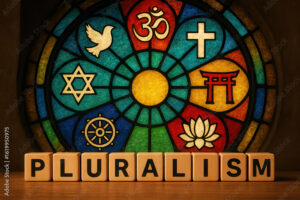 university life. The central question is how a Catholic liberal arts college in Vermont should actually teach, form, and accompany students in a time when both institutional mission and personal conscience are under scrutiny.
Saint Michael’s College occupies a particular place in this conversation. It is unmistakably Catholic, yet it serves a student body marked by religious diversity, moral disagreement, and a wide range of prior experiences with faith or no faith at all. It is committed to liberal learning, but also to Catholic Social Teaching and the broader Catholic intellectual tradition. In that setting, the College must avoid two opposite failures. On the one hand, it cannot become so hesitant about its Catholic identity that it presents the tradition only as a faint cultural inheritance. On the other hand, it cannot embody that identity in ways that make students feel they are being pressed toward personal assent rather than invited into serious intellectual and moral engagement.
The Church’s own teaching supports this balance. In Ex Corde Ecclesiae, Pope John Paul II states that Catholic teaching and discipline are to influence all university activities, while the freedom of conscience of each person is to be fully respected (1990, Part II: General Norms, Art. 2, §4). That sentence should be read slowly. It does not permit a Catholic college to drift into neutrality. Nor does it permit the institution to pursue Catholic identity through coercive means. It asks the university to be recognizably Catholic and recognizably respectful of conscience at the same time.
 In practice, this means Saint Michael’s College should treat classroom rigor and religious freedom as mutually reinforcing rather than mutually threatening. Students should be challenged by theological claims, historical arguments, moral complexity, and Catholic Social Teaching. They should not be sheltered from disagreement. But they should also know, clearly and consistently, that they are not being graded on belief, required to disclose personal faith commitments, or expected to participate devotionally to succeed academically. A Catholic institution should be able to distinguish between the intellectual demands of a course and the inner freedom of the student. The former is necessary to education. The latter is necessary to human dignity.
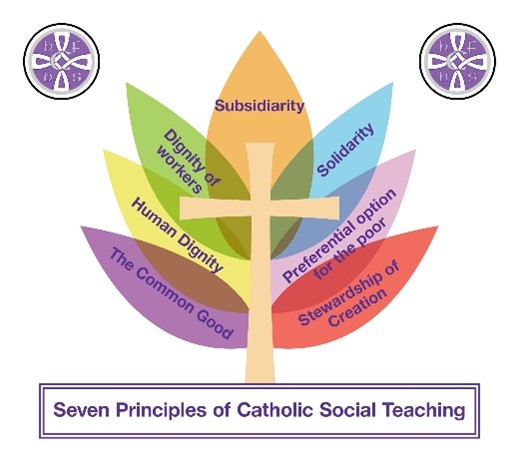
This approach is deeply consonant with Catholic social thought. The dignity of the human person requires that no student be reduced to an object of pressure or symbolic compliance. The Catholic social justice principle of rights and responsibilities means that students deserve fairness and respect, while also accepting the obligations that come with joining a Catholic academic community. Participation suggests that education is something shared, not merely consumed. Solidarity asks that the institution build a common life in which difference does not become estrangement. The common good means that Saint Michael’s must cultivate a culture where truth can be pursued without fear, pretense, or manipulation. (USCCB, Seven Themes of Catholic Social Teaching).
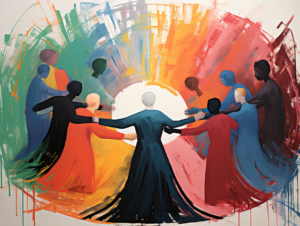 For Saint Michael’s College, then, the most important policy question may not be whether Catholic identity and conscience can coexist. They can. The more practical question is whether the College can make that coexistence visible in its everyday practices: in syllabus language, in classroom expectations, in faculty formation, in student support, and in the public way it speaks about its mission. A strong Catholic college should be able to say to students, with confidence and honesty: here you will study Christianity and Catholic thought seriously; here you will be challenged; here you will also be respected in conscience.
That is not a diluted version of Catholic higher education. It is a mature one. It refuses the false choice between conviction and hospitality. It takes the Catholic intellectual tradition seriously enough to teach it well, and the human person seriously enough not to impose assent. In a national climate where government is increasingly tempted to supervise higher education from outside, and where conscience can sometimes be invoked to avoid the work of learning from within, Saint Michael’s College has an opportunity to model another way. It can show that a Catholic college may be clear in identity, demanding in thought, and non-coercive in spirit. That witness may be one of its most important contributions to higher education today.
If you would like to make a comment or ask a question, I can be reached at dtheroux@smcvt.edu. Let’s talk!

For all press inquiries contact Elizabeth Murray, Associate Director of Communications at Saint Michael's College.
Related News See more news