Maintaining Catholicity when the Society of Saint Edmund completes.

In the previous reflection, we considered what it means for a Catholic college to live in communion with the Church. Communion does not require ecclesiastical authorities to direct the daily academic and administrative affairs of a college. Neither, however, does institutional autonomy mean separation from the Church or freedom from responsibility for Catholic identity.
This balance became a pressing question for American Catholic higher education during the 1960s. Colleges founded and governed by religious communities were becoming larger and more complex. Their faculties and student bodies were increasingly diverse. Professional expertise in finance, law, development, academic administration, and institutional planning had become indispensable. At the same time, the number of religious priests, brothers, and sisters available to administer these institutions was beginning to decline.
The 1967 Land O’Lakes Statement addressed this changing environment. It insisted that a Catholic university must be a university “in the full modern sense of the word,” possessing the “true autonomy and academic freedom” necessary for teaching and research. Yet the same statement maintained that Catholicism must remain “perceptibly present and effectively operative” within the institution. Land O’Lakes therefore sought not simply independence from the Church, but an institutional arrangement in which academic integrity and Catholic identity could coexist. It was a preliminary statement by individual Catholic educational leaders, not an official teaching document of the Church (Land O’Lakes Statement, preamble and no. 1).
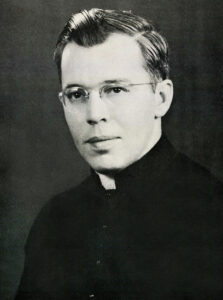
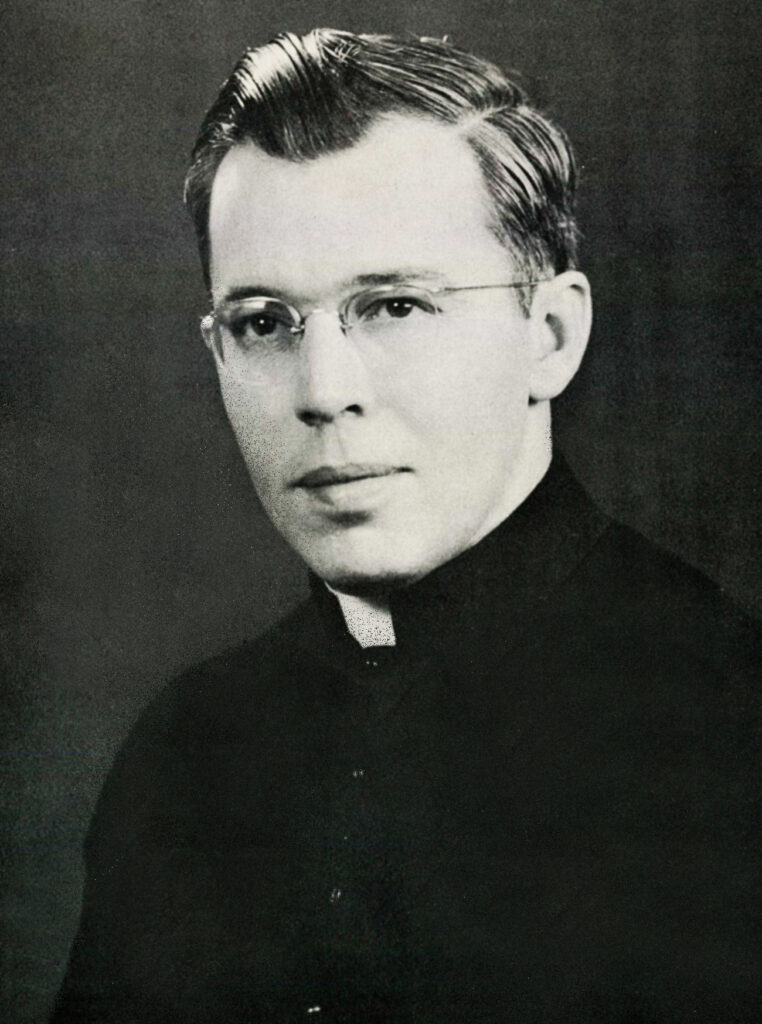
Gerald E. Dupont, SSE (1913-1974), 10th President of Saint Michael’s College.
Saint Michael’s College confronted these questions directly. Until the 1960s, the College had been governed by an exclusively Edmundite Board and operated largely as an apostolate of the Society of Saint Edmund. Father Gerald Dupont, S.S.E., president of Saint Michael’s College (1958-1969), recognized that the increasing complexity and financial pressures of higher education required new structures and broader expertise. He engaged Dr. Earl J. McGrath, director of Columbia University’s Institute of Higher Education, to study governance patterns among Catholic colleges. Their research included responses from hundreds of Catholic institutions and documented the rapid movement toward greater lay participation on governing boards (Alice Gallin, Independence and a New Partnership in Catholic Higher Education, 78-85).
Dupont and McGrath recommended a predominantly lay Board while preserving enough Edmundite representation to prevent changes to the College’s charter without Edmundite support. The eventual arrangement expanded the Board from ten Edmundites to twenty-four trustees, including fourteen lay members. The Society would no longer bear sole responsibility for institutional governance, but it intended to remain involved in the College’s Catholic character and educational apostolate. In 1969, the reconstituted Board elected Bernard Boutin as Saint Michael’s first lay president.
This was not quite the later two-tier model in which a separate sponsor body holds reserved powers over an independent governing board. It was better understood as a transitional arrangement: lay trustees received genuine governing authority, while the Edmundites retained representation and a protective role regarding the College’s identity and charter.
 A related theory emerged at the same time. Father John J. McGrath, a canon lawyer, argued in his 1968 book Catholic Institutions in the United States that when a religious institute reorganized an institution as a civil corporation governed predominantly by lay trustees, the institution became a form of public trust. The religious community moved, in his understanding, from canonical owner to “sponsoring body.” This became known as the McGrath thesis.
The thesis was controversial. Canonists such as Adam Maida argued that changing a civil corporation or appointing lay trustees did not, by itself, remove an apostolate from the Church or extinguish the canonical responsibilities of its founding religious institute. Civil independence and canonical separation were not necessarily the same thing. This debate eventually contributed to clearer models of Catholic sponsorship, particularly the use of reserved powers through which a sponsor protects mission, Catholic identity, and major institutional decisions without administering daily operations.
The history matters because the transfer of governance to lay leadership was never meant to make Catholic mission someone else’s responsibility. It transferred that responsibility to a wider circle.
The Edmundites relinquished exclusive governance so that Saint Michael’s could develop as a professionally governed college. They did not intend the College to cease being Catholic. Today, trustees, administrators, faculty, and staff inherit not only authority over the institution, but stewardship of the mission entrusted to it.
The enduring question is therefore not whether Saint Michael’s is independent of direct ecclesiastical administration. It is whether that independence continues to serve its purpose: the enhancement of the human person and the advancement of human culture in the light of the Catholic faith.
If you would like to make a comment or ask a question, I can be reached at dtheroux@smcvt.edu. Let’s talk!

For all press inquiries contact Elizabeth Murray, Associate Director of Communications at Saint Michael's College.
Related News See more news