For More Information
For More Information

Kristin Dykstra
Distinguished Scholar in Residence & Director of First Year Seminar
First Year Seminar: Common Text
Each year, Saint Michael’s College chooses a Common Text to be read and discussed by the incoming class of new students. All first-year students are asked to read the book over the summer prior to arriving on campus, which gives you something in common with your classmates as soon as you arrive. A panel discussion of the book is held during your Orientation week in late August, and each First-Year Seminar discusses the book at the start of the fall and spring semesters.
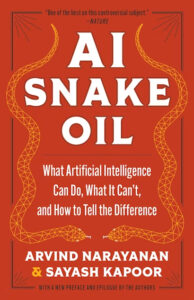
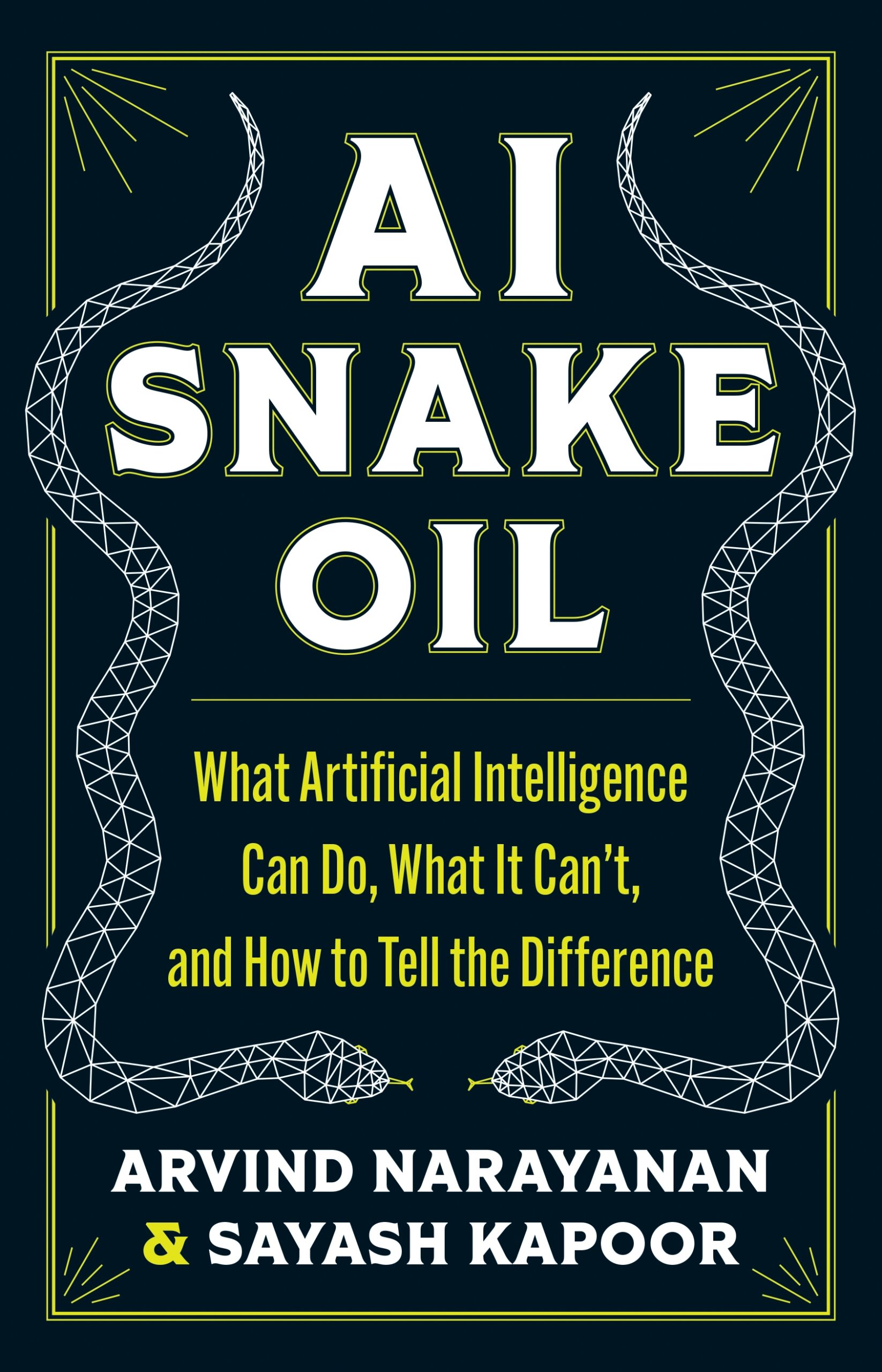
The Saint Michael’s College Common Text for the Class of 2030 is AI Snake Oil: What Artificial Intelligence Can Do, What It Can’t, and How to Tell the Difference, by Arvind Narayanan and Sayash Kapoor.
We have chosen this book as our Common Text for a second year because it lays a solid foundation for grasping and debating facts about an industry that now appears disruptive to many aspects of human society. Getting a smart foundation in the facts is essential making good decisions about how you can get the most value out of your college education.
AI Snake Oil does not promote either “anti-AI” or “pro-AI” rhetoric. Instead, the co-authors promote critical thinking and a solid grasp of the history that led us to where we are today, to empower you in making your own decisions.
About the Book
How can we help to ensure that new technologies best serve the common good?
Stay smarter than your tools.
In 2019, Dr. Arvind Narayanan gave a talk called “How to Recognize AI Snake Oil.” It went viral and kicked off the writing of this book.
AI Snake Oil offers excellent critical context for understanding both benefits and failures associated with a variety of AI tools. Co-authors Narayanan and Kapoor are computer scientists who examine AI tools, especially (but not exclusively) generative and predictive AI. The co-authors bring a technical, practical point of view to their research regarding how well AI tools actually work – which is information that you can’t get in a reliable way from corporations seeking profit from individual AI tools.
They find mixed results. Narayanan and Kapoor identify scenarios in which AI tools are and will continue to be useful. Yet they also identify plenty of hype: products that fail to deliver on their sellers’ claims and/or have actively caused harm to a variety of different groups of people.
Narayanan and Kapoor acknowledge contemporary excitement, doubt, and fears about AI, as well as injustices to be rectified. They also show where and why humans must play essential roles in the future. AI Snake Oil contributes to a healthy overall process of gaining AI literacy. This approach led Time Magazine to select Narayanan and Kapoor for The 100 Most Influential People in AI, in the category of “Thinkers.”
How to Get the Book
The paperback version of AI Snake Oil is available now to incoming SMC students with our private discount code, if you buy the book directly from the publisher, Princeton University Press.
Where is the SMC discount code? Students will receive our private code in materials from the school over the summer. You’ll also find the code in an early August letter from your First Year Seminar professor.
If you pick up the first edition instead (the hardback), all of its main pages match up with the paperback second edition. There is also an audiobook of the first edition that you can get from the Press.
What’s the difference? The newer edition includes a few extra pages at the start and end, talking about why the foundation offered by AI Snake Oil remains relevant today and reflecting on issues for the future.
Expect to Write and Talk About the Common Text Right Away
All first-year students should read the Common Text over the summer, regardless of whether they will take their required First-Year Seminar in the fall or spring semester.
- As its title says, the Common Text gives you something in common with every other incoming student.
- Orientation Week includes a large panel discussion organized around the Common Text, and you’ll benefit much more from this event if you’ve read the book.
- Once formal classes start, you will again use what you picked up from reading the book and attending the faculty panel. Each FYS section is organized by its own instructor, so assignments and discussions will differ. Regardless, you should expect to submit an essay about the Common Text within the first two weeks of the semester.
We are very pleased to host a related expert lecture in September by Dr. Marc Watkins. You can hear the latest from him and participate in a Q&A session. We encourage our students to speak up and help activate the conversation with one of the greats. See below for more on his talk.
Reading Tips
Get ready for a book with plenty of everyday examples, to get our community thinking in new ways about the AI tools appearing around us.
Some sections of AI Snake Oil will be challenging to read on your own. Don’t worry! We select a challenging Common Text in order to learn how think our way through it, together. It is fine if some sections make more sense to you than others at the start. FYS includes various activities to shed light on our book and topic as we go.
Here are a few examples of tech that Narayanan and Kapoor will use to help illustrate their points. When you’re not sure about the vocabulary or idea they’re setting up, try looking at this kind of example:
- 39: Netflix recommendations, illustrating how rules are both developed and applied automatically
- 48-49: Incorrect accusations of welfare fraud, illustrating “over-automation”
- 88: Videos that go viral for being awful, illustrating the unpredictability of success
- 124-125: Two versions of the Mona Lisa, illustrating ramifications for people whose works are taken and reproduced without permission
- 140: Chatbots outputting false information (otherwise known as …?)
As you get familiar with AI Snake Oil, you may find that you’re sharing an experience reported by students from 2025-2026: they realized that points made by Narayanan and Kapoor were helping them to understand headline news rolling out about technology, in a more organized way.
The Faculty Panel and Essays
The 2025 Common Text panel will take place on Friday, August 28, from 12:30-2:00pm, in the Recital Hall of McCarthy Arts Center.
Our faculty panelists bring very distinct professional profiles and experience with AI to our FYS discussion: Brad Demarest (Computer Science), Becca Gurney (Art & Design), and Crystal L’Hote (Philosophy).
This panel introduces you to how and why liberal arts colleges have been so successful in US history: We approach complex topics by looking into them from many sides. This “interdisciplinary” view helps us to think and talk across professional boundaries in the real world, as well as social boundaries, to lay a strong foundation for advanced thinking and problem-solving.
First Year Seminar Featured Speaker, Dr. Marc Watkins
“There is a role for everyone in shaping the future of AI and its role in society,” Narayanan and Kapoor state in our Common Text (290). In fact, AI Snake Oil is an urgent call to incorporate the wisdom and insights of more individuals and social sectors into the shaping of any future involving AI tools.

Our September First Year Seminar Lecture features Dr. Marc Watkins, who will speak to us out of his extensive experience with education, technology, and the people who have tested new technologies in their lives.
How do decisions made by our SMC college students right now tie into the pressing conversations about humanity happening in communities around the world?
“The Renewal of Human Agency for Our Current Era”
Thursday, September 17, 2026
7 – 8:15 PM, McCarthy Recital Hall, SMC
With respondent: Father David Theroux, Vice President of Edmundite Mission at Saint Michael’s College
Agency refers to the capacity to take meaningful, effective action. Dr. Watkins will discuss the urgent need to renew human visions of our agency for this era of living with AI. We are not alone in this need. Communities around the world are talking about how to articulate a sense of purpose for people of all generations, within and beyond education. Why and how is human agency still essential, despite the machine intelligence that mimics human thought? Father Theroux will offer a short response from the perspective of the Edmundite Mission, before we open to Q&A with students.
About the speaker: Dr. Watkins directs the AI Institute for Teachers and is an Assistant Director of Academic Innovation at the University of Mississippi. He is co-editor of The Norton Guide to AI-Aware Teaching (2026), a major new resource for teachers nationwide. His work with generative AI in education predates ChatGPT, and he advocates approaching the technology’s integration in education with both curiosity and skepticism. When training faculty in applied artificial intelligence, Watkins believes educators should be equally supported if they choose to work with AI or include friction to curb AI’s influence on student learning.
For more information, contact:
Kristin Dykstra
Director, First-Year Seminar Program
Distinguished Scholar in Residence
Saint Edmund’s Hall 345
802.654.2801
kdykstra@smcvt.edu
| Past First-Year Seminar Common Text Selections | ||
|---|---|---|
| 2025-2026 | Arvind Narayanan and Sayash Kapoor | AI Snake Oil: What Artificial Intelligence Can Do, What It Can’t, and How to Tell the Difference |
| 2024-2025 | Judith Heumann | Being Heumann: An Unrepentant Memoir of a Disability Rights Activist |
| 2023-2024 | Winona Guo and Priya Vulchi | Tell Me Who You Are: A Road Map for Cultivating Racial Literacy |
| 2022-2023 | Danielle Evans | The Office of Historical Corrections |
| 2021-2022 | Robin Wall Kimmerer | Braiding Sweetgrass: Indigenous Wisdom, Scientific Knowledge, and the Teachings of Plants |
| 2020-2021 | Michelle Kuo | Reading with Patrick: A Teacher, a Student, and a Life-Changing Friendship |
| 2019-2020 | Francisco Cantú | The Line Becomes A River: Dispatches from the Border |
| 2018-2019 | Lin-Manual Miranda | Hamilton: The Musical |
| 2017-2018 | Ta-Nehisi Coates | Between the World and Me |
| 2016-2017 | Loung Ung | First They Killed My Father: A Daughter of Cambodia Remembers |
| 2015-2016 | Emily St. John Mandel | Station Eleven |
| 2014-2015 | James Baldwin | “Sonny’s Blues” |
| 2013-2014 | The Book of Job | |
| 2012-2013 | Nicholas Carr | The Shallows |
| 2011-2012 | Jonathan Safran Foer | Eating Animals |
| 2010-2011 | Elizabeth Kolbert | Field Notes from a Catastrophe |
| 2009-2010 | Kafka | The Metamorphosis |
| 2008-2009 | Simon Wiesenthal | The Sunflower |
| 2007-2008 | Isak Dinesen | “Babette’s Feast” |
| 2006-2007 | Khaled Hosseini | The Kite Runner |
| 2005-2006 | Yann Martel | The Life of Pi |